
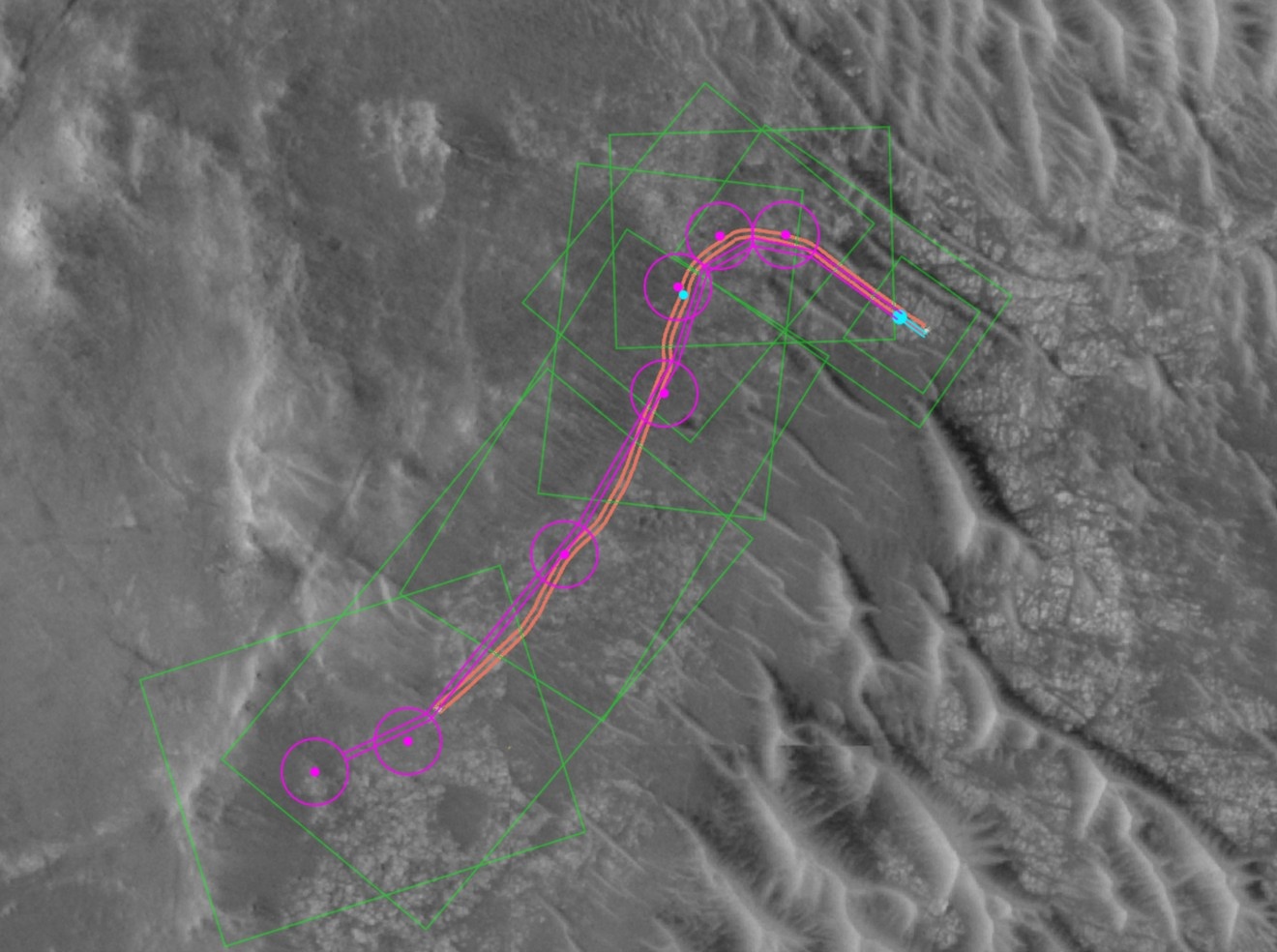
What happened on Sol 1707
On December 8, 2025 — Martian day Sol 1707 — the Perseverance rover received a special set of instructions. It started its engine, avoided sharp rocks, and precisely bypassed sand pits. The driving distance was only 400 metres — about one lap of a standard running track. But like Armstrong's small step, this was a giant leap for AI. Kersai
The commands sent to NASA's Perseverance rover that day had been written by an AI. Specifically, they were written by Anthropic's AI model, Claude. Engineers at NASA's Jet Propulsion Laboratory used Claude to plot out the route for Perseverance to navigate a path through a field of rocks on the Martian surface. Because of the signal delay to the rover, operators cannot micromanage where it drives. They plan a route, send it, and only later see the results. Until that day, human experts had always been the ones to do that planning. This time, an AI did it. CNBC
On December 8, with AI-generated waypoints in its memory, Perseverance drove 689 feet — 210 metres. Two days later, it drove another 807 feet – 246 metres. Bloomberg Two drives. 456 metres total. And not a single human had drawn the route.
How the AI actually did it
For 28 years, since the first Mars rovers, the process of planning a drive has been the same. Human engineers study high-resolution orbital photographs of the Martian terrain. They identify hazards — boulders, sand traps, rocky ridges — and manually plot a series of waypoints, spaced roughly 100 metres apart. They write the commands in a specialised language called Rover Markup Language. They verify the route through a digital twin — a virtual replica of the rover — checking over 500,000 telemetry variables. Then they send the plan to Mars, where it takes 20 minutes to arrive at the speed of light. The rover executes the route. The humans wait. This process, repeated thousands of times over three decades, has been entirely human.
JPL engineers decided to test whether Claude could plan a route as effectively as a human. They fed Claude Code, Anthropic's programming agent, with data collected over 28 years of Mars missions. Claude used its vision capabilities to analyse overhead images of Jezero Crater, planning Perseverance's breadcrumb trail point by point. It strung together ten-metre segments into a path, then iterated to refine the waypoints, critiquing its own work and suggesting revisions. I'M A FOUNDER.
The AI identified hazards including sand traps, boulder fields, bedrock, and rocky outcrops, then generated a path defined by a series of waypoints that avoided each one. Transparency Coalition: The JPL team ran Claude's plan through their digital twin simulation, checking every variable. When the engineers reviewed Claude's plans, they found that only minor changes were needed. Ground-level camera images gave a clearer view of sand ripples on either side of a narrow corridor, and the rover drivers elected to split the route more precisely at that point. But otherwise, the route held up completely. CNBC
The engineers estimate that using Claude in this way will cut route-planning time in half and make the journeys more consistent. Less time spent on tedious manual planning means the rover's operators can fit in more drives, collect more scientific data, and do more analysis. It means, in short, that we will learn much more about Mars. CNBC
Why this is bigger than a navigation story
The easy way to read this story is as a logistics improvement — AI shaves time off a manual task, the rover drives slightly more often, and scientists get more data. That reading is accurate but incomplete.
What happened on Sol 1707 is something more fundamental: an AI demonstrated that it could take 28 years of accumulated human expertise, ingest it, apply it to a novel situation it had never encountered, and produce a result that was trusted enough to be sent across 360 million kilometres of space and executed without a human hand on the controls. The task was not replaying a known route. The AI analyzed the same images and information that human planners typically use, then identified waypoint locations so Perseverance could travel safely across difficult Martian terrain. Mean CEO's BLOG It read the terrain the way a veteran rover driver reads it. And it got it right.
NASA said it hopes the technology tested with Perseverance can benefit many different areas. As one JPL engineer put it: "Imagine intelligent systems not only on the ground on Earth but also in edge applications in our rovers, helicopters, drones, and other surface elements trained with the collective wisdom of our NASA engineers, scientists, and astronauts. That is the game-changing technology we need to establish the infrastructure and systems required for a permanent human presence on the Moon." Aiandnews
The phrase is worth sitting with: trained with the collective wisdom of engineers, scientists, and astronauts. This is what AI at its best does. It does not replace expertise. It encodes it, preserves it, and makes it available at a scale and speed that no individual human lifespan can match. The rover driver who retires takes their knowledge with them. The AI system trained on their decisions does not.
What this means for the children in your school right now
The children in schools today — the ones sitting in classrooms, doing homework, preparing for exams — are the generation that will design the missions that follow Perseverance. The ones that go to Europa. The ones that land humans on Mars. The ones that, decades from now, point sensors at planets we have not yet named and ask questions we have not yet thought to ask.
What they will need to do that is not a syllabus of facts. It is the capacity for curiosity so deep it survives confusion. Judgement refined enough to know when to trust an AI's route and when to override it. The imagination to ask a question nobody has asked before. The courage to send a plan 360 million kilometres away and believe it will hold.
These are not skills that come from memorising content in silence. They come from schools that are designed around exploration — that treat wonder as a curriculum outcome, that put real tools in children's hands and ask them to build things that do not yet exist. This is what NEO was designed for. Not to teach children about AI as a subject, but to make them people who work with it — who question it, direct it, and take responsibility for what it does.
The Perseverance drive is a small story about a rover moving 456 metres across a crater on a distant planet. It is also a large story about what becomes possible when human expertise is encoded into an intelligent system and trusted to act. The children learning to work with AI today are not preparing for a job that exists. They are preparing for the missions that do not exist yet.
The detail worth remembering
Vandi Verma, a space roboticist at JPL and a member of the Perseverance engineering team, said, "We are moving towards a day where generative AI and other smart tools will help our surface rovers handle kilometre-scale drives while minimising operator workload and flag interesting surface features for our science team by scouring huge volumes of rover images." Mean CEO's BLOG
Kilometre-scale autonomous drives on Mars, planned by AI. We are moving towards that day. The children in your school will live to see it. The question is whether their school prepared them to be the ones doing the planning — or simply the ones watching.
Human First. AI Next.™
