Artificial intelligence in education is moving from concept to execution in India. Over the past few weeks, two major developments have signaled how seriously the country is taking AI readiness in schools: Google’s decision to roll out its AI Educator Series for Indian teachers, and the Government of India’s continued push under the IndiaAI Mission and NEP 2020 to build AI skills, infrastructure, and governance for the next generation of learners.
In May 2026, Google announced that it is bringing the Google AI Educator Series (GES) to India as part of new partnerships to support educators and learners. The programme is being launched in collaboration with the state governments of Maharashtra, Chhattisgarh, Assam, the Union Territory of Ladakh, and the Punjab School Education Board. The goal is clear: make AI literacy and practical AI skills accessible to teachers across diverse regions—not just in big cities.
According to Google, the AI Educator Series is a mobile-first training programme, customized for Indian educators and initially available in six languages: Assamese, Hindi, Marathi, Telugu, Odia, and Punjabi, with plans to expand to more languages over time. This multilingual approach matters because it helps ensure that AI training is not limited to English-medium schools and can reach educators in government and regional language schools as well.
Globally, the Google AI Educator Series has been designed as a free, on-demand training program co-developed by Google for Education and ISTE+ASCD, focusing on real classroom use cases. Sessions are short—typically 10–15 minutes for K–12 educators and 30–45 minutes for higher education faculty—and each module ends with a quiz and a digital badge. The training covers how to use tools such as Gemini for Education and NotebookLM to:
In the Indian rollout, GES will help teachers and faculty members learn how to responsibly use Google’s AI tools, including Gemini, to enhance teaching and learning experiences while keeping educators in full control of final decisions and content. Google and partners will also run train-the-trainer events around India, enabling a core group of educators to lead in-person AI training in their own schools and districts, which can accelerate adoption at scale.
This industry-led training effort fits into a broader national strategy. The Government of India has repeatedly emphasized that AI is central to India’s economic and social future, and education is one of the key pillars of that vision. A recent Press Information Bureau (PIB) note titled “AI in Education – Building India’s Talent Pipeline for Global Leadership” outlines how India is trying to become a global AI powerhouse, with rapidly growing AI-powered startups and a strong focus on building an AI-skilled workforce.
Under the IndiaAI Mission, India is investing in AI innovation, data infrastructure, and skilling initiatives across the country. One example is a partnership between the IndiaAI Mission and the Uttar Pradesh government to establish 65 Data and AI Labs across the state, designed to democratize access to AI education and hands-on learning. These labs are intended to align education and skilling with future technology requirements, giving students access to real datasets and tools to build AI-related skills early.
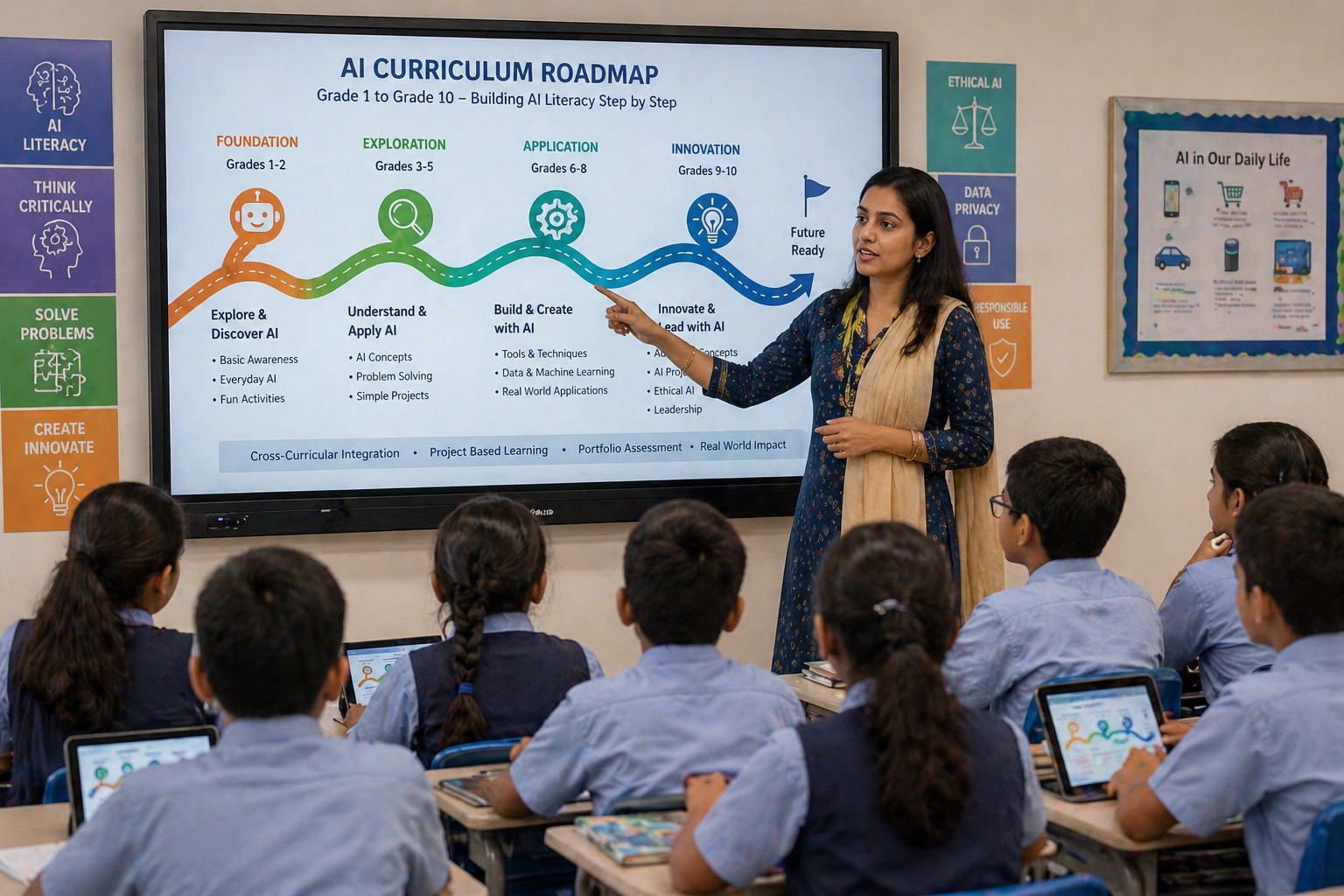
The National Education Policy (NEP) 2020 provides the policy backbone for this transformation. NEP 2020 explicitly calls for the strategic use of emerging technologies, including AI, to improve access, equity, quality, and learning outcomes in school education. It encourages the introduction of AI as both a tool and a subject, supporting smart classrooms, online learning, and more personalized, data-informed instruction.
NCERT and CBSE have already begun operationalizing NEP 2020’s vision:
The NCERT-led programme on leveraging AI in schools aims to ensure that educators understand AI’s key concepts, policy frameworks, governance models, and practical classroom applications. After completing the training, educators are expected to:
Together, Google’s AI Educator Series and India’s policy and mission-level initiatives show that AI in education is no longer limited to a few pilot schools or private edtech platforms. It is becoming a system-level priority.
For schools and educators, this has several implications:
For individual educators, this is an ideal moment to:
The key takeaway from today’s AI developments is that India is building an AI-ready education ecosystem, not just adding isolated AI tools. Government policies, national missions, corporate partnerships, and educator training programmes are starting to move in the same direction:
For platforms like AI Ready School, this is a strong signal that schools will actively look for practical, curriculum-aligned, and policy-compliant AI solutions that help them implement NEP 2020 and IndiaAI goals on the ground.
Human First. AI Next.™
