What Google released
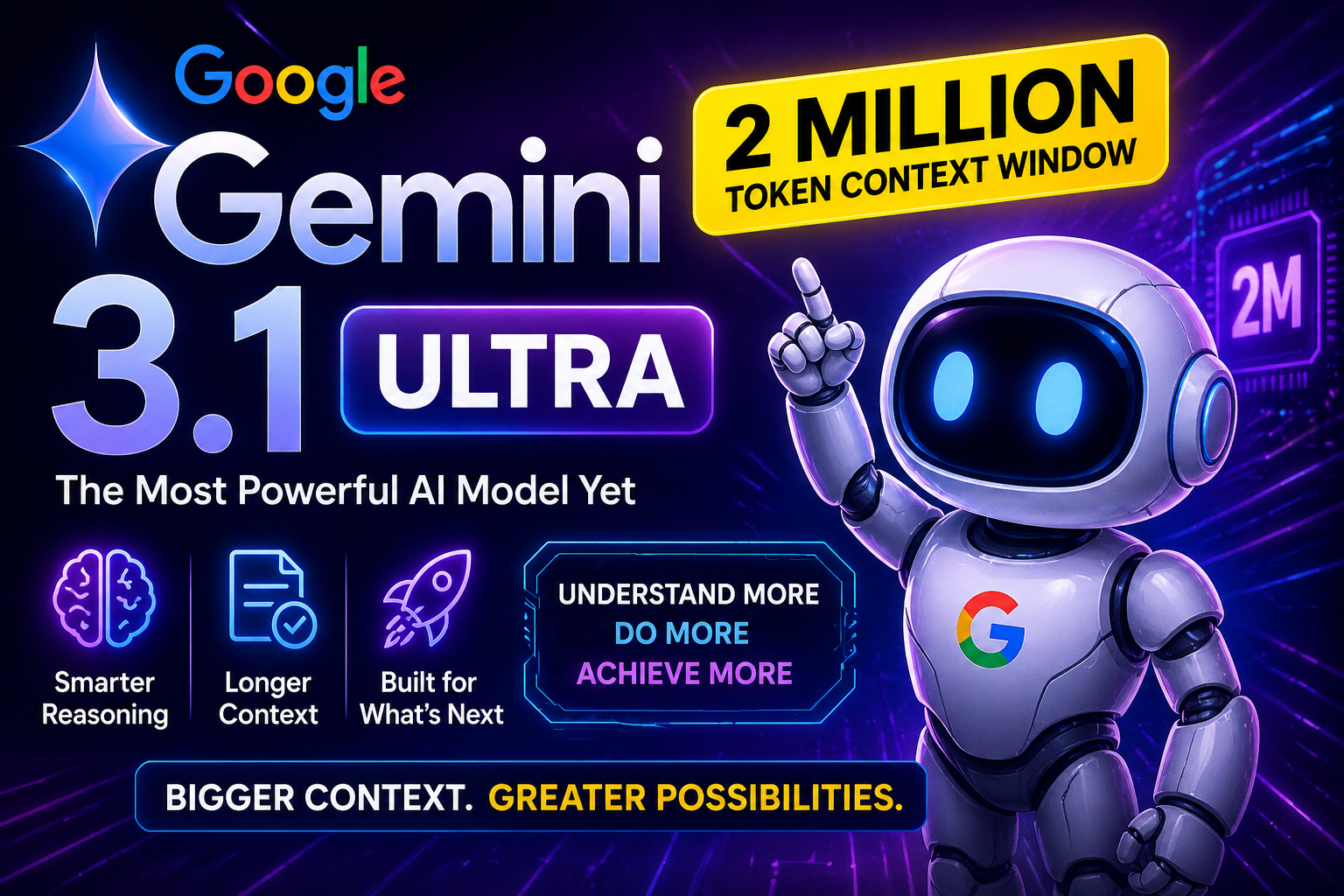
Google released Gemini 3.1 Ultra in April 2026 with the largest context window of any publicly available model: 2 million tokens. To understand what that number actually means, it helps to compare it to what came before.
GPT-5's context window is 128,000 tokens. Claude 3.7 Sonnet is 200,000 tokens. Gemini 3.1 Ultra's 2 million token window is a 10x increase over the previous generation — and it is the single most significant architectural decision in the model. That number is not a marketing claim. It changes what class of problems you can submit to the model. I
In practical terms: 2 million tokens is equivalent to processing entire books, massive codebases, or full websites in one prompt. You could feed it an entire school curriculum. A student's complete three-year learning history. Every research paper published on a given topic in a decade. Every assessment, essay, project, and conversation a child has had with an AI companion over years of schooling — held in a single conversation, reasoned across simultaneously.
Unlike prior Gemini versions, 3.1 was designed from training to reason across all modalities simultaneously — text, image, audio, and video — without transcription intermediaries. It also ships with a new sandboxed Code Execution tool allowing the model to write, run, and test code mid-conversation, alongside significantly improved grounding to reduce hallucinations on factual queries.
What the benchmarks say
Gemini 3.1 Pro leads in 13 of 16 major benchmarks, including abstract reasoning — ARC-AGI-2: 77.1% versus GPT-5.3's 52.9% — and science — GPQA Diamond: 94.3%.
ARC-AGI-2 is a benchmark maintained by the ARC Prize organisation that tests abstract reasoning on entirely novel logic patterns — patterns that models could not have memorised from training data. It specifically measures the ability to infer rules from examples rather than recall pre-learned information. This distinction matters enormously. An AI that scores well on memorisation benchmarks is a sophisticated encyclopedia. An AI that scores well on ARC-AGI-2 is doing something closer to genuine reasoning — the ability to encounter a pattern it has never seen before and work out the rules from first principles.
Google's pricing advantage is striking. At $2 per million input tokens, Gemini 3.1 Pro costs one-fifth of GPT-5.3 and a fraction of Claude Opus 4.6, while delivering competitive or superior benchmark performance. For enterprises processing large volumes of text, this cost differential translates into significant savings.
Why 2 million tokens is a different kind of milestone
Every major AI capability improvement of the past three years has been about what the model can do — reasoning, coding, multimodal understanding, speed. The 2-million-token context window is about something different. It is about what the model can hold in mind.
Human working memory can hold, on average, seven pieces of information at once. A brilliant human expert, reading a research paper, can hold its key arguments in mind alongside perhaps a few hundred pages of prior reading they remember well. An AI with a 2-million-token context window can hold the equivalent of 1,500 pages of text — simultaneously, perfectly, without forgetting a single detail — while reasoning across all of it in real time.
This is not a quantitative improvement. It is a qualitative shift in what AI can be used for. Problems that previously required teams of humans to read, synthesise, and cross-reference vast bodies of material can now be submitted to a single AI call. Drug discovery. Legal analysis across thousands of precedents. Scientific literature synthesis. Educational assessment across a child's entire learning history.
AI is sprinting, and the rest of us are trying to find our shoes. The 2-million-token window is one of the clearest illustrations of what that sentence actually means. AI Ready School
What this means for the children in your classrooms
The 2-million-token context window does not change what great education looks like. It changes what becomes possible when great education is backed by great AI.
Consider what a learning companion could do with genuine long-context memory. Today, most AI tools for students begin each conversation fresh — no memory of yesterday's confusion about fractions, no recollection of the essay written last month that revealed a gap in historical reasoning, no awareness of the pattern of mistakes that suggests a fundamental misunderstanding rather than a surface error. Each conversation starts from zero.
This is the exact problem Cypher's 360° learner profile was designed to address — building a persistent, growing picture of each child's understanding across time. The arrival of models with 2-million-token context windows is not a threat to that philosophy. It is the infrastructure that makes it more powerful. An AI companion that can hold a child's entire learning history in its context — every question asked, every answer attempted, every moment of confusion and breakthrough — can offer a quality of guidance that no single conversation has ever been able to provide.
For Morpheus, the implications are equally concrete. A teacher working with 30 students across a full academic year generates an extraordinary volume of signal — assessments, attendance patterns, participation, written work, verbal responses. Today, most of that signal is lost. It lives in isolated gradebooks, unread reports, and the teacher's own overstretched memory. A model that can hold all of it simultaneously, reason across it, and surface the specific children who need a specific kind of intervention this week — that is not a marginal improvement in teaching efficiency. It is a transformation in what a teacher can know about the children in their care.
For Zion — the 30+ tool platform where students research, create, and build — long-context AI changes what research itself looks like. A student who previously had to read twenty papers and manually synthesise them can now engage in a genuine intellectual conversation with an AI that has read all twenty simultaneously, can be questioned on contradictions between them, and can help the student develop their own position rather than just summarising the consensus.
The number worth pausing on
Within three years of going mainstream, AI is now used by more than half of people around the world — a rate of adoption faster than the personal computer or the internet. An estimated 88% of organisations now use AI. CNBC
Gemini 3.1 Ultra is not the end of this trajectory. It is a waypoint. The context windows will grow. The reasoning will deepen. The cost will fall. What will not change — what AI cannot change — is the fact that the quality of what a child becomes depends on the quality of the education they receive.
A 2-million-token context window can remember everything. It cannot wonder at anything. It can synthesise every paper ever written on a subject. It cannot feel the pull of a question that has no answer yet. It can hold a student's entire learning history in mind. It cannot decide that this particular child, in this particular moment, needs to be seen as a human being rather than a data point.
These remain the irreplaceable contributions of great teachers, great schools, and a philosophy of education that takes the whole child seriously. What changes with Gemini 3.1 Ultra — and with every milestone that follows it — is that the AI infrastructure available to support that work becomes more capable, more affordable, and more powerful than anything education has ever had access to before.
The schools that understand both sides of that sentence are the ones that will matter most to the generation growing up inside it.
Human First. AI Next.™
