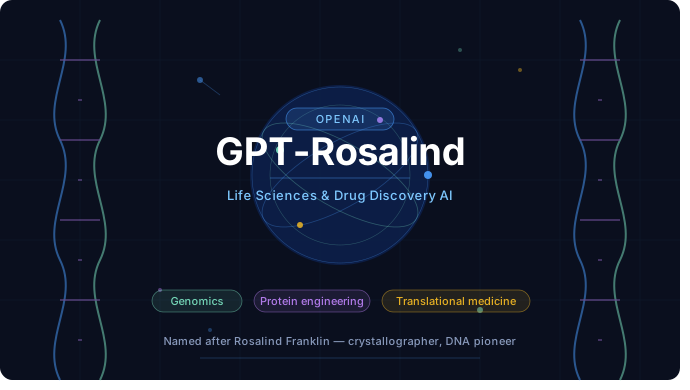
OpenAI has launched GPT-Rosalind, its first model built specifically for life sciences research. Named after British chemist Rosalind Franklin, whose X-ray crystallography work helped reveal the structure of DNA, the model is designed to accelerate the earliest and most time-consuming stages of drug discovery. This is a significant departure from the general-purpose model strategy that has defined the AI industry for the past five years.
Source: OpenAI — openai.com/index/introducing-gpt-rosalind/
What was shared
OpenAI introduced GPT-Rosalind as the first model in a new Life Sciences series. Unlike general-purpose language models trained across all domains, GPT-Rosalind is fine-tuned specifically for biology, protein engineering, genomics, and translational medicine. The model is designed to assist researchers with the complex, multi-step analytical workflows that define early-stage drug discovery: literature synthesis, hypothesis generation, sequence-to-function interpretation, experimental planning, and reagent design.
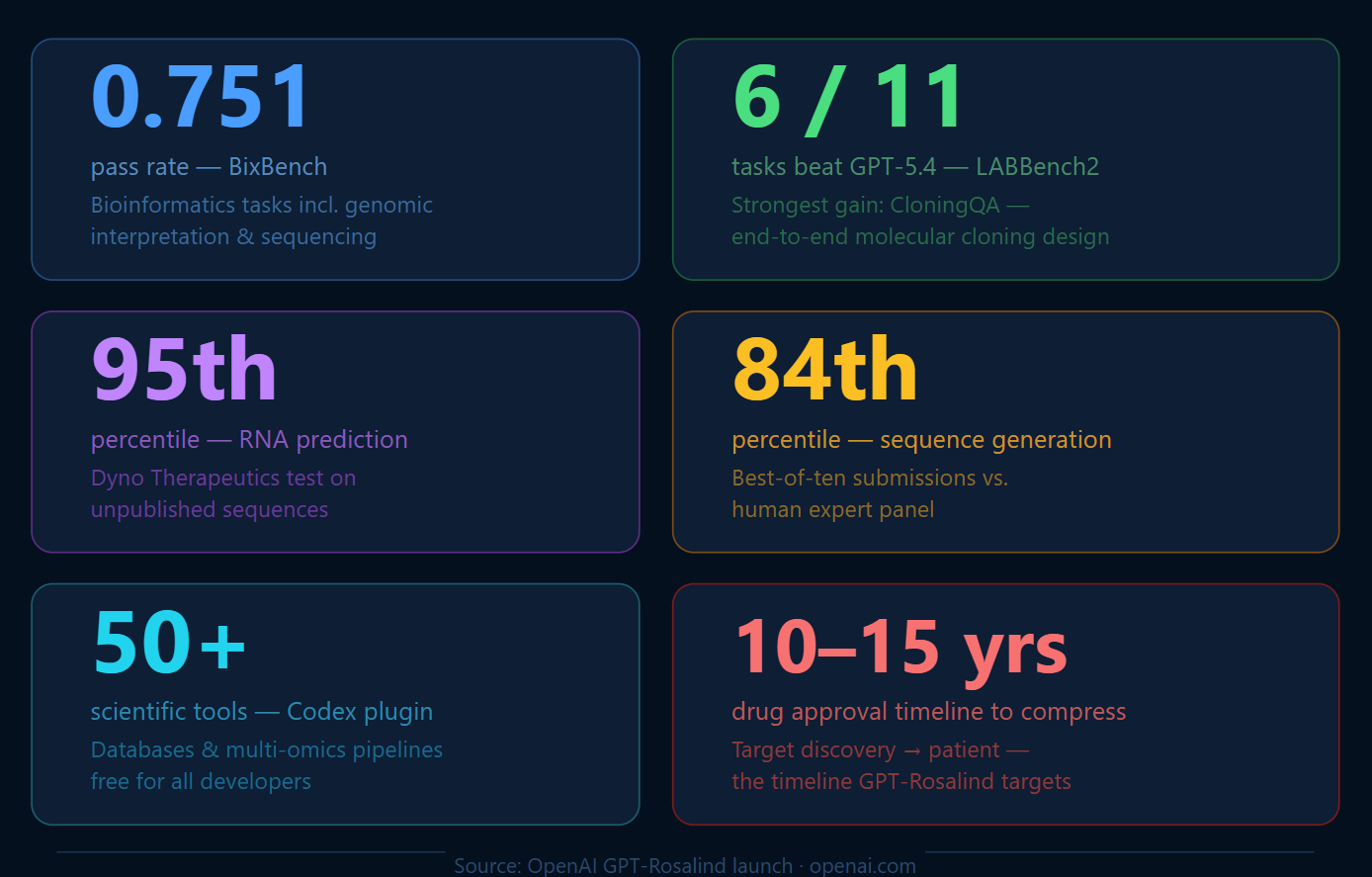
Alongside GPT-Rosalind, OpenAI launched a free Life Sciences research plugin for Codex that connects models to over 50 scientific tools, databases, and multi-omics pipelines. The plugin gives researchers programmatic access to biological databases without needing GPT-Rosalind's gated access tier.
What makes GPT-Rosalind different from general models
The model addresses a specific structural problem in biological research. A researcher working on a gene therapy candidate might need to survey hundreds of recent papers, identify patterns in protein structures, design a cloning protocol, and predict RNA behaviour in a cell. These tasks have traditionally required different tools, different specialists, and weeks of time. GPT-Rosalind is designed to handle this entire workflow within a single interface, combining literature synthesis with computational biology reasoning.
The model's most distinctive capability is its ability to use scientific tools and databases in multi-step workflows rather than simply answering questions. It can query specialised databases, parse recent scientific literature, interact with computational tools, and suggest new experimental pathways, all within the same session.
Key numbers
Access and launch partners
GPT-Rosalind is available as a research preview in ChatGPT, Codex, and for qualified enterprise customers via the API. Access is gated through a trusted-access programme restricted to US organisations working on legitimate life sciences research with strong governance controls. Early launch partners include Amgen, Moderna, the Allen Institute, Thermo Fisher Scientific, and Los Alamos National Laboratory.
The free Codex plugin is available to all developers and researchers without access restrictions, though it operates without GPT-Rosalind's domain-specific fine-tuning.
The broader signal: domain-specific models as the next phase
This launch reflects a structural shift happening across the AI industry. Rather than relying solely on increasingly large general-purpose models, leading labs are now investing in models optimised for specific scientific or professional domains. The logic is the same as fine-tuning for code generation or instruction-following, applied at a deeper level: a model that reasons specifically about genomic sequences, chemical structures, and experimental protocols can be more useful in those contexts than a model that knows something about everything.
GPT-Rosalind is the clearest signal yet that the frontier model race is bifurcating. One track continues to build larger, more capable general models. A parallel track is now building smaller, more precise domain models that outperform general models on the specific workflows that matter most in high-stakes professional contexts.
Why this matters for AI-Ready Schools
This launch has direct and specific implications for how schools teach AI and science, particularly at the secondary level.
Domain-specific AI is the future students are entering. The students in today's Grade 9 and 10 classrooms will enter professional environments where general-purpose AI tools are table stakes and domain-specific AI models are the differentiators. A student who understands why a biology-specific model outperforms a general model on protein prediction has a conceptual understanding of AI that most adults currently lack. This is precisely the AI-Sense that the NEO AI Innovation Lab curriculum is designed to develop.
The convergence of AI and life sciences is a research pathway for school students. GPT-Rosalind's launch makes biology-AI projects more accessible and more meaningful for students. A Grade 9 student interested in medicine or agriculture can now use AI tools that are built for biological reasoning rather than adapting general tools to scientific tasks. The Research Buddy in Zion's Research Hub already points toward this kind of deep, domain-specific inquiry. GPT-Rosalind shows what that looks like at the professional frontier.
The benchmark design is a lesson in critical AI evaluation. The most rigorous evaluation in GPT-Rosalind's launch, the Dyno Therapeutics test on unpublished sequences, was specifically designed to rule out memorisation. Students in the NEO curriculum learn to design fair AI evaluations: what would have to be true for this result to be genuine rather than an artefact of the training data? GPT-Rosalind's evaluation design is a real-world example of exactly this thinking.
The "10-15 years to drug approval" framing is a compelling hook for science education. The statistic that it takes a decade and a half to bring a drug from discovery to patient makes the stakes of AI-assisted research viscerally real. For science teachers using Morpheus to build lesson plans, the GPT-Rosalind launch is a rich current-events entry point into topics covering biology, pharmacology, AI ethics, and the economics of healthcare, all within a single context.
Named after a woman whose contribution was historically uncredited. Rosalind Franklin's X-ray crystallography work was essential to the discovery of DNA's double helix structure, yet Watson and Crick received the Nobel Prize without her. OpenAI's decision to name the model after her is a deliberate act of recognition. For schools teaching AI alongside history and ethics, this naming is itself a discussion starter: who gets credit for scientific discovery, and how does AI change the answer to that question?
The domain-specific AI model is not a niche development. It is a preview of how every major professional field will eventually operate: with AI tools built for the specific reasoning demands of that field, not general tools adapted from elsewhere.
Tags: OpenAI · GPT-Rosalind · Life Sciences · Drug Discovery · Domain-Specific AI · Genomics · Protein Engineering · BixBench · Rosalind Franklin · Codex · Science Education · AI in Biology
Human First. AI Next.™
