
What NVIDIA launched
On June 1, 2026, at GTC Taipei during Computex, NVIDIA launched Cosmos 3 — an open world foundation model for physical AI built on a breakthrough mixture-of-transformers architecture that combines vision reasoning, world generation, and action prediction in a single system.
Cosmos 3 is the world's first fully open omnimodel that can natively understand and generate text, images, video, ambient sound, and actions with leading physics accuracy — reducing physical AI training and evaluation cycles from months to days. GlobeNewswire
NVIDIA trained Cosmos 3 on 20 trillion tokens of multimodal data, including nearly a billion images, 400 million real and synthetic videos, ambient audio, text, and action data from humans and robots. That action data is what makes Cosmos different from a regular video generator. Axios
Three versions launched immediately: Cosmos 3 Super and Cosmos 3 Nano are available now, with Cosmos 3 Edge coming soon for real-time inference on devices. All three are fully open-source, available on Hugging Face and NVIDIA's developer platform. Alongside the model, NVIDIA launched the Cosmos Coalition — a global collaboration between world model builders and AI developers including Agile Robots, Black Forest Labs, Generalist, LTX, Runway, and Skild AI — to advance the next generation of open world models. GlobeNewswire
Early adopters span robotics, autonomous vehicles, and smart infrastructure: Agile Robots, Doosan Robotics, LG Electronics, Samsung, and Skild AI for robotics; Li Auto for autonomous vehicles. These are not research collaborations. They are production deployments, happening now. GlobeNewswire
What Cosmos 3 actually does — and why this architecture is different
Every major AI model released in the past three years has been, at its core, a language model — a system trained to predict what text comes next. Even the most advanced multimodal models, which can process images and audio alongside text, are fundamentally built on that architecture. They understand the world through language. They produce outputs in language. They cannot act.
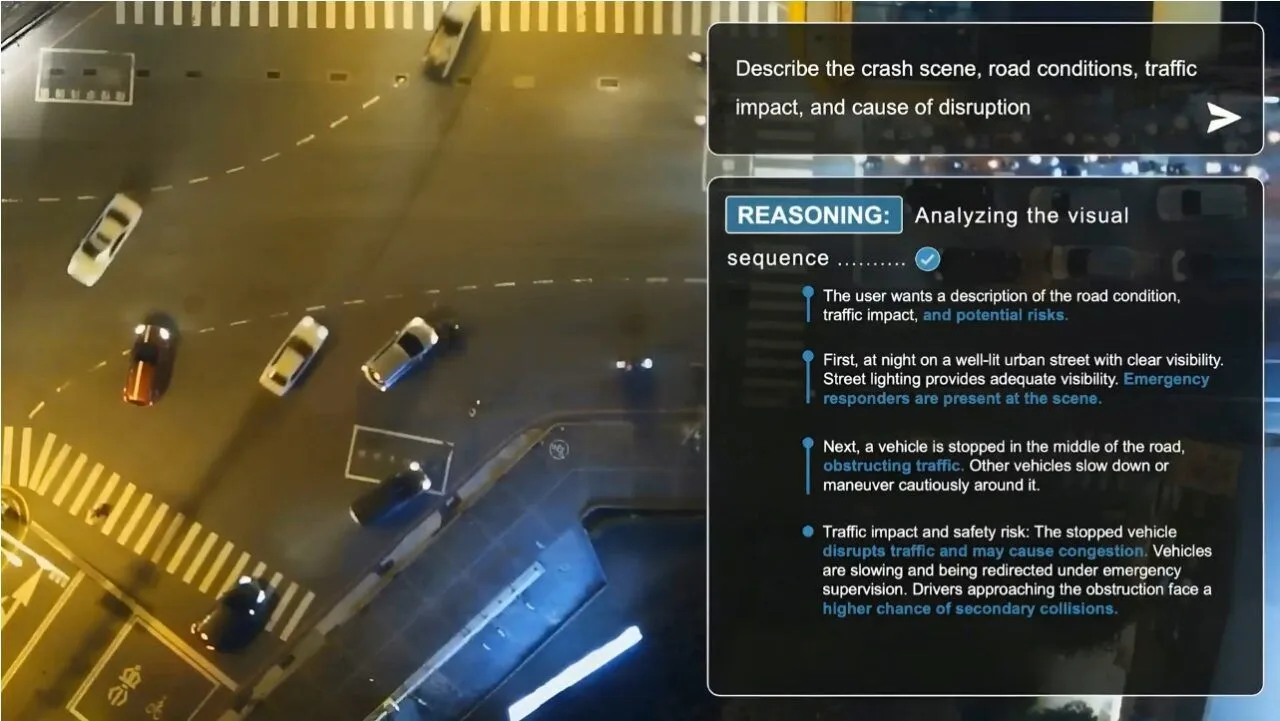
Cosmos 3 tackles a fundamental challenge in physical AI: enabling robots, autonomous vehicles, or vision agents to generalise in the real world with limited training data and fragmented simulation stacks. The model's mixture-of-transformers architecture pairs a reasoning transformer with an expert generation transformer, enabling Cosmos 3 to understand object interactions, motion, and spatial-temporal relationships before generating video and action trajectories. NVIDIA Newsroom
This distinction — between a model that understands and a model that acts — is the most important line in the entire Cosmos 3 announcement. Previous AI systems could watch a robot arm pick up a cup and describe what it saw. Cosmos 3 can watch that action, understand the physics of why it worked, simulate what would happen if the cup were heavier or the surface were wet, and generate the action trajectory that would succeed under the new conditions. It reasons about the physical world, then produces instructions for moving through it.
For autonomous vehicle researchers, the problem is the "long tail" of driving — rare interactions, unusual road geometry, lighting changes, and edge-case behaviours that are difficult to repeatedly collect but critical for training and validation. Cosmos 3 can generate synthetic data and scene variations, then support post-training with embodiment-specific behaviour and environment data for tasks ranging from pick-and-place to dexterous manipulation. NVIDIA Blog
What this means in practice: a robot learning to navigate a warehouse no longer needs to physically encounter every possible configuration of boxes, lighting conditions, and human traffic patterns to learn how to handle them. It trains on synthetic worlds generated by Cosmos 3 — worlds that are physically accurate enough that the skills transfer to the real environment. Training that previously took months can now take days.
The scale of what this enables
AI Magazine named Cosmos 3 one of this week's five most important global AI stories. That is a significant editorial judgment in a week that also included Claude Fable 5's public release. To understand why, consider what the physical AI stack now makes possible.
NVIDIA is continuing its move beyond chips into AI models and software, positioning itself to become a foundational platform for physical AI development. For the past decade, NVIDIA's dominance came from making the chips that trained AI. With Cosmos 3, NVIDIA is moving up the stack — from the hardware that powers intelligence to the model that defines it. This is the same move Google made when it stopped just providing search results and built the AI that powers them. NVIDIA is betting that the future of physical AI runs on Cosmos the way the internet once ran on Google's index. Axios
The industries that Cosmos 3 directly targets tell the story of what is at stake. Autonomous vehicles. Industrial robotics. Warehouse automation. Smart city infrastructure. Surgical robotics. Agricultural automation. Each of these sectors has been waiting for AI that can reason about the physical world accurately enough to be deployed safely at scale. The gap between a language model that can describe how to pick up a fragile object and a physical AI that can actually do it, in a factory, reliably, across thousands of different object shapes and surface conditions — that is the gap Cosmos 3 is designed to close.
NVIDIA technologies — including GPUs, open models, simulation frameworks, and CUDA-accelerated libraries — were referenced in the majority of accepted CVPR 2026 papers, with adoption across leading global research labs and institutions including Carnegie Mellon University, Stanford University, UC Berkeley, Tsinghua University, and Peking University. The academic community has already moved to build on this foundation. The production deployments will follow. NVIDIA Blog
Why this matters for the children in your school today
AI Ready School covered two physical AI milestones in the past month. In April, we covered Claude planning Perseverance's first autonomous Mars drive. In May, we covered NASA's HPSC chip — the processor being built to give spacecraft the ability to think for themselves across the solar system. Cosmos 3 is the third chapter of the same story, and it is the one closest to the ground beneath your students' feet.
The robots that will stock supermarket shelves, perform minimally invasive surgery, manufacture the smartphones of 2035, and drive the vehicles your students will travel in — all of those machines will be trained on world foundation models like Cosmos 3. The engineers who build them will need to understand physical AI: how to feed the right data into a world model, how to evaluate whether the synthetic training environments are physically accurate enough, how to identify the failure modes that emerge when a robot trained in simulation meets a real-world edge case it has never seen.
This is precisely what NEO was designed to prepare students for. Not abstract lessons about robotics, but hands-on practice with real machines — programming them, watching them fail, understanding why, and redesigning the approach. The child who has spent time in a NEO lab programming a robot arm to perform a task is not just learning to code. They are learning the cognitive framework that all physical AI engineering requires: define the problem clearly, specify the expected behaviour, test in a controlled environment, evaluate the failure modes, and iterate. That framework does not change when the robot becomes more sophisticated. It becomes more important.
Cosmos 3 reduces training cycles from months to days. That compression in time means physical AI products will reach market faster, deploy at lower cost, and iterate more quickly than any previous generation of robotics. The pace of change in the physical world — in factories, hospitals, farms, and cities — is about to accelerate the same way the pace of change in software accelerated when large language models arrived. The students who are ready for that acceleration are the ones who have been building, not watching.
The sentence from NVIDIA worth reading carefully
"The Cosmos 3 family of open, frontier omnimodels gives developers a generational leap in ability to build robots, autonomous vehicles, and vision AI that perceive, reason, plan, and act in the physical world." NVIDIA Newsroom
Perceive. Reason. Plan. Act. In that sequence lies the entire history of what AI has been trying to do in the physical world — and what it has, until now, been unable to do reliably. Cosmos 3 is not the final answer. It is the foundation. The machines built on it will be the ones your students spend their careers working alongside, directing, and being responsible for. The question every school must answer is whether it is building the humans those machines will need.
Human First. AI Next.™
