What was supposed to happen in Korea
In June 2023, then-President Yoon announced a sweeping vision: by 2028, every core subject in Korean elementary, middle, and high schools would be delivered through AI-powered tablets. It was, at the time, one of the most ambitious national AI-in-education commitments anywhere in the world — a government betting hundreds of millions of dollars that AI-personalised textbooks could genuinely transform how an entire country's children learn.
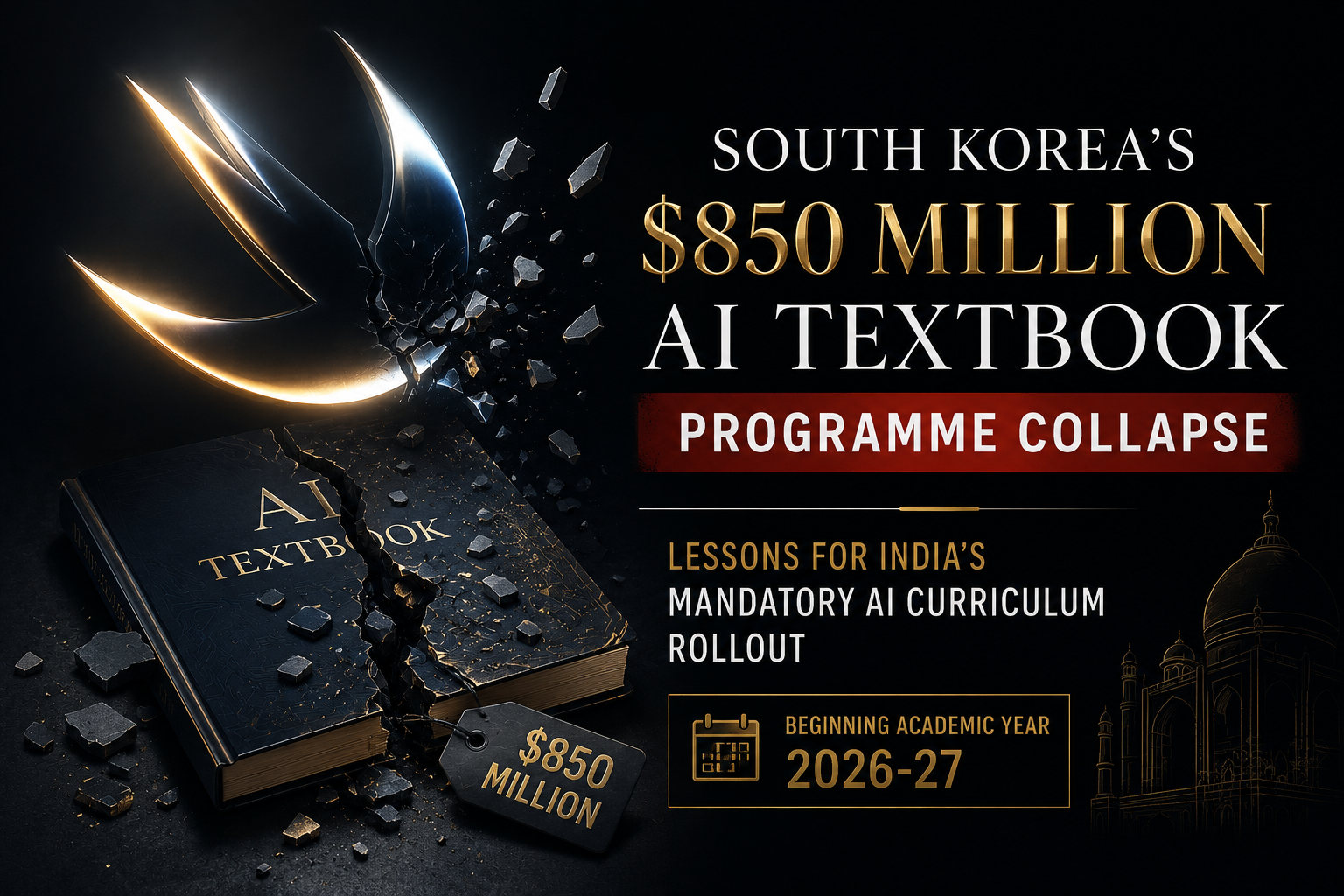
Three years later, the programme has effectively collapsed. Not gradually. Within four months of its full rollout.
What actually went wrong — three specific, avoidable failures
The first failure was technical readiness. Korean publishers had access to substantial AI research talent and government coordination. Yet the textbooks still launched with factual errors, latency issues, and adaptive systems that did not meaningfully personalise. Classroom-grade AI proved far harder to ship than enterprise AI — a lesson that holds regardless of how much research talent or government support stands behind the rollout.
This distinction matters enormously, and it is one that AI Ready School has built its entire product philosophy around. An AI tool that works well enough for a corporate knowledge worker is not automatically ready for an eight-year-old child learning to read. The tolerance for error, the need for genuine pedagogical design rather than a chatbot wrapped in a curriculum skin, and the requirement that personalisation actually personalise rather than simply appear to — these are not minor implementation details. They are the difference between a programme that transforms learning and one that collapses under its own promises.
The second failure was teacher overload. A December 2024 survey by the Korean Teachers and Education Workers Union, covering 2,626 teachers, found that 98.5% considered the existing AI textbook training insufficient. In effect, the rollout had skipped the people who would actually deliver the programme.
Read that number again: 98.5% of teachers surveyed said their training was not enough. Not a vocal minority. Nearly every teacher in the system. A national AI education programme is, in practice, only as good as the teachers standing in front of the classroom using it. If they are not genuinely prepared — not given a single afternoon workshop, but real, sustained, practical capability — the most sophisticated AI textbook in the world will fail in their hands, through no fault of their own.
The third failure was parental trust. A petition from a parent group gathered 56,505 signatures opposing AI textbooks. And the most damning data came from regional adoption maps: in one politically conservative city, AI textbook adoption hit 98% in some subjects. In liberal-leaning regions, adoption sat at 8%, 9%, and 12% respectively. The rollout had become a partisan flashpoint before it ever had a genuine chance to prove its educational value on its own merits.
A national education technology initiative that becomes a political identity marker — something parents support or oppose based on which party they voted for, rather than evidence of whether it actually helps their child learn — has lost the thing it most needed to succeed: trust built on demonstrated results, school by school, child by child.
Why this is not just Korea's story
In the United States, Meta, Google, and OpenAI are all building school-facing AI products that rely on district-level or state-level adoption. Although the specific political mechanism differs from Korea's, the underlying dependency structure does not — a top-down AI education rollout depends on trust, technical readiness, and teacher capability all arriving at once, and if any one of the three is missing, the programme is vulnerable.
This is the pattern every country attempting large-scale AI-in-education needs to study, and it lands at a moment of direct, specific relevance for India.
On October 29, 2025, the Department of School Education and Literacy announced that artificial intelligence and computational thinking will become mandatory subjects from Class 3 onwards, beginning with the 2026-27 academic year. This is not a suggestion or a pilot. It is a nationwide mandate aligned with NEP 2020 and the National Curriculum Framework for School Education 2023, affecting every CBSE, KVS, and NVS school in the country, with state boards expected to follow. Bloomberg
The Central Board of Secondary Education has set up an expert committee, led by Prof. Karthik Raman, to develop the curriculum, guided by the concept of linking AI learning to "The World Around Us" for real-life relevance. The aim is to make AI education a universal skill as essential as reading or numeracy, promoting a shift from rote learning to problem-solving, creativity, and ethical technology use. LLM Leaderboard
The ambition is genuinely admirable. But the Korean collapse happened to a country with substantial resources, strong government coordination, and real research talent — and it still failed within four months because of teacher preparation and technical readiness, the exact two areas where the scale of the Indian challenge is, by any honest measure, considerably larger.
India needs to train over 10 million teachers to deliver AI-related education — by the government's own acknowledgement, the biggest hurdle in the entire rollout. Internet connectivity stands at roughly 63% nationally, with government schools at 58.6% versus private schools at 77.1%. Teacher training is intended to be delivered through NISHTHA training modules and video-based learning resources.
Ten million teachers. Video-based training modules. If Korea's teachers — in a far smaller, more centrally coordinated system, with significant government resourcing — still reported 98.5% insufficient training, the question every Indian school administrator should be asking right now is not whether the national mandate is well-intentioned. It clearly is. The question is whether the training infrastructure behind it can genuinely reach 10 million teachers with the depth and practical capability that Korea's far smaller system failed to deliver even once.
What schools can actually do — starting now, not in 2026-27
The lesson from Korea is not that AI in education does not work. The lesson is precise: AI in education does not work when it is delivered top-down, without adequate teacher preparation, without technical rigour proportionate to the age and stakes involved, and without the trust that comes from schools and parents seeing real, demonstrated results rather than being told to trust the promise.
Schools that wait for government-led training programmes to reach their staff will likely face delays. Schools that proactively invest in teacher development will have a significant head start. This is the single most important sentence in the entire Korean cautionary tale, translated for an Indian audience. The mandate is coming in 2026-27 regardless of whether any individual school is ready for it. The schools that treat the gap between now and then as preparation time — rather than waiting for the curriculum framework and training modules to arrive fully formed — are the ones that will deliver the mandate's promise rather than repeat Korea's collapse.
This is precisely the role Morpheus and AI Ready School's Teacher Workshop programme were built to play. Not as a replacement for the government's national rollout, but as the kind of deep, practical, hands-on teacher preparation that Korea's survey of 2,626 educators revealed was almost entirely absent from its own programme. A teacher who has genuinely practised using AI tools in a real classroom context — not watched a video module, but actually built a lesson, run an assessment, and seen the technology work or fail in front of real students — is a teacher who will not be one of the 98.5% reporting insufficient preparation when India's own mandate goes live.
The technical readiness question matters just as much. The Korean textbooks launched with factual errors, latency issues, and adaptive systems that did not meaningfully personalise — precisely the failure mode that AI Ready School's Cypher was designed to avoid by building a genuine 360° learner profile from real signals over time, rather than a surface-level personalisation layer applied to existing content. The difference between AI that appears personalised and AI that actually adapts to what a specific child does and does not understand is not a marketing distinction. Korea's collapse shows it is the difference between a national programme that succeeds and one that becomes a punchline within a single academic year.
The sentence every Indian school leader should read twice
"Classroom-grade AI is harder to ship than enterprise AI."
That single sentence, from a detailed post-mortem of an $850 million national failure, is the most important piece of AI education news this week — more important, in practical terms, than any new model release. Korea had the money, the talent, and the government coordination, and still discovered this the hard way. India's mandate begins in the same academic year this article is being published in. The schools that internalise this lesson now — and build real teacher capability and genuine technical rigour ahead of the deadline, rather than after it arrives — are the ones that will be ready when it matters.
Human First. AI Next.™
