A NATIONAL RESEARCH STUDY — INVITATION TO PARTICIPATE
A national study bringing together classrooms from across India — different boards, geographies, and school types — to build an honest, evidence-based picture of what AI-assisted teaching actually changes in the classroom. Conducted by AIRS Research, the research division of AI Ready School.




Taken together, these figures point to the same conclusion: AI is already present in Indian classrooms at scale, largely without a shared, evidence-based understanding of what it is actually doing to teaching and learning. This study exists to build that understanding before adoption patterns — good or bad — become fixed.
Size of India's K-12 sector today, projected by 2030 — a scale at which AI adoption decisions affect a very large number of students, very quickly.
When the Ministry of Education's AI curriculum begins nationally, aligned with NEP 2020 and NCF-SE 2023.
Of Indian teachers are already using AI tools in some form — but usage is uneven and largely informal.
Of students in some private schools already use generative AI multiple times a week, often without structured guidance.

How AI-assisted teaching and learning tools affect student understanding and confidence, across a representative range of Indian K-12 school contexts.

How teachers adapt lesson planning, delivery, and assessment when AI tools are introduced into the classroom.

How AI readiness and usage vary across school types, geographies, and boards, to identify where support is most needed.

An independent, evidence-based reference that school leaders and policymakers can use to make informed, responsible decisions about AI adoption.

To the national conversation on AI in K-12 education, in support of the goals of NEP 2020 and the NCF-SE 2023.

A short, structured on-campus session designed and facilitated by the AIRS research team — combining measurable data with direct classroom observation. The protocol was field-tested across three pilot classrooms before this study began.
Each session is a measurement exercise, not a demonstration. The AIRS research team designs the instruments, runs the session, and analyzes the results — your school and students simply take part in the classroom experience.
We use the agentic AI teaching platform built by us to run the research. Because the platform supports the full lifecycle of teaching and learning — from lesson creation through delivery to review — it lets us observe how AI changes the classroom end to end, rather than measuring one isolated moment of it.
We work with the teacher of the selected grade, section, and subject to build a complete lesson package for one topic using the lesson builder. Once the package is ready, we train the teacher to deliver it themselves — so the session reflects how the tool actually gets used in a real classroom, not a demonstration run entirely by our team.
We start with a baseline test, measuring what students already know before the session. Students then revise the same concepts using the AI tutor, which delivers from the identical lesson package the teacher built — so the tutoring and the teaching are drawn from one consistent source, not two disconnected experiences. We close with a final assessment test to measure what changed.
We compare the baseline and final results and compile them into a report, then analyze what the data actually shows — whether students learned better with AI-assisted, personalized instruction, or whether the impact was negligible. The report isn't built to confirm an assumed outcome; it's built to show whichever result the data supports.
We understand that schools are extremely busy and are tied up with many things. So, we just take one grade, one section, one subject and, one teacher for the research process. We will also understand how your school is promoting the responsible usage of AI and if you have any AI usage policy/framework in place.
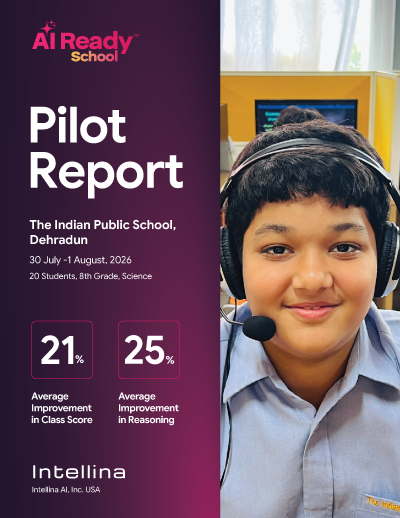
Before this became a 100-school national study, the same four instruments were piloted in three classrooms across three different contexts — a government school, a CBSE school, and a residential school — to test whether the method itself holds up outside a single setting.
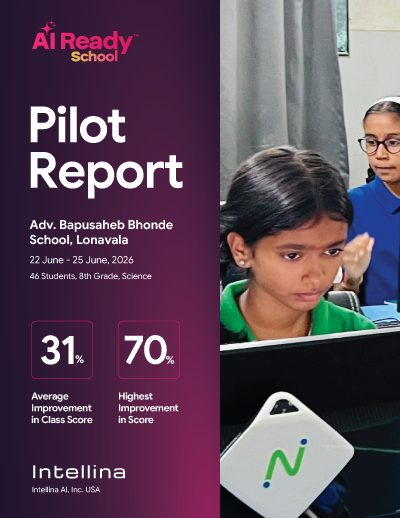
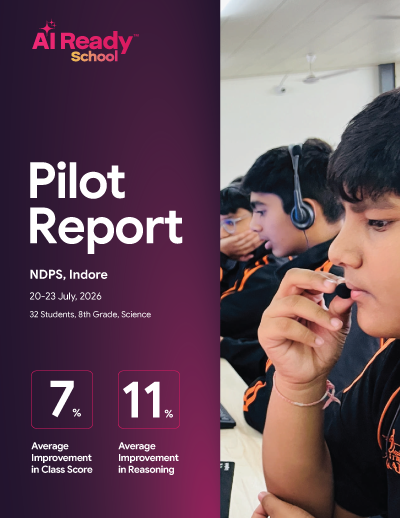
The study is targeting participation from 100 schools across India, each contributing one grade, one section, and one subject, selected to reflect this range — so the findings speak to Indian K-12 education broadly, not to any single type of school.
Government and private institutions.
Urban and rural settings, across multiple states.
CBSE, ICSE, State boards, and international curricula.
Spanning multiple grade bands and subject areas.
Participation is designed to be a meaningful experience in its own right, not only a data point in a national report. Here's what changes inside your classroom during the session — for the teacher delivering it and the students taking part.

Official Certificates of Participation for the school, teachers and students.
A copy of the final published national research report.
Recognition as a participating institution, distributed nationally to the education community.
An invitation to the report's launch event schedule on 27 January 27 in Delhi.
FREE Course on Responsible, Ethical and Mindful Usage of AI.
2 Months FREE access to the AIRS platform.
FREE AI Workshop for the teachers to make them ready.
Every participating school can submit a nomination to receive "AI Ready School" of the year award.
Human First. AI Next.™
