
Chiranjeevi Maddala
June 6, 2026
How Twenty-Five School Students Spent Four Weeks Learning to Build, Deploy, and Direct Real Artificial Intelligence Agents — Starting from Absolute ZeroMost summer camps teach swimming, crafts, or sport. This one taught students to build AI agents, automate tasks with Claude, and deploy live web applications — in four weeks, starting from absolute zero.
Between May 4 and May 29, 2026, AI Ready School ran its Agentic AI Summer Camp at Meru International School, Miyapur, Hyderabad — a hybrid program serving both offline students from the campus and online students from across India. The students were in Grades 7, 8, and 9. Not one had prior experience with artificial intelligence. Every single one shipped a real project by the final day.
This is the story of how that happened.
The camp was designed around a single conviction: knowing how to use an AI tool is like knowing how to use a calculator. It helps, but it does not make you a mathematician. The world already has enough people who can type prompts into a chatbot. What it needs — and what the next generation will be judged on — is the ability to think with AI, build with it, and direct it toward problems that matter.
AT A GLANCE

The camp was structured as four weeks of progressive learning — each week building on the last, from conceptual foundations to real deployed products. By the time Week 4 arrived, students were not talking about AI. They were building with it.
Grades 7 through 9 represent a critical window. These are the years in which students begin forming durable intellectual habits — what they engage with deeply at this stage tends to stay with them. The World Economic Forum estimates that 85 percent of the jobs that will exist in 2030 have not yet been invented. That is not a statistic about the distant future. The students in this camp will be entering the workforce in roughly a decade.
Researchers at McKinsey Global Institute project that 40 percent of the current global workforce will need to reskill within three years due to AI adoption. The Burning Glass Technologies research suggests that students who develop coding and AI skills early have up to four times higher earning potential than peers who do not. These numbers are not meant to alarm — they are meant to focus.
The response to these numbers has largely been to introduce AI tools into classrooms — to show students how to use ChatGPT to write essays, how to generate images, how to summarise a document. That is a reasonable beginning, but it stops far short of where it needs to go. The students who will thrive are not those who used the most AI tools. They are those who understood them well enough to direct them.
This camp was built around that distinction.
AI Ready School calls the target outcome AI Sense — the ability to think with AI rather than simply use it. It is not a skill in the narrow sense. It is a disposition: the habit of approaching problems by asking what an AI agent could do, how it should be directed, where human judgment remains essential, and how multiple tools can be orchestrated into a system that produces something greater than the sum of its parts.
The camp was designed to build that disposition — not through lectures, but through four weeks of doing.
The students who will thrive are not those who used the most AI tools. They are those who understood them well enough to direct them.
The camp enrolled students from Grades 7, 8, and 9 — a range that meant some students were eleven years old and others fourteen. All of them came in as complete beginners. The curriculum did not assume prior exposure to programming, to computer science, or to any formal study of artificial intelligence. What it assumed was curiosity, and a willingness to struggle through things that were unfamiliar.
Both were present in abundance.
The first week was entirely conceptual — and deliberately so. Before students could build with AI, they needed to understand what they were building with. This sounds obvious. In practice, it is where most educational programs skip ahead too fast, and students never quite develop the foundational understanding that makes everything else coherent.
Week 1 covered four core ideas. First: what artificial intelligence is, how it works at a conceptual level, and — crucially — where it fails. Students learned that AI is not magic, that it is pattern-matching at enormous scale, and that it has specific, predictable limitations. Understanding those limitations is part of knowing when to use it and when not to.
Second: what makes an AI agent different from a chatbot. A chatbot responds to questions. An agent reasons, plans, and acts — it can pursue a goal across multiple steps, use tools, access information, and modify its approach based on what it finds. This distinction is not semantic. It is the difference between a calculator and a junior analyst. Students spent significant time on this distinction because it underpins everything that follows.
Third: how AI is reshaping careers and industries. Students explored real domains — healthcare, logistics, content creation, software development — where AI agents are already doing work that once required teams of people. The goal was not to provoke anxiety but to build realism. The jobs of 2030 will not go to those who resist these changes. They will go to those who know how to work alongside the systems driving them.
Fourth: AI versus human thinking. This turned out to be one of the most engaging discussions of the entire camp. Students were asked to think carefully about what machines do better than humans — speed, consistency, pattern recognition at scale — and what humans do better than machines — contextual judgment, genuine creativity, ethical reasoning, the ability to care about outcomes. By the end of Week 1, students could answer questions that most adults find difficult: when should you let the agent work, and when should you lead?
The week ended with each student able to articulate a clear mental model of agentic AI — what it is, what it is not, and why the distinction matters. That foundation made everything in the following three weeks significantly more meaningful.
If Week 1 was about understanding, Week 2 was about touching. Students got hands-on access to real AI tools: Claude AI, Claude Cowork, Claude Code, and AI Ready School's own platforms — Cypher, an AI-powered learning companion, and Zion, a suite of over thirty tools built specifically for school-age learners.
The shift in the room when students first opened Claude was visible. Many had used search engines and perhaps experimented with basic chatbots. None had had a structured, purposeful conversation with a reasoning AI system. The experience was — in the word several students used — eye-opening.
The key lesson of Week 2 was that prompting is not asking questions. It is directing a thinking partner. Students learned to assign roles to Claude — to say, in effect, you are a curriculum designer, here is the goal, here are the constraints, here is what good output looks like. They learned to ask Claude to reason step by step, to show its work, to flag uncertainty rather than guess confidently. The difference between a student who types a question and a student who directs an AI agent toward a goal is enormous — and it is learnable.
Claude Code introduced students to the idea that building software no longer requires memorising syntax. Students described what they wanted in plain language — a tool that does X, a system that handles Y — and watched Claude produce working code. The lesson was not that code no longer matters. It is that the barrier to building has shifted. The new constraint is clarity of thought, not technical fluency.
Claude Cowork gave students their first experience of AI as a practical assistant. They used it to automate desktop tasks — organising files, drafting content, managing workflows — and experienced firsthand what it feels like to hand a tedious process to an agent and focus their attention on something that requires human judgment. For many students, this was the first time AI felt genuinely useful in their own lives rather than in the abstract.
By the end of Week 2, every student had built something small — a simple app, an automated workflow, a structured AI conversation that produced a real output. The confidence shift was significant. They arrived unsure whether they were the kind of person who could build things with AI. They left Week 2 knowing they were.
Week 3 was the most technically demanding part of the camp. It was also, by a considerable margin, the most important.
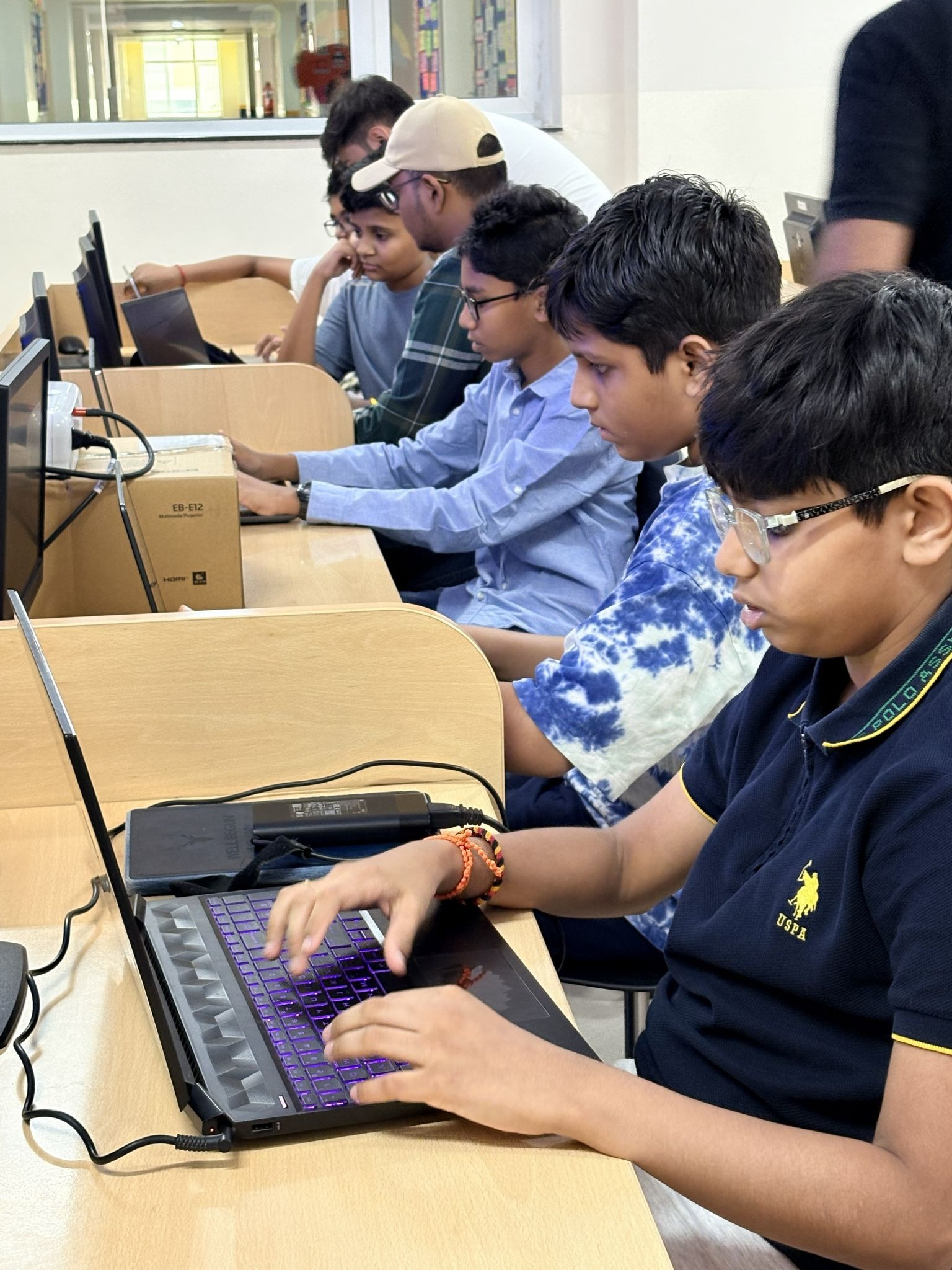
Students set up local AI environments on their own Windows machines. This meant installing Node.js, configuring Claude Desktop, and connecting it to their file systems using the MCP — Model Context Protocol — filesystem server. For a group with no prior technical background, this was a significant undertaking. They edited real JSON configuration files. They troubleshot problems on machines that each behaved slightly differently. And they watched, live, as Claude read and wrote files directly on their computers.
The early days of the week were chaotic. Configurations failed. Error messages appeared that students did not recognise. Some setups required individual attention from trainers. The AI Ready School platform provided structure, and the trainers held the room together — but struggle was real and visible.
And then, one by one, every student got it working.
The moment when a student sees their AI agent read a file from their own desktop — a file they created, in a folder they built — is one that does not fade. It is the moment the abstract becomes real.
This mattered for reasons beyond the technical accomplishment. The students who struggled through Week 3 and came out the other side had learned something about themselves — that they could work through problems they did not understand, persist through setbacks, and eventually arrive at something that worked. That quality — resilience in the face of technical difficulty — is arguably more valuable than any specific skill the camp taught.
Week 3 also introduced students to the concept of orchestration — connecting multiple AI tools into a single flowing system where one agent researches, another summarises, another formats the output. The students experienced what it means to be the architect of an AI workflow rather than simply a user of a tool. The mental shift from operator to orchestrator is one of the most important transitions in the AI literacy journey, and Week 3 is where it happened for these students.
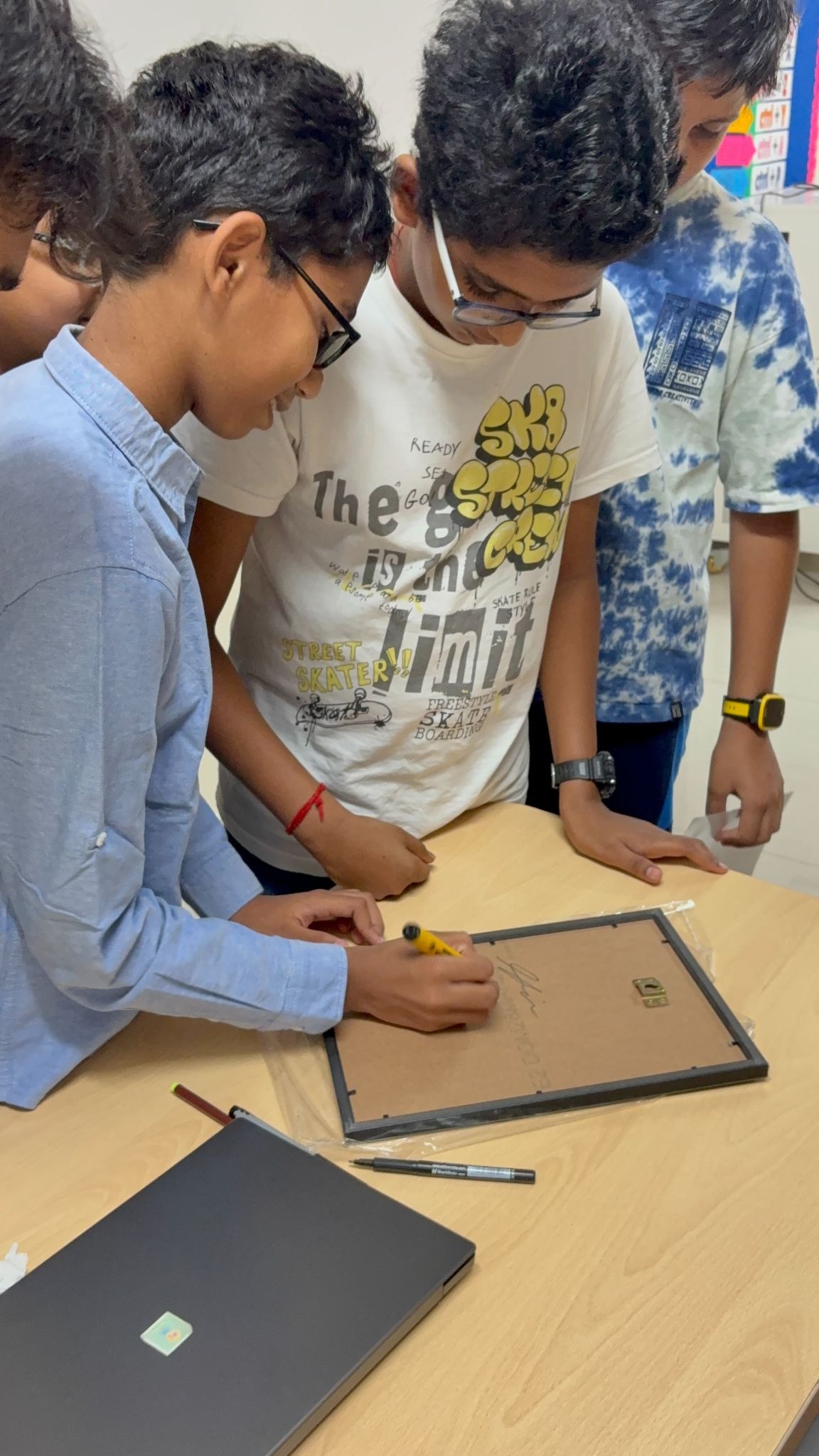
The final week was project week. Students chose real problems, built real solutions, and presented them to a live audience of peers, parents, and mentors. Two major projects emerged from the camp.
Students designed and built a personalised AI-powered study assistant — an agent that takes any topic, breaks it into core concepts, generates quiz questions, tracks what the student has mastered, and remembers everything across sessions. The Study Agent was not a demo. It was a live, deployed application running on real infrastructure, with a real database storing real student profiles.
The technical stack the students used:
• Next.js — a modern framework for building web applications
• Supabase — an open-source database platform for storing user data and profiles
• Vercel — a deployment platform for making the application live on the internet
These are not simplified or educational stand-ins for real tools. Next.js, Supabase, and Vercel are what professional developers use. The students who built the Study Agent were working with the same infrastructure stack that powers real software products.
The Study Agent was live and running with real API keys by the final day of camp. Not a prototype. Not a mockup. A deployed product.
The second major project was the full configuration and demonstration of each student's local AI environment — Claude Desktop connected to their personal file systems via the MCP filesystem server. Students documented their setups, explained the configuration process, and demonstrated Claude reading and writing files locally in real time.
For a group that arrived at the camp not knowing what an AI agent was, the MCP project represented a remarkable technical accomplishment. They had installed developer tooling, written configuration files, debugged real errors, and built a functioning bridge between one of the world's most capable AI models and their own computers.
The project presentation session was the emotional high point of the camp. Students walked through their work in front of parents, peers, and mentors — explaining not just what they had built, but the problem it solved, the decisions they made along the way, and what they would improve next. The ability to communicate about technical work to a non-technical audience is a skill that most adults find difficult. These students, in four weeks, had already begun developing it.
The camp gave students access to a carefully selected set of tools — chosen not for novelty but for depth. Every tool on this list was used for a real purpose, not a demonstration.
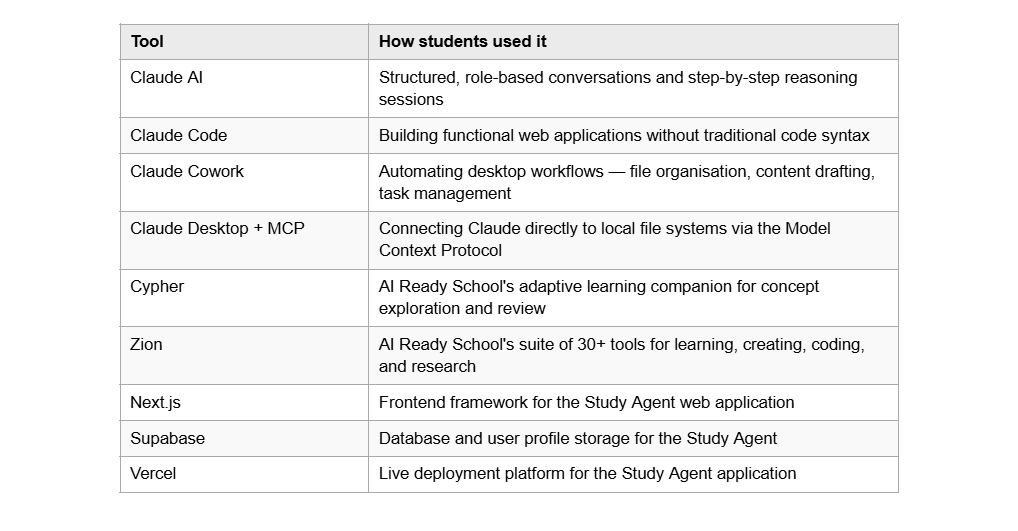
The selection of tools was deliberate. Claude AI, Claude Code, and Claude Cowork represent three different modes of engaging with AI — conversational direction, code generation, and task automation — and together they gave students a complete picture of what modern agentic AI looks like in practice.
The AI Ready School tools — Cypher and Zion — were designed specifically for this age group and integrated seamlessly with the camp's curriculum. Students did not have to navigate tools built for adult developers. The learning environment was designed for them.
A reasonable question, given the number of AI programs that have emerged in the past two years for school-age students, is what distinguished this camp from the rest. The answer is not a single feature. It is a philosophy executed consistently across four weeks.
Real tools, not simplified stand-ins.
Students used the same tools that professionals use — Claude AI, Claude Code, Next.js, Supabase, Vercel, the MCP protocol. There were no educational simulators, no training wheels, no dumbed-down interfaces. The difficulty was real, and so were the results.
Small cohorts.
The camp capped cohort sizes at eighteen students. In practice, the offline group at Meru International School numbered five to six students, which meant individual attention was genuinely available. In a domain as hands-on as this one, the ratio of trainer to student matters enormously.
Expert trainers.
The trainers who ran the camp had hands-on experience building large-scale AI systems — not educators who had recently learned to use AI tools. That distinction matters. Students could ask questions that went beyond the curriculum, and they received answers grounded in real professional experience.
Productive struggle as a feature.
Week 3 was hard by design. The camp did not protect students from difficulty — it structured difficulty so that students could work through it with support. The result was that students who got their MCP setup working did not just learn a technical skill. They learned that they could solve technical problems they had never encountered before. That confidence is transferable to every future challenge they will face.
Outcomes, not activities.
Most educational programs are measured by what students did — what sessions they attended, what exercises they completed. This camp was measured by what students built. The Study Agent was live. The MCP environments were running. The project presentations were real. The certificate students received at the end represented actual accomplishment, not participation.
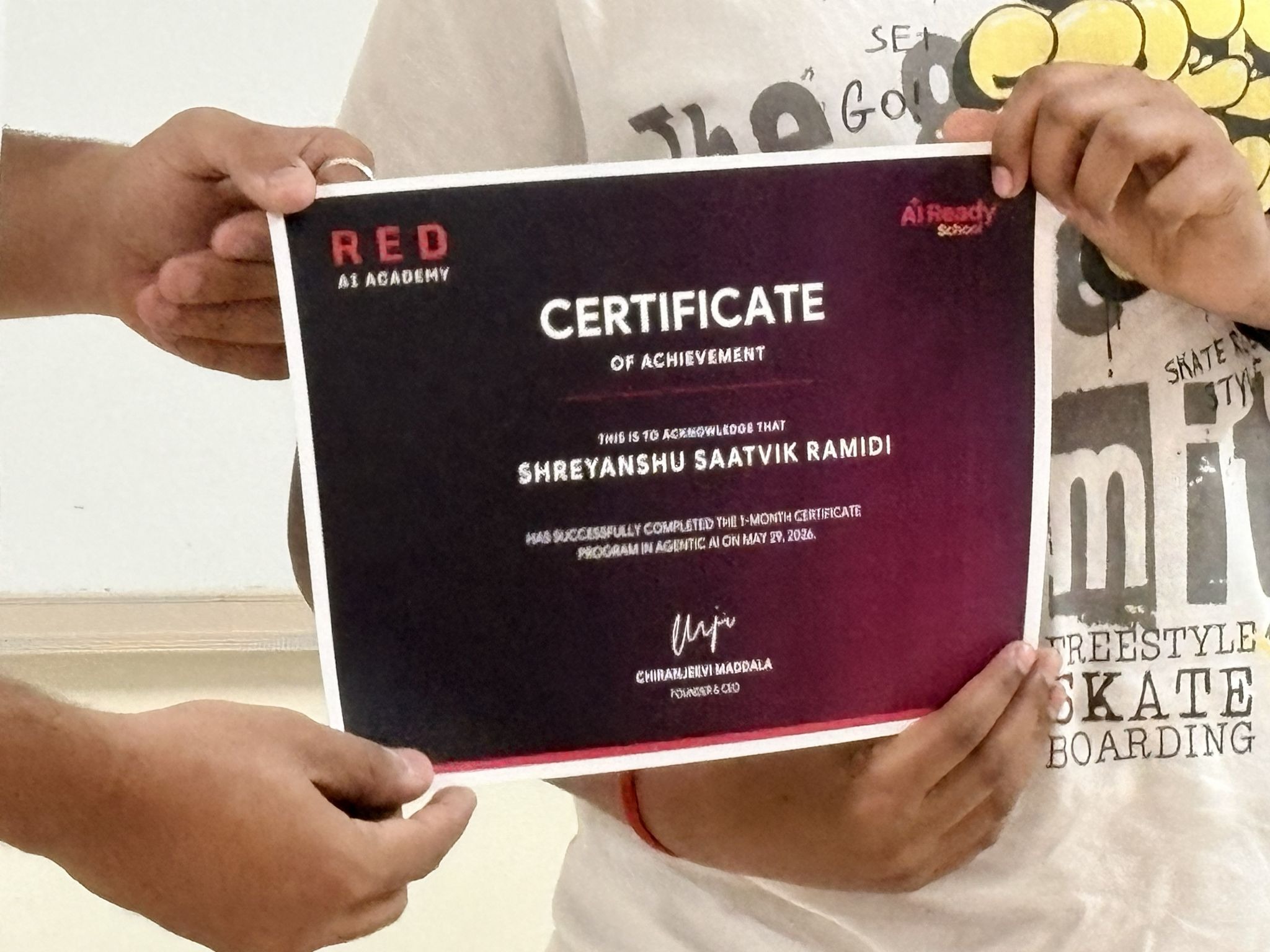
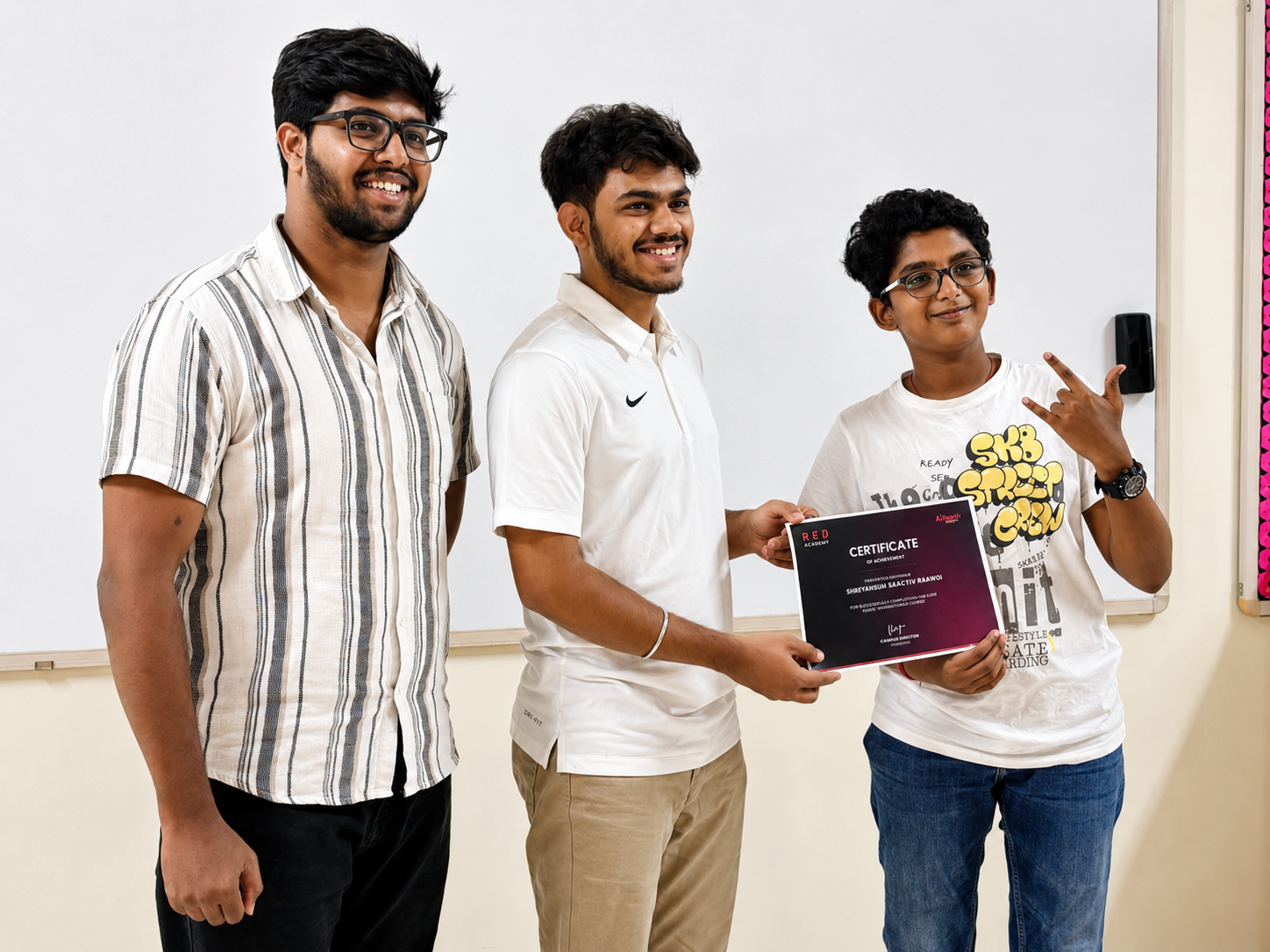
Every student who completed the four weeks and presented their project received the AI Ready School Certificate in Agentic AI, jointly issued by RED AI Academy and AI Ready School. The certificate recognises not just what students built, but how they now think — the mental models, the habits of mind, and the practical confidence that the camp developed.
Beyond the certificate, each student created an online portfolio and a downloadable PDF documenting their work. These are not keepsakes. They are evidence — something a student can show to a future school admissions panel, a scholarship committee, or an employer — that demonstrates not only what they built but the thinking process behind it.
The camp is over. The learning is not. Students left with working projects, real accounts on professional tools, and — most importantly — a mental model of how AI works that will remain relevant regardless of which specific tools the industry converges on next. Tools change. Understanding endures.
It is worth being precise about what this camp demonstrated — because the implications extend beyond the students who attended it.
In four weeks, with no prior technical background, students in Grades 7 through 9 built and deployed a full-stack web application, configured a local AI environment using professional developer tools, and developed the conceptual foundation to continue learning independently. They did this while also developing the communication skills to explain their work to a non-technical audience.
This is not a story about exceptional students. These were ordinary school children — curious, willing to struggle, and given the right environment to develop their capabilities. The lesson is that the right environment matters enormously, and that the ceiling for what young people can learn — when taught with real tools, real problems, and genuine respect for their capacity — is much higher than most educational programs assume.
They came in not knowing what AI was. They left having deployed an application to the internet and connected an AI agent to their own computers. That gap — covered in four weeks — is the story.
The next cohort of the Agentic AI Summer Camp is open for enrolment. If you want your child to be part of it — or if you are a school interested in bringing this programme to your students — visit aireadyschool.com or contact the team directly at 9100013885.
Human First. AI Next.™