
Chiranjeevi Maddala
April 20, 2026
Every school in India is now teaching students to use AI. Almost none of them are teaching students to understand it, build with it, or demonstrate it. There is a difference between a student who can prompt ChatGPT and a student who has trained a machine learning model, published a research paper, and competed in a national AI innovation challenge. That difference is a portfolio. And in an AI-driven economy, the portfolio is everything.
Arjun is 14. He scores well. His teachers like him. He works hard. His parents have done everything right: good school, tuitions, extracurriculars, a summer coding course. By every conventional measure, Arjun is prepared.
His father, who runs a mid-sized manufacturing business, asked us a direct question at a school event in Hyderabad last year: "My son knows how to use ChatGPT and can write Python. Is that enough?" We gave him a direct answer. In 2026, those are table stakes. The students who will lead in the next decade are not the ones who can use AI tools. They are the ones who understand how those tools work, where they fail, what assumptions they make, and how to build something original with them. The students who arrive at university and career entry with documented evidence of that capability, a portfolio of research, projects, and competition results, will occupy a categorically different position from the students who can only point to examination scores.
The NEO AI Innovation Lab was built for Arjun. And for every student like him: capable, motivated, and in a school system that is teaching them to use AI without teaching them to understand it.
There is a version of AI education that produces students who are good at getting AI to do things for them. There is another version that produces students who understand AI well enough to direct it, question it, and build something new with it. Only the second version produces a portfolio that matters.
Walk into any school that has adopted AI tools and you will find students who can generate images, summarise articles, debug code with AI assistance, and produce polished presentations in minutes. These are useful skills. They are not differentiating ones. Within two years, every student in every school in India will have them. The 2026-27 AI curriculum mandate from Class 3 ensures that. Basic AI tool fluency is becoming the new digital literacy: necessary but not sufficient.
The students who will have genuine advantage are the ones who have gone further. Who can answer questions that most adults cannot. What is a training dataset, and how does bias get into it? How does a language model decide what word comes next? Why does an AI image generator sometimes produce hands with six fingers? What happens when you deploy a model trained on urban data in a rural context? These are not advanced engineering questions. They are the literacy questions of the AI era, and they are accessible to any curious student who has been given the right environment to explore them.
The NEO AI Innovation Lab is that environment. It is not a place where students learn to use AI tools. It is a place where students learn what AI actually is, how it actually works, and how to build something original with that understanding. The difference between these two things is the difference between a student who can drive and a student who understands how engines work. Both can get from A to B. Only one can diagnose what is wrong when the car stops, build something new with the engine, and explain to someone else why it works.
This matters enormously for university admissions, for career entry, and for the long-term trajectory of a student in an economy where AI capability is the most rapidly appreciating professional asset in the labour market. A PwC Global AI Jobs Barometer 2025 finding that workers with AI-related skills earn a 43% higher wage premium than peers in identical roles without those skills describes the market for adults who developed AI skills on the job. The students who develop those skills before they enter the job market will compound that advantage from day one.
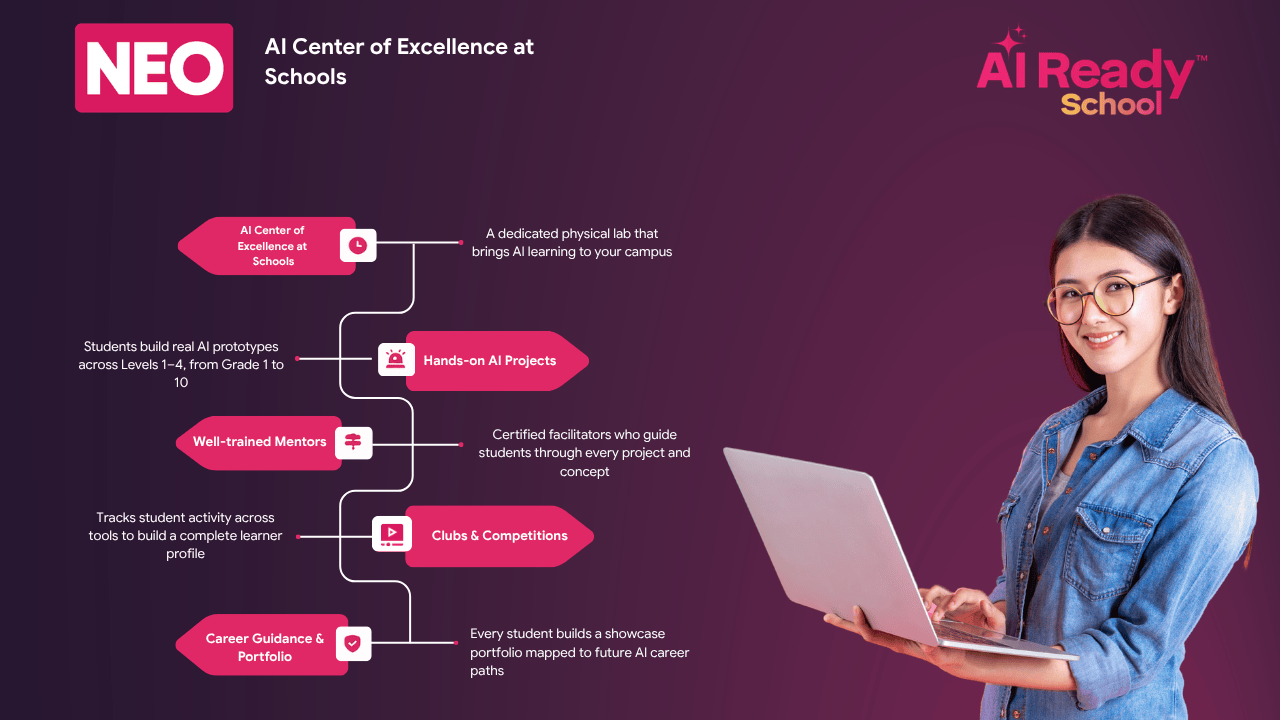
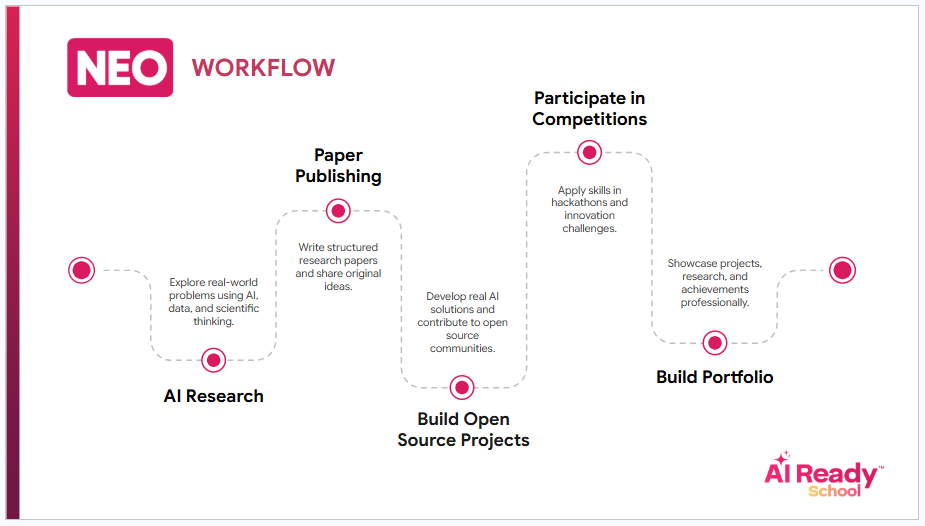
The NEO AI Innovation Lab curriculum is structured around five progressive stages that together build the kind of AI capability that produces portfolios worth showing to university admissions panels, scholarship committees, and employers. Each stage builds on the previous one. Each stage produces something concrete. By the time a student completes the full pathway, they have not just learned about AI. They have done it, repeatedly, at increasing levels of sophistication, with results that are documented and verifiable.
The first stage of the NEO pathway is also the most foundational, and the one that most distinguishes NEO from every other AI program available to Indian school students. Before students build anything, they learn to ask questions.
AI research at the school level does not mean reproducing what others have found. It means taking a genuine question about how AI works, how it affects a domain the student cares about, or how it can be applied to a problem they have identified, and investigating it with scientific rigour. Students learn to frame a research question, design an investigation, collect and analyse data, interpret results with appropriate caution, and draw conclusions that are warranted by the evidence.
The topics students choose reveal the range of genuine curiosity that AI research at the school level makes possible. A Grade 9 student interested in agriculture designs an investigation into how machine learning models trained on satellite imagery perform when tested on data from different soil types than the training set. A Grade 8 student interested in classical music trains a model on Carnatic compositions and studies how it categorises pieces the model has never heard. A Grade 10 student concerned about healthcare access investigates how AI diagnostic tools perform across different demographic groups and what the implications are for rural healthcare delivery.
These are not toy problems. They are genuine research questions that have been investigated, with real data, by real students, and that produce findings with real implications. The research methodology students develop through this process, the habit of asking precise questions, designing fair tests, evaluating evidence critically, and drawing conclusions with appropriate humility, is the cognitive infrastructure that every demanding professional context in the AI economy requires.
NEO mentors guide students through the research process. They ask the questions that sharpen the investigation: what would have to be true for your hypothesis to be wrong? What assumptions is your methodology making? What would a sceptical reviewer say about this result? These are the questions that produce researchers, not just students who have completed a research project.
The student who learns to ask a precise question about an AI system's behaviour is not just developing a research skill. They are developing the most valuable professional skill in an economy where AI outputs cannot be trusted blindly.
The second stage of the NEO pathway takes the research from Stage 1 and transforms it into a published document. This is not a school essay with a bibliography. It is a structured research paper, formatted according to academic conventions, with a literature review, methodology, results, discussion, and conclusions. Students learn to cite sources correctly, to acknowledge limitations in their work, to distinguish between their findings and their interpretations, and to communicate complex ideas clearly in formal written English.
The act of writing a research paper does something to thinking that no other exercise replicates. It forces precision. Vague ideas that feel solid in conversation reveal themselves as imprecise when you have to write them down exactly. Claims that seemed well-supported turn out to need more evidence when you have to document the evidence on paper. Conclusions that felt obvious require justification when you have to explain your reasoning to a reader who was not there for the investigation.
NEO students publish their research papers in the NEO AI Innovation Lab's structured publication framework and, at the advanced level, submit to external publications and student research forums. A student with a published research paper on machine learning, referenced in their university application, is demonstrating something that no examination score can demonstrate: the capacity to do original work, document it rigorously, and communicate it clearly to an audience outside their classroom.
For students applying to competitive undergraduate programmes, this is significant. University admissions offices in India and internationally are increasingly looking for evidence of genuine intellectual capability beyond board examination results. A research paper demonstrates exactly the qualities that examination scores cannot measure: original thinking, methodological rigour, intellectual honesty about limitations, and the ability to communicate complex ideas in writing. A student who has published one research paper by Grade 10 has a credential that most applicants to competitive programmes never develop.
The third stage of the NEO pathway is where students move from studying AI to building with it. Every student in NEO builds at least one open-source AI project that addresses a real-world problem. The project must be functional, documented, and published in a way that others can access, use, and build on.
The open-source requirement is not incidental. It is philosophically central to what NEO is trying to develop. When a student builds a project that other people will actually use, the quality standard changes. You cannot leave a bug undocumented when someone else is going to encounter it. You cannot leave your methodology unexplained when someone else needs to understand it to extend your work. The open-source project forces the same precision that the research paper forces, but in code rather than prose.
The projects NEO students have built reflect the same range of genuine curiosity as their research topics. A Grade 9 student in Raipur built an app that identifies plants from photographs using a model she trained on images she collected herself. The app is used by her school's biology department. A Grade 10 student built a tool that analyses audio recordings of students reading aloud and identifies specific phonetic errors, then recommends targeted practice exercises. A Grade 8 student built a system that classifies agricultural field images by crop health status, trained on data collected from farms near his family's village.
These projects are not impressive because they are technically sophisticated by professional standards. They are impressive because they are real. They solve problems that the student identified, were built by the student using skills the student developed, and are available to anyone who wants to use them. When a university admissions officer reads a portfolio that includes a link to a working, documented, open-source AI application, they are seeing evidence of capability that no amount of coursework can produce.
The Zion Project Hub is the primary environment where NEO students build their open-source projects. The AI Coding Playground, Teachable Machine, App Builder, and AI Model Playground tools provide the infrastructure. The NEO curriculum provides the methodology. The mentors provide the guidance that turns good ideas into working systems.
The student who has built a working AI application and published it for others to use has done something that a quarter-century of schooling typically never asks of a student: produced something real, for a real purpose, that other people can use.
The fourth stage of the NEO pathway puts students' research, writing, and building capabilities to the test in competitive contexts. NEO students participate in hackathons, AI challenges, and innovation competitions at the school, regional, national, and international level. The flagship competition in the NEO pathway is the AI Startup Show Juniors.
The AI Startup Show Juniors is not a science fair. It is an innovation challenge that expects students to identify a real-world problem, design an AI-powered solution, build a functional prototype, and pitch their solution to a panel of judges that includes technology professionals, investors, and education leaders. The judging criteria include the quality of the problem identification, the originality of the solution, the functionality of the prototype, the quality of the research underlying the design, and the clarity of the presentation.
Students who compete in the AI Startup Show Juniors are not performing for a classroom audience. They are presenting to professionals who evaluate technology ideas for a living and who have no obligation to be kind about work that does not meet the standard. This context is irreplaceable. The student who has pitched an AI solution to a panel of industry professionals, received challenging questions, and adjusted their thinking in real time has developed a professional capability that no examination can develop.
Competition participation also does something for student confidence that is difficult to achieve in any other way. A student who has competed, won recognition, received expert feedback, and revised their work in response to that feedback knows that their capability is real and externally validated. This is not the confidence that comes from being told by a teacher that you are talented. It is the confidence that comes from having demonstrated capability to people who did not already believe in you.
Competition results become the most immediately legible part of a student's portfolio. A first-place finish at the AI Startup Show Juniors tells a university admissions officer, in a single line, that this student's work was judged the best in a field of competing entries by a panel of qualified evaluators. No examination score communicates this level of external validation.
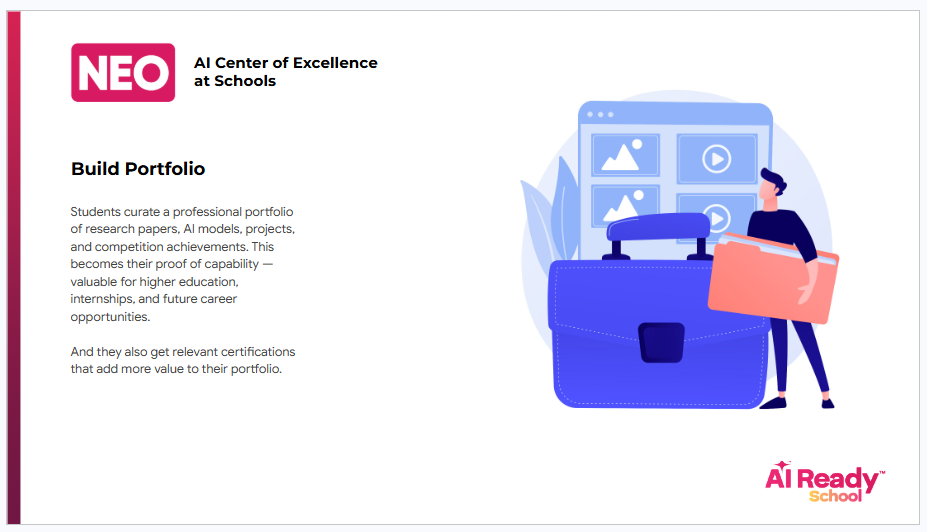
The fifth stage of the NEO pathway is where everything comes together. Every research paper, every open-source project, every competition result, and every skill certification is assembled into a professional portfolio that documents what the student has done, what they have learned, and what they are capable of.
The NEO portfolio is not a collection of certificates. It is a curated narrative of a student's intellectual development. It tells the story of a student who began with a question about AI, investigated it with scientific rigour, documented their findings in a published paper, applied their understanding to build something real and useful, and tested their capabilities in competitive contexts against their peers. The portfolio provides verifiable evidence for every claim it makes: links to published papers, links to working open-source projects, documentation of competition results, and the teacher and mentor annotations that contextualise each piece of work.
This portfolio format is increasingly recognised by university admissions panels in India and internationally as a more complete and more reliable indicator of a student's capability than examination scores alone. IIT admissions processes, international university holistic review processes, and scholarship committees are all, to varying degrees, looking for the kind of evidence that a NEO portfolio provides. A student who arrives at an interview with a portfolio containing a published research paper, a working open-source AI application, and a competition result has a conversation starter that most interviewees never have.
The portfolio also has a practical career function that extends well beyond university admissions. In the AI economy, the first thing a technical interviewer will ask a recent graduate is: "What have you built?" A student who graduated from a school with a NEO program can answer that question with a working application, a published paper, and a competition credential. A student who graduated from a school that taught them to use AI tools can describe the tools they used.
The portfolio is not a document. It is the evidence that the student's capability is real. In an economy where AI literacy is claimed by everyone, demonstrated capability is the only claim that matters.
Career counselors and parents sometimes ask us for a concrete picture of what a student's NEO portfolio contains when they finish the program. Here is a representative example from a Grade 10 student who completed the full NEO pathway.
Research paper: "Evaluating Accuracy of AI Plant Disease Detection Models Across Different Lighting Conditions" — a structured research paper investigating how a publicly available plant disease detection model performs when the input images are taken in different lighting conditions than the training data was collected under. The paper documents the hypothesis, methodology, results, and implications for agricultural AI deployment. Published in the NEO AI Innovation Lab research framework.
Open-source project: A mobile-friendly web application that allows farmers to photograph crops and receive disease probability assessments, with the model's confidence level and specific advice for improving photograph quality to get more accurate results. The application is documented, hosted, and has been used by a agricultural NGO in Chhattisgarh to pilot a crop monitoring program.
Competition result: Regional finalist, AI Startup Show Juniors, presenting "FarmSight: Accessible AI Crop Disease Detection for Rural India." The panel evaluation noted the quality of the problem identification, the rigor of the underlying research, and the practical design of the solution.
Skill certifications: NEO Level 4 curriculum completion, with competency assessments in machine learning fundamentals, research methodology, technical communication, and AI ethics.
Mentor annotations: Three annotations from the NEO on-campus mentor and two from visiting industry mentors, each describing specific moments in the student's development and the particular capabilities they observed.
This portfolio exists because the student was in a school that had a NEO lab. It does not exist because the student was unusually gifted. It exists because the student was given a structured environment, a curriculum that progressed at the right pace, mentors who asked the right questions, and a competition that raised the stakes appropriately. The capability is real. The portfolio is the evidence.
Career counselors in India are in a challenging position. The advice that has served students well for decades, study hard, score high, aim for engineering or medicine, is incomplete in ways that are becoming more visible every year. The Anthropic labour market study published in March 2026 showed that 74.5% of programming tasks are already being performed by AI. The students entering engineering programs today will graduate into a job market where the entry-level tasks that absorbed fresh graduates in the previous decade are substantially automated.
This does not mean engineering is a bad choice. It means that an engineering degree without AI capability is a significantly weaker credential than it was five years ago, and that the gap between engineering graduates with demonstrated AI capability and those without is widening rapidly. A PwC analysis found that professionals with specialised AI skills command salaries up to 56% higher than peers in identical roles without those skills. Stanford's HAI 2026 AI Index found that job postings requiring AI skills grew 3.5 times faster than all other job postings over the past three years.
The practical advice for career counselors is direct. Students who want to lead rather than be displaced in the AI economy need more than examination scores and degree certificates. They need demonstrated capability in working with AI at a level that goes beyond tool use. They need the research skills, the building skills, the communication skills, and the competitive credentials that document that capability. The NEO pathway provides all of these. A student who completes the NEO program has a head start on developing the AI skills that the labour market is beginning to price at a significant premium.
For students considering their options between schools, the presence of a NEO AI Innovation Lab is a meaningful differentiator. It is the difference between a school that teaches about AI and a school that develops students who can demonstrate AI capability. Given where the labour market is heading, that difference will matter more in five years than it does today.
The parents who come to us with the most urgency are the ones whose children are in Grades 9 and 10, who can see the university admissions horizon approaching, and who are asking: what does my child have that every other applicant does not?
The honest answer, for most students, is: not much yet. Examination scores are the primary currency of Indian university admissions, and in a system where lakhs of students score above 90%, examination scores are an inadequate differentiator for the most competitive programs and scholarships. Parents who want their children to have a genuine advantage in competitive admissions need their children to have something that examination scores cannot demonstrate: evidence of original capability.
The NEO portfolio is exactly this. A research paper demonstrates original thinking. An open-source project demonstrates applied capability. A competition result demonstrates external validation. Together, they constitute a profile that the majority of applicants to competitive programs do not have and cannot quickly develop, because the NEO portfolio is the product of sustained work over one to two years, not a credential that can be acquired in the weeks before an application deadline.
Parents who enroll their children in NEO in Grade 9 are making a decision whose returns compound through Grade 10 and into the university application process. The student who enters Grade 11 with a published research paper, a working AI application, and a competition result is in a categorically different position from the student who enters Grade 11 with only examination results. That difference is the product of two years of structured work in an environment designed to produce it.
The other concern parents raise is displacement. If AI is automating so many jobs, what is the safe career for my child? The answer is that safety in the AI economy comes not from avoiding AI-adjacent fields but from developing capabilities that AI cannot replicate: the ability to identify the right problem, frame the right research question, evaluate AI outputs critically, design original solutions, and communicate complex ideas to diverse audiences. These are precisely the capabilities that the NEO pathway develops. The student who has done all five stages of the NEO program is not just more employable in AI-adjacent fields. They are more capable in every field, because the habits of mind that AI research develops, rigour, originality, clear communication, and comfort with uncertainty, are universally valuable.
If you are a student reading this, here is the most important thing to understand. The window to differentiate yourself through AI capability is open right now, and it is narrowing. Today, a student with a published AI research paper and a working open-source project is unusual. In four years, when every school has a NEO lab and every student has been through a structured AI curriculum, that student will be ordinary.
The students who use this window, who build their portfolios now, while the credential is still rare, will enter university and career settings with advantages that persist long after AI education becomes universal. The first generation of genuinely capable AI students in India will define the standard that all subsequent generations are measured against. You can be in that generation. The decision is whether to start now or wait until everyone else has already started.
The NEO AI Innovation Lab gives you the environment, the curriculum, the mentors, and the competitions. The work is yours. The portfolio is yours. And in an economy where AI capability is the most rapidly appreciating professional asset available to a student, the portfolio you build now is the most important investment you will make before you leave school.
The students who lead in the AI economy will not be the ones who were taught to use AI the longest. They will be the ones who understood it earliest. That window is open right now.
The NEO AI Innovation Lab is part of the complete AI Ready School ecosystem, alongside Cypher (personalised learning companion), Morpheus (AI teaching agent), Zion (30+ AI tools), and Matrix (sovereign AI infrastructure).
To enroll your student in NEO or to establish a NEO AI Innovation Lab at your school, reach out at hey@aireadyschool.com or call +91 9100013885.
Human First. AI Next.™

.png)