
Chiranjeevi Maddala
May 19, 2026
To the principals, trustees, academic directors, and school founders who have been reading these blogs, thinking about these questions, and sitting with the weight of what they mean for the children in their care.
Dear School Leader,
I want to begin with something I do not say often enough in public: this work is hard. Not the technology part. The technology part, compared to what you do every day, is the easy part. What is hard is what you carry. The responsibility of looking at 800 children, or 1,200 children, or 4,000 children distributed across four campuses, and knowing that the decisions you make about their education will shape the trajectory of their lives in ways that neither they nor their parents will fully understand until years from now.
You chose this work. And you chose it, I believe, because you understood something that most people do not: that education is not a service. It is a covenant. Between a school and a child. Between a generation of educators and the generation they are preparing. Between the world as it is and the world as it could be.
I have spent the last thirty blog posts making an argument. It has been a detailed argument, full of data and case studies and ROI calculations and philosophical frameworks. But stripped of all of that, the argument is simple: the world your students are growing into is an AI world. And the question of whether your school prepares them for it, or whether your school prepares them for a world that no longer exists, is the most important question you will answer in the next twelve months.
I am writing this letter because I believe you are ready to answer it.
The data is in. The philosophy is clear. The technology is proven. What remains is the decision.
We began this series thirty days ago with a question about ecosystems. Not tools. Not platforms. Not subscriptions. Ecosystems — the complete, connected, philosophically coherent environment that a school needs to become genuinely AI-ready rather than superficially AI-adjacent.
We wrote about the 74.5% of programming tasks already being performed by AI, and what it means that we are still preparing students for careers that are being automated in real time. We wrote about the 43.3% of Class 8 students in rural India who cannot solve a basic division problem after eight years of continuous assessment — and about the gap detection capability that AI provides that traditional assessment never could. We wrote about the teacher who spends 53% of her working week on tasks that are not teaching, and about what happens when she gets those hours back.
We wrote about Cypher, and what it means to build an AI companion that asks better questions instead of giving easier answers. We wrote about Morpheus, and what it means for a teacher to walk into Monday morning having spent Sunday thinking about how to teach rather than what to prepare. We wrote about Zion, and the students whose intelligence had always exceeded their technical means of expressing it, and what happened when the tools finally caught up with the minds using them.
We wrote about NEO, and the student in Grade 8 who built a working app that identifies plants from photographs and said, quietly, that he understood now the difference between using AI and understanding it. We wrote about Matrix, and about the government school in Raipur whose students produced analysis-level cognitive improvements of 77% when the infrastructure finally gave their teacher the tools and the data to see them clearly.
We wrote about the schools that are getting it right. About the seven schools in Raipur whose leaders shared, honestly and specifically, what they did and what they found and what they would tell you if you called them. About the economics, the ROI, the cost structures and the return calculations that school finance managers need before they can make the case to their boards. About the predictions for the next twelve months that are grounded in what is already happening rather than in what makes a compelling slide deck.
And we wrote about our own journey. From Digital Ready in 2017 to igebra.ai in 2020 to AI Ready School today. About what we learned at each stage. About what we got wrong, and what we learned from getting it wrong, and how what we learned from getting it wrong became the foundation for what we eventually got right.
Thirty blog posts. Hundreds of thousands of words. And all of it, every piece of evidence and every philosophical argument and every case study and every prediction, was in service of one thing: giving you what you need to make the most important decision your school will make this decade.
We gave you the argument. Now we are asking you to make the decision.

Here is what I think about when I think about the urgency of this moment.
I think about Arjun. Fourteen years old, scoring well, working hard, doing everything right by the metrics his school uses to measure whether students are doing everything right. His father asked us at a school event whether his son's proficiency with ChatGPT was enough to prepare him for the world he was entering. We told him the truth: it was table stakes. The students who will lead in the next decade are not the ones who use AI most fluently. They are the ones who understand AI deeply enough to direct it, question it, build with it, and recognise when it is wrong.
Arjun's father looked at us and asked the question that every parent in India is asking, in one form or another: then what does my son need that he is not getting? And the honest answer is: he needs a school that has made the decision. Not a school that is thinking about it. Not a school that has a subscription to a platform. A school that has decided, specifically and publicly and with accountability, that it is going to prepare every student in its care for the world that is coming rather than the world that has passed.
I think about the student at B.P. Pujari Government School whose Grade 6 algebraic understanding had a structural error that compounded silently through Grade 7 and into Grade 8, while she scored 70% on every unit test and her teachers considered her a mid-performing student with no specific concerns. The AI found the error. A targeted intervention fixed it. Her performance on the seven topics affected by that one Grade 6 misconception improved by 18 percentage points in six weeks. She was not a mid-performing student. She was a capable student with an undetected gap that the system had never been designed to find.
There are students like her in your school. The system you are currently using to assess and support them cannot find them. Not because your teachers are not excellent. But because no human being, managing 40 students across 5 subjects with administrative responsibilities and professional exhaustion, can maintain the level of continuous, granular, concept-level attention that finding those students requires. The technology that can find them exists. The philosophy for deploying it responsibly exists. The implementation evidence exists.
The only thing that does not yet exist, for the students in your school who are right now scoring 70% on a foundation that has a crack in it, is your decision to do something about it.
Every day of inaction is a day in which those students go undetected. The compounding is invisible. The consequences are not.
I want to say something that I think school leaders know but rarely hear said directly: you are the most important people in this conversation.
Not the technology companies. Not the government. Not the investors. Not the EdTech media. You.
Because the mandate does not educate children. The platform does not educate children. The philosophy does not educate children. You do. The decisions you make about what your school becomes, about what your teachers develop, about what your students are asked to think and create and understand — those decisions are the ones that determine what education in India looks like for this generation.
The government has done its part. India's Ministry of Education has issued one of the most significant education policy mandates of this decade: AI and Computational Thinking from Class 3, compulsory, effective 2026-27. The technology has done its part. The platforms exist, the infrastructure exists, the curriculum frameworks exist. The evidence has done its part. Thirty blog posts, hundreds of data points, documented outcomes from real schools with real students.
What remains is the decision that only you can make. And I want to be honest with you about what that decision actually involves, because I think the framing of AI in schools as a technology decision has obscured what it actually is.
It is not a technology decision. It is a values decision.
It is a decision about whether your school believes that every child in your care deserves the quality of learning experience that AI-powered personalisation can provide, or whether personalised education is a privilege that continues to be reserved for the students who can afford private tutors and elite schools. It is a decision about whether your teachers deserve to have their time returned to them — the time that is currently consumed by mechanical tasks that AI can handle — so they can do the relational and pedagogical work that only they can do. It is a decision about whether the children who are currently invisible to your assessment system, the ones whose gaps are compounding silently and whose capabilities are going unrecognised, deserve to be seen.
When you frame it that way, it is not a difficult decision. It is actually the easiest decision you will make. The difficulty is not in the decision. It is in the implementation. And that is exactly why AI Ready School exists.
We did not build this platform to make AI adoption easier. We built it to make AI adoption right. The difference matters enormously. And it is the difference that eight years of learning in the field produces.
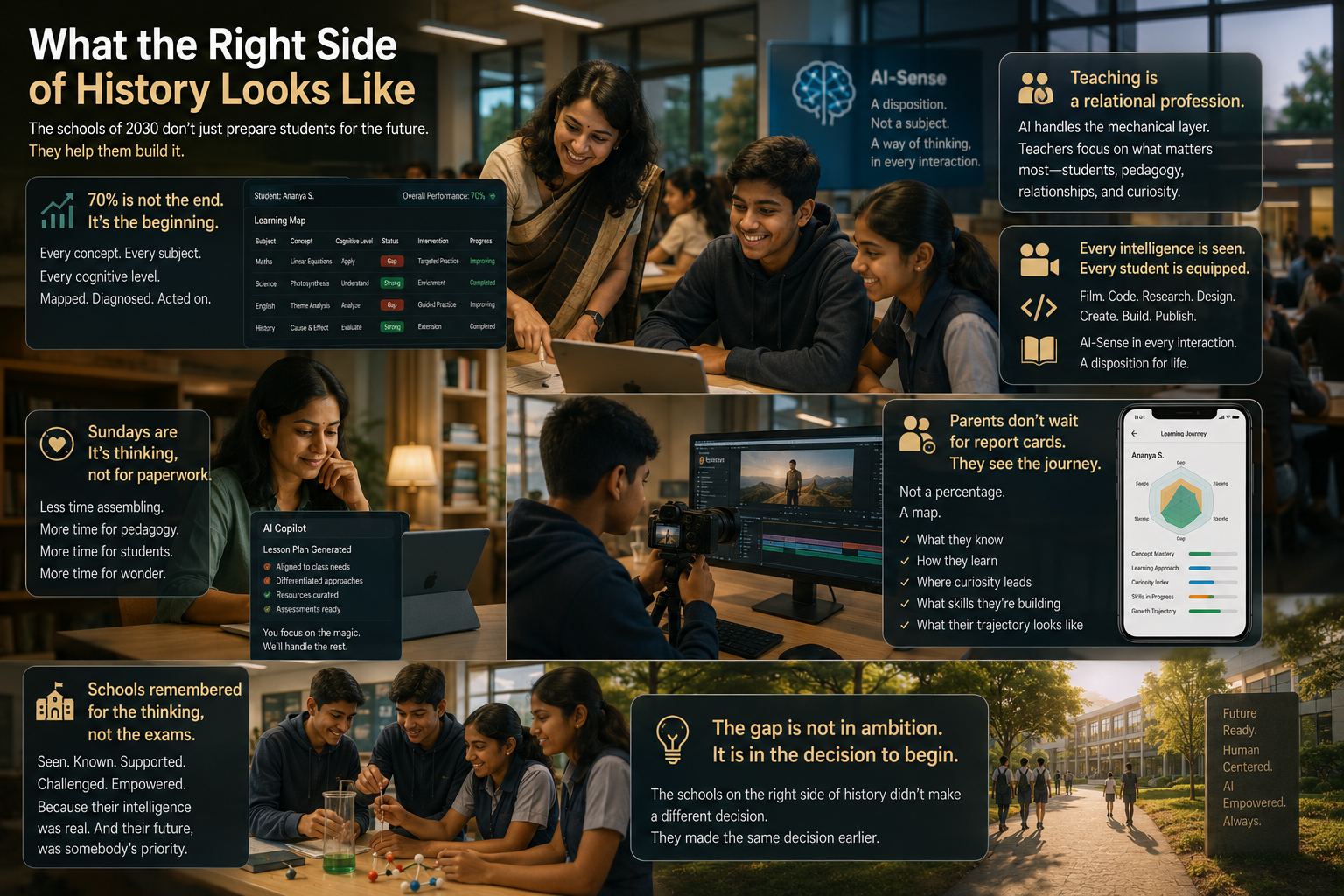
I want to offer you a vision of what the schools that are on the right side of this history will look like in 2030.
They will be schools where a student who scores 70% consistently is not described as a mid-performing student with no specific concerns. They will be schools where that student's teacher has a dashboard that shows, specifically, which concept in which subject at which cognitive level is producing that performance, and what the targeted intervention is, and whether the intervention is working. They will be schools where the 70% is not the end of the story. It is the beginning of a conversation about what comes next.
They will be schools where a teacher does not spend her Sunday evening assembling lesson materials. She spends it thinking about how to teach — about the specific students who need specific approaches, about the pedagogical move that will unlock the concept that has been resistant, about the relationship that needs tending and the curiosity that needs feeding. They will be schools where teaching is not an administrative function with moments of genuine connection. It is a relational and pedagogical profession with AI handling the mechanical layer.
They will be schools where a student whose intelligence expresses itself through film or code or original research has an environment that sees that intelligence and gives it tools. Where the student who thinks in films can make films. Where the student who builds can build. Where the student who researches can publish. Where AI-Sense is not a subject that is taught in isolation but a disposition that is developed through every interaction a student has with AI throughout their school career.
They will be schools where parents do not wait for a report card four times a year to understand how their child is learning. They will be schools where the answer to "how is my child doing?" is not a percentage. It is a map of what the child knows, how they learn best, where their curiosity is running, what skills they are developing, and what their trajectory looks like.
They will be schools that the children who attended them remember not because of the examinations they passed but because of the thinking they developed. Because they were taught, by teachers empowered by AI to teach rather than to administer, that their intelligence was real and specific and capable of things that the world needed. Because the school saw them — specifically, individually, continuously — and acted on what it saw.
That is what the right side of history looks like. And the distance between your school as it is today and that vision is not as large as it might feel. The gap is not in ambition. It is in the decision to begin.
The schools on the right side of history did not make a different decision. They made the same decision earlier.
Eight years ago, I sat in a room in Hyderabad with a team of people who cared deeply about education and technology, and we asked what seemed like a simple question: why are Indian schools so far behind on digital adoption, and what would it take to close that gap?
We have learned, in the years since, that the question was not quite right. The right question is not about adoption. It is about transformation. The schools that have changed are not the schools that adopted technology. They are the schools whose teachers, students, parents, and leaders were transformed by the experience of seeing education work the way it always should have worked — specifically, individually, continuously, and with genuine belief in every child's capacity.
That transformation is what we are in the business of. Not the platform. Not the subscription. The transformation.
And I want to tell you something I believe with the certainty that comes from eight years of building, failing, learning, and building again: the transformation is possible for your school. It is possible for the government school in a Tier 2 city with unreliable internet and teachers who have never used AI tools. It is possible for the international school in Hyderabad with 28 nationalities and parents who expect real-time data and boards who demand evidence. It is possible for the network of four campuses whose founder built the first one on intimacy and watched intimacy get harder to maintain as the network grew.
It is possible because the technology is not the constraint. The technology is solved. The constraint is the decision. And the decision is yours.
Make it. Not next term. Not after the board meeting in July. Not after the competitive school down the road announces something that forces your hand. Make it because the children in your school deserve the decision to be made for them, now, by the leader they trusted with their education.
This is the moment. You are the person. The children are not waiting.
With deep respect for the work you do and deep belief in what it can become,
Chiranjeevi Maddala Founder, AI Ready School
If you have read all thirty posts in this series, you have spent time with the data, the philosophy, the case studies, the product explanations, the economic analysis, the predictions, and the origin story. You know more about AI in education than most school leaders in India. You know enough to make a good decision.
If this is the first post you have read, the thirty that preceded it are available at AI Ready School's blog. Each one was written to give school leaders one specific piece of the argument for AI adoption done right. Together, they constitute the most complete case for responsible AI in Indian schools that we know how to make.
Either way, the case has been made. The question that remains is what you do with it.
AI Ready School provides a complete AI ecosystem for K-12 schools: Cypher (personalised learning companion), Morpheus (AI teaching agent), Zion (safe AI tool suite), NEO (AI Innovation Labs), and Matrix (sovereign AI infrastructure). Human First. AI Next. Always.
The consultation is free. The conversation is honest. The decision is yours.
To book your consultation today, reach out at hey@aireadyschool.com or call +91 9100013885.
Human First. AI Next.™

.png)