
Chiranjeevi Maddala
June 11, 2026
Anthropic has released Claude Fable 5, the most capable AI model the company has ever made available to the general public — and simultaneously told the world it considered the model too dangerous to release without structural restrictions. The launch is the most consequential AI governance event of 2026, not because of the benchmarks, but because of the decision architecture Anthropic built around them. Every school leader in India should understand what happened, why it happened, and what it means for the AI tools their students are using today.
Source: Anthropic — anthropic.com/news/claude-fable-5-mythos-5
What Was Shared
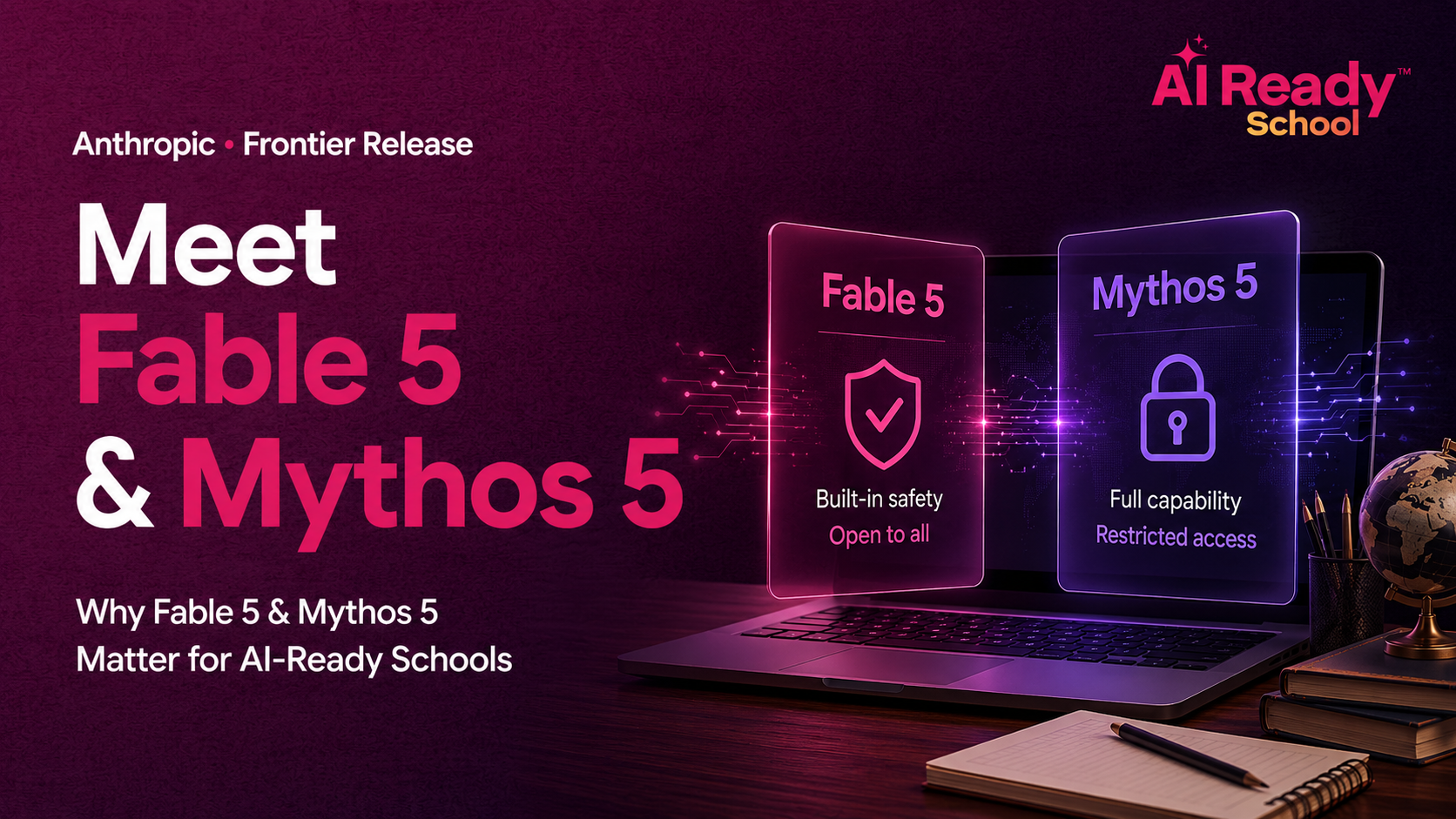
Anthropic launched two models on June 9, 2026. Claude Fable 5 is the publicly available version — a Mythos-class model with safety classifiers applied, available to anyone through the Claude API, Amazon Bedrock, Vertex AI, Microsoft Foundry, and GitHub Copilot. Claude Mythos 5 is the same underlying model with the cyber safeguards lifted, available only to vetted partners in Project Glasswing — government cybersecurity teams, critical infrastructure operators, and select life sciences researchers.
The naming itself carries the explanation: Fable is from the Latin fabula, meaning "that which is told." Mythos is the raw capability. The safeguards are what distinguish the two. Same brain. Two entirely different levels of access.
Pricing for both models is $10 per million input tokens and $50 per million output tokens — less than half the price of Claude Mythos Preview, the restricted-only model Anthropic released in April. Fable 5 is free to Pro, Max, Team, and seat-based Enterprise subscribers through June 22. From June 23, it moves to usage-based pricing via usage credits, with Anthropic committing to restore it as a standard subscription feature as quickly as capacity allows. Developers can access the model via the API model string claude-fable-5.
The Technical Capabilities
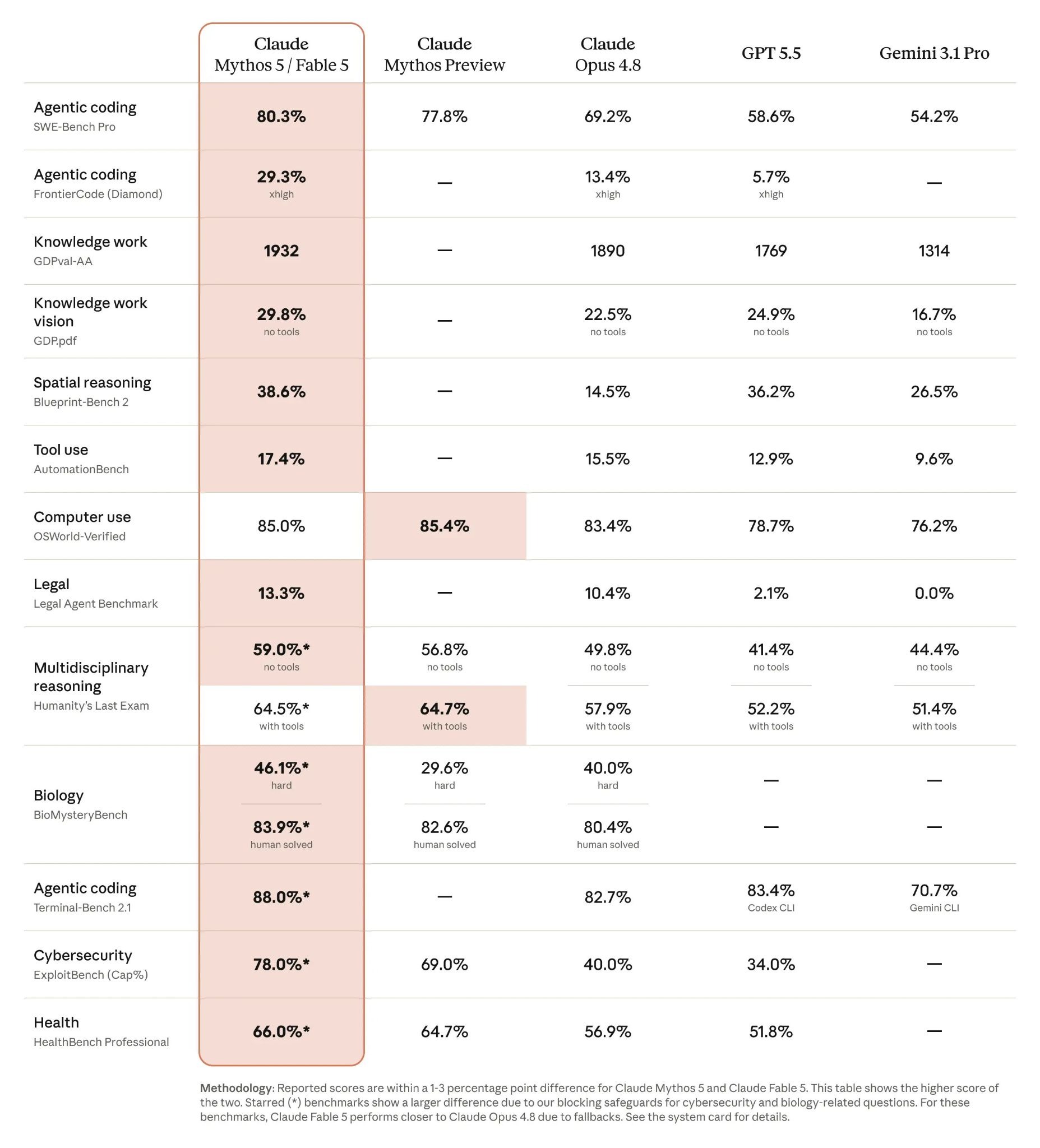
Fable 5 and Mythos 5 have a one million token context window and support 128,000 maximum output tokens. They are state-of-the-art on nearly all tested benchmarks of AI capability, with exceptional performance across software engineering, knowledge work, vision, scientific research, and long-running autonomous tasks. The longer and more complex the task, the larger Fable 5's lead over Anthropic's previous models.
On software engineering, Stripe reported during early testing that Fable 5 compressed months of engineering into days — performing a codebase-wide migration across a 50-million-line Ruby codebase in a single day that would otherwise have taken a whole team over two months by hand. On Cognition's FrontierCode evaluation, which tests whether models can pass difficult coding tasks while meeting the standards of high-quality production codebases, Fable 5 scores highest among frontier models even at medium effort.
On knowledge work, Fable 5 achieves the highest score of any model on Hebbia's Finance Benchmark for senior-level reasoning. On vision, it is the new state-of-the-art — able to rebuild a web application's source code from screenshots alone, and capable of completing Pokémon FireRed using only raw game screenshots with no maps, navigation aids, or additional tools, something that required complex helper harnesses in earlier Claude models.
On memory and long-context tasks, Fable 5 stays focused across millions of tokens in long-running tasks and improves its outputs using its own notes. When tested on the deck-building game Slay the Spire with access to persistent file-based memory, Fable 5 improved its performance three times more than Opus 4.8 did under the same conditions.
On life sciences, using Mythos 5, Anthropic's internal protein design experts accelerated aspects of the drug design process by approximately ten times. In one example, Mythos 5 — with protein design and bioinformatics tools but no human assistance — matched or beat skilled human operators at tasks normally completed by scientists, including choosing binding sites, selecting and running protein design tools, and recovering from failures. Nine of fourteen protein targets yielded strong drug design candidates currently under investigation.
The Safety Architecture: Why This Release Is Different From Every Previous One
The capabilities are extraordinary. What distinguishes this release from every previous frontier model launch is the governance architecture built around them.
In April 2026, Anthropic released Claude Mythos Preview but refused to make it publicly available, stating that the model's cybersecurity capabilities were too powerful for unrestricted access. That was not a marketing position. It was a genuine governance decision — one of the few times a frontier AI company has publicly said it had built something it would not release to everyone. The two months between April and June were spent building, testing, and validating the classifier architecture that makes Fable 5 possible.
Fable 5 ships with a new set of classifiers: separate AI systems that detect potential misuse — including jailbreak attempts — and prevent the main model from responding. When classifiers detect a request related to cybersecurity, biology and chemistry, or distillation, the response is automatically handled by Claude Opus 4.8 instead. Users are informed when this occurs. Anthropic's early data shows that more than 95% of Fable sessions involve no fallback at all — for those sessions, Fable 5's performance is effectively the same as that of Mythos 5.
Anthropic red-teamed these classifiers extensively. An external bug bounty produced no universal jailbreaks in over 1,000 hours of testing. External red-teaming organisations also failed to find universal jailbreaks on long-form agentic tasks — though the UK AISI made progress toward one within a brief initial testing window. On the most rigorous external test, Fable 5 complied with zero harmful single-turn requests relating to planning a cyberattack, exploit development, or defence evasion, whether or not the requests used any of 30 different public jailbreak techniques.
The distillation classifier addresses a separate risk: large-scale attempts to extract Claude's capabilities to train competing models. Requests flagged as distillation attempts fall back to Opus 4.8. Fable 5 and Mythos 5 also carry a new data retention policy — 30-day retention for all traffic on Mythos-class models on both first- and third-party surfaces. Anthropic states this data will not be used to train new Claude models and will be deleted after 30 days in almost all cases. The retention is specifically to defend against complex and novel attacks operating across many requests.
Why This Matters for AI-Ready Schools
This release is not primarily a technology story. It is a governance story. And governance is the subject that AI education in India most urgently needs to address.
The dual-model architecture is the most important AI curriculum case study of 2026. The Fable 5 and Mythos 5 release is a live, publicly documented demonstration of Constitutional AI in practice — a framework built on the principle that AI systems can be designed with inbuilt values that shape their behaviour across every interaction. For students in NEO AI Innovation Labs studying how AI governance works, this is not a theoretical case study. It is the frontier of responsible AI deployment, happening in public, this week. The question of how you make the most capable AI model also the most responsibly deployed one is the central question of AI-Sense education.
The classifier-gated safety model is the standard every school should hold their AI vendors to.
The most important question a school leader should ask any AI vendor is not what the tool can do. It is how safety is built into the architecture, not the policy. The difference between an AI tool that has a safety policy and an AI tool that has a safety architecture is the difference between a promise and a structure. Anthropic's classifiers work at the model level — they do not rely on users following rules. Cypher's interaction architecture and Zion's content filtering layer follow the same principle: safety built into the generation layer, not bolted on as content moderation after the fact. The Fable 5 release validates this approach at the frontier of AI development.
The one million token context window changes what personalised learning can be. A context window of one million tokens means an AI can hold a complete, untruncated record of a student's learning history in active memory during a single session. The learner profile that Cypher builds continuously across every student interaction — tracking Knowledge, Learning Style, Cognitive Behaviour, and Skills — becomes architecturally more powerful when the underlying model can process that complete profile without approximation or summarisation.
The pricing signal is relevant for every school calculating AI infrastructure costs.
At $10 per million input tokens and $50 per million output tokens — double the previous Opus pricing — Fable 5 represents a meaningful increase in the per-token cost of AI at the frontier. For schools using cloud-based AI tools that charge per interaction, the cost of AI-powered learning at scale increases proportionally. Matrix's on-premises infrastructure, which runs AI processing locally without per-token API charges, becomes economically more significant as frontier model pricing continues to rise.
The "AI too dangerous to release without restrictions" moment belongs in every school's AI curriculum.
Anthropic released Fable 5 in the same period it warned the global AI community that systems are advancing so rapidly they may soon achieve recursive self-improvement — the ability to improve themselves without human direction. Students who will enter the workforce between 2030 and 2035 will inhabit a world in which the questions Fable 5 raises — how capable should the most powerful publicly available AI be, who should have unrestricted access to it, and what happens when it exceeds human ability to oversee it — are not abstract philosophical concerns. They are policy questions, governance questions, and professional questions. AI-Sense education, as defined in the Thinking 2.0 framework, is preparation for exactly this reality.
The most important lesson from the Fable 5 release is not what the model can do. It is that the people who built it decided, publicly and specifically, what it should not be allowed to do — and built a structure to enforce that decision. That decision-making process is what every student preparing for an AI-shaped world needs to understand.
Human First. AI Next.™