
Chiranjeevi Maddala
April 18, 2026
A government school in Chhattisgarh with no prior exposure to personalised learning technology. An international school in Hyderabad running IB and Cambridge simultaneously. Partner schools in Uzbekistan operating in a different language, culture, and infrastructure reality. The same platform. Fundamentally different outcomes for every student in every context.
There is a question every serious education leader asks before committing to an AI platform — and it is not the question the vendor demo is designed to answer. The demo shows you a feature. The question is:does this actually work in my context?
It is the right question. A government school in Raipur and an IB school in Hyderabad are not the same institution. They serve different students, operate on different boards, run with different infrastructure levels, and measure success against different outcomes. An AI platform that works beautifully in one and fails in the other has not solved the problem of AI in education. It has solved the problem of AI in one type of school — which is a far smaller achievement than it sounds.
The question of context adaptability is also, quietly, the most important question for India's AI education mandate. The government's AI and computational thinking mandate starting 2026–27 covers every CBSE, KVS, and NVS school in the country — from elite private schools in metros to government schools in villages where reliable internet is not guaranteed. Any platform that cannot serve both ends of that spectrum is not a platform for India's education system. It is a platform for part of it.
This blog is about what genuine scalability looks like in practice — not as a feature claim but as a documented reality across three very different implementation contexts where AI Ready School has been deployed, measured, and shown to work.
B.P. Pujari Government School, Raipur, Chhattisgarh
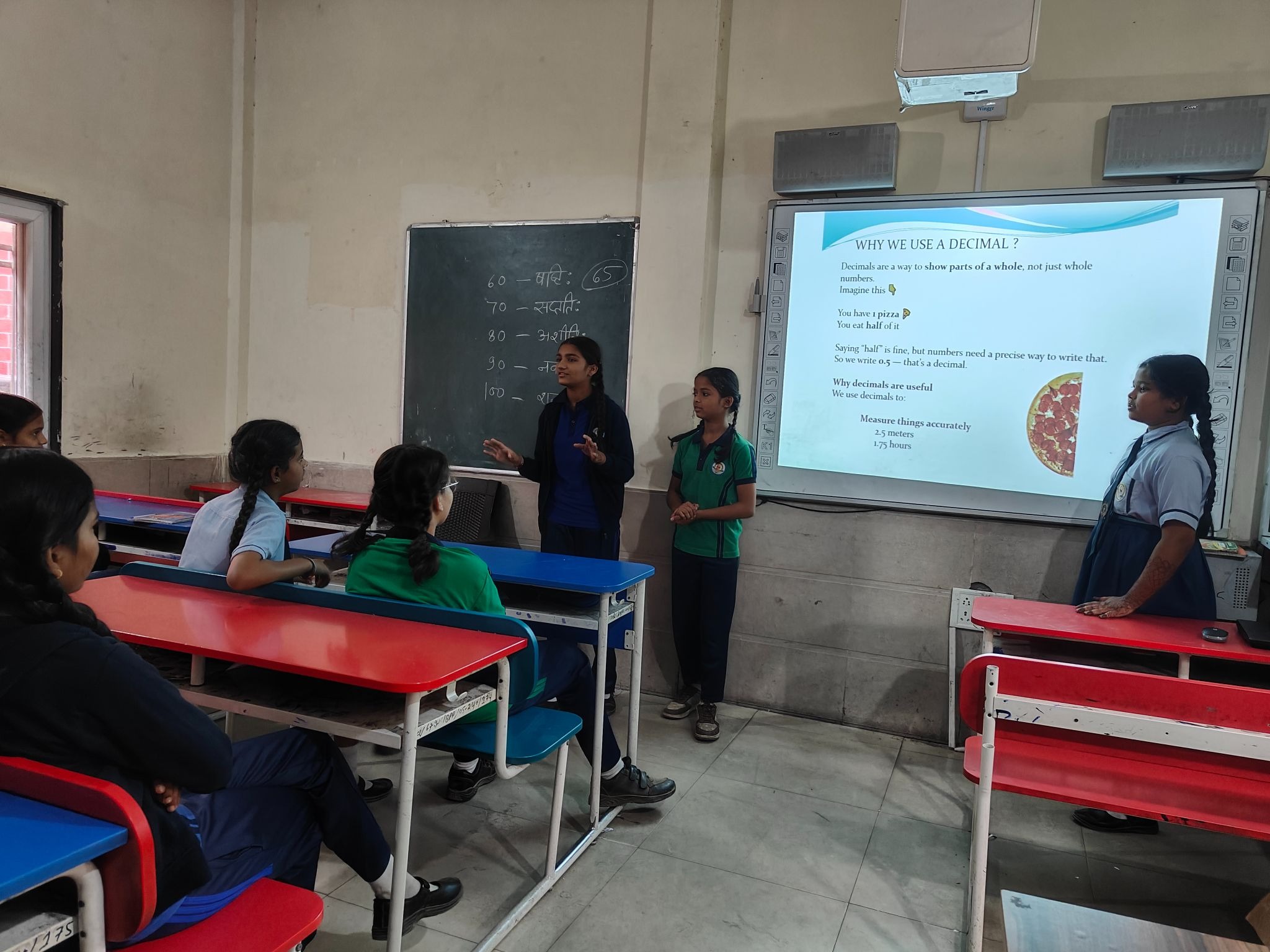
Walk into B.P. Pujari Government School in Raipur and you will find something that contradicts almost everything the edtech industry assumes about AI adoption. The students had no prior exposure to personalised learning technology. The school infrastructure was basic. The teachers had limited experience with AI tools. And yet this is the implementation that produced the numbers most schools with far greater resources have not come close to matching.
In February 2026, the results from a structured intervention in a Grade 7 mathematics classroom were documented and published. The 34% improvement in final class scores compared to the baseline assessment. 57% improvement in application-level cognitive tasks. 77% improvement in analysis-level cognitive tasks—the tasks that measure what students can do independently, under examination conditions, without any AI assistance.
Prior to implementation, students in Grade 7 Mathematics had no exposure to personalised learning technology. Class sizes were large, differentiation was nearly impossible at scale, and foundational gaps from previous years had gone undetected and unaddressed.
The intervention used Cypher, AI Ready School's personalised learning companion, in a flipped classroom model where students were asked not just to learn but to teach. Groups were assigned sub-topics, asked to create presentations, design assessments, and teach their peers. Cypher functioned as a learning companion that helped students clarify concepts, generate examples, and reflect on their understanding — without ever doing their thinking for them.
The platform ran on the school's existing infrastructure. The curriculum was aligned to CBSE standards. The language of instruction was adapted to the local context. The teacher did not need to become an AI expert — Morpheus handled the lesson preparation and monitoring while she focused on facilitation.

What makes the Raipur results significant is not just the numbers. It is the type of gains. The 77% improvement in analysis-level tasks — the highest-order cognitive category in Bloom's taxonomy — came from students who had no prior experience with AI-assisted learning. It came not from the AI answering their questions but from a design that made them answer each other's questions, with the AI as a scaffold rather than a solution.
As documented in our research on how AI-enabled flipped classrooms drove a 34.5% improvement in learning outcomes, the mechanism was clear: students learn best when they are responsible for teaching, not just receiving. Cypher made that model possible at a government school with basic infrastructure. That is the point.
International Schools in Hyderabad — Multi-Curriculum, Multi-Nationality
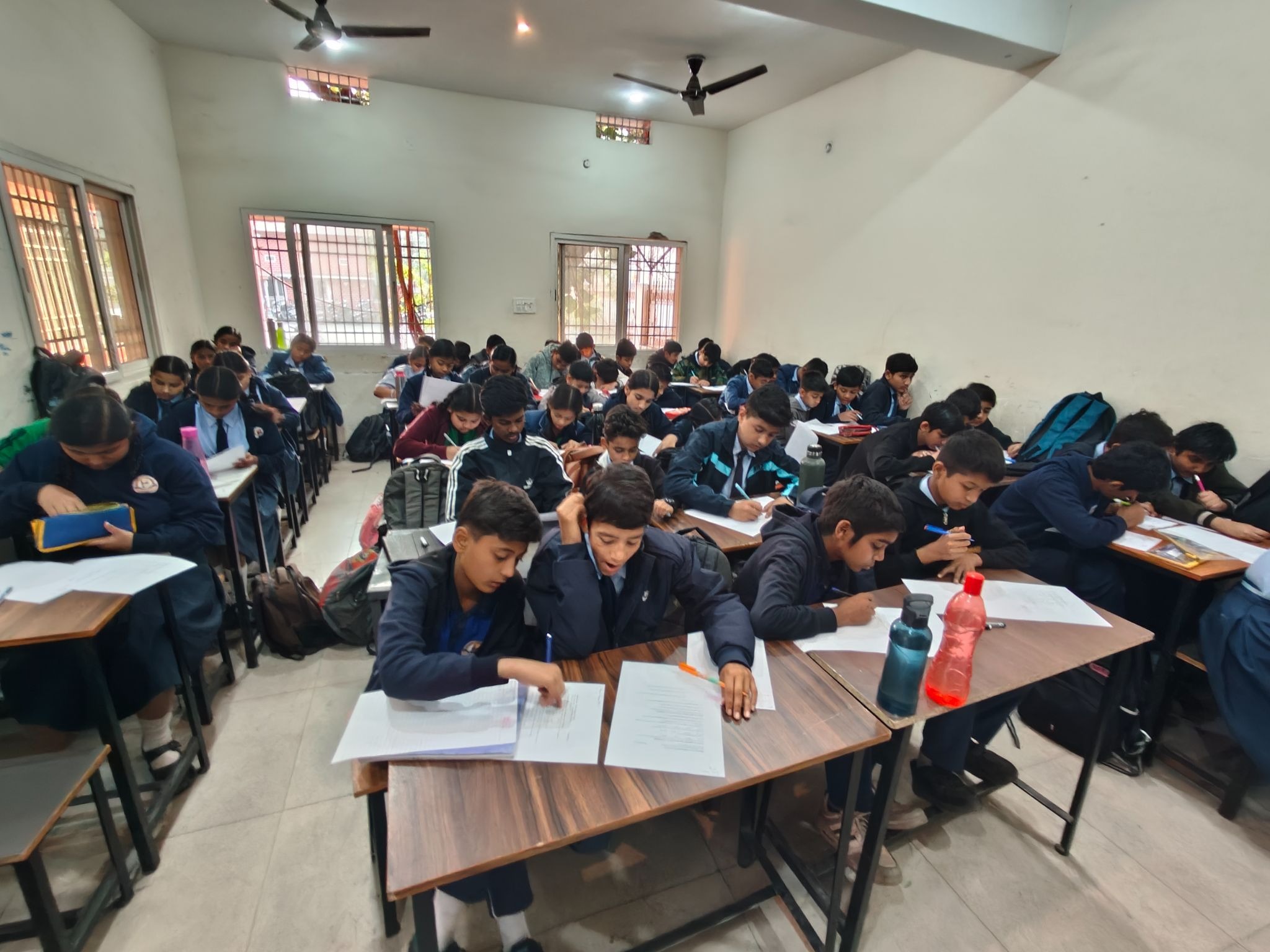
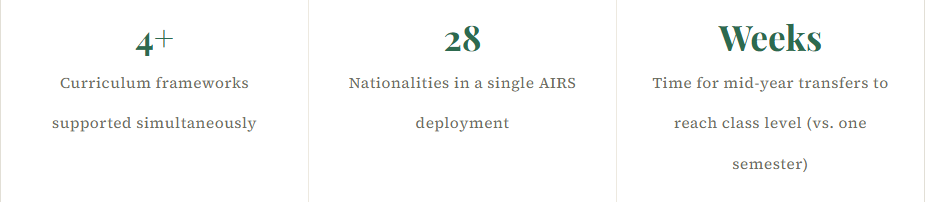
The challenge in Hyderabad's international school environment is almost the opposite of the one in Raipur. Here, the problem is not a lack of resources. It is complexity. Schools running IB and Cambridge simultaneously, students from 28 nationalities, teachers joining mid-year from eleven different countries, and students transferring in from different curriculum backgrounds who need to be integrated into a school that cannot stop to accommodate them.
This is the context that the use case of Ms Priya Nambiar, director of an IB World School in Hyderabad, captures precisely. Three to five experienced teachers leave every year and are replaced by teachers who have never worked in India before. When an experienced teacher leaves, they take with them an institutional knowledge of their students that exists nowhere in writing. New teachers start from scratch. Students pay the price during the transition.
The institutional memory problem is one of the most underacknowledged challenges in international schooling. Every student's knowledge state, learning style, interaction history, and progress trajectory lives in AIRS – so a new teacher inheriting a class doesn't start from scratch. They start from a complete, continuously updated picture of every student they are about to teach.
For mid-year transfer students — like Marcus, 13, who moved from a British curriculum school in Singapore to an IB school in Hyderabad in October — AIRS maps their knowledge state against the new school's specific sequence within weeks. Cypher builds a silent catch-up track running alongside regular classes. No remedial group. No visible separation. By February, the knowledge graph looks like the rest of the class.
The platform handles CBSE, ICSE, IB, Cambridge, and state board curricula simultaneously. A student moving between frameworks does not fall through the gap between them — the system maps both and identifies the precise points of divergence.
The adaptability here is not about switching modes. It is about the depth of curriculum knowledge built into the platform. When a teacher at a CBSE school in Raipur configures a lesson in Morpheus, the system knows the CBSE framework, the NCERT textbook sequence, and the specific chapter they are working on. When a teacher at an IB school in Hyderabad does the same, it knows the IB framework, the unit planner structure, and the assessment criteria. These are not the same configurations with different labels. They are distinct knowledge architectures built for each system.
This matters because generic AI tools have no curriculum alignment. When a teacher prompts ChatGPT with "Create a lesson plan for photosynthesis, Grade 7, IB," the output is generic — it does not know the IB programme, the unit planner, the learner profile requirements, or what the class covered last month. Morpheus starts from context. That is the difference between a tool and a system.
Partner Schools in Uzbekistan — Cross-Border, Cross-Language
In 2025, AI Ready School began working with partner schools in Uzbekistan. This is a fundamentally different operational context — a different language, a different educational culture, a different infrastructure reality, and a different relationship between students and authority in the classroom. What remained constant was the core problem: students arriving at each stage of their education with knowledge gaps that the system had not detected, teachers spending most of their time on work that did not require their best capabilities, and school leaders making decisions without the real-time learning intelligence they needed.
The Uzbekistan implementation produced a case study that our blog on teaching with AI: analysing teen mobile usage in Uzbekistan documents. The pedagogical approach — using AI to move students from passive consumers to active researchers — translated across the language and cultural boundary because the underlying learning science does not change with geography.
Uzbekistan's educational context has several distinctive features. The language of instruction shifts between Uzbek, Russian, and English depending on the school and subject. Infrastructure in smaller cities is comparable to India's Tier 2 and Tier 3 cities — functional but not high-bandwidth. The curriculum framework is different from CBSE or IB, requiring full reconfiguration of the platform's knowledge architecture for the local system.
Cypher's multilingual capability — it communicates through audio and responds in audio, making it accessible across India's diverse linguistic landscape — proved directly transferable. The platform's ability to function on local infrastructure rather than requiring high-bandwidth cloud connectivity was equally important. This is precisely the reason our Matrix sovereign AI infrastructure product was designed — to give schools the AI capability they need without depending on external cloud providers that may not have reliable reach in their geography.
The teachers in Uzbekistan who engaged in our AI workshops found that the pedagogical shift — from "AI as answer machine" to "AI as thinking companion" — required the same reorientation as it does in India. The platform did not need to be rebuilt. The professional development model translated directly.

What Makes Context-Adaptability Possible
Most AI education platforms are not context-adaptable. They are context-specific. They work for the type of school their founders went to or the type of school that their first major customer happened to be. The assumption that what works in one context generalises to others is rarely tested and frequently wrong.
The platform's adaptability across Raipur, Hyderabad, and Uzbekistan is not an accident. It is the result of three deliberate architectural decisions that distinguish AI Ready School from tools built for a single context.
The principal question that every education chain operator, international school network, and government education department should ask any AI vendor is the one from our Principal's Checklist: 'Show me how this works in a school like mine, with a student like mine, producing data I can act on.' Not a generic demo. Evidence from a comparable context.
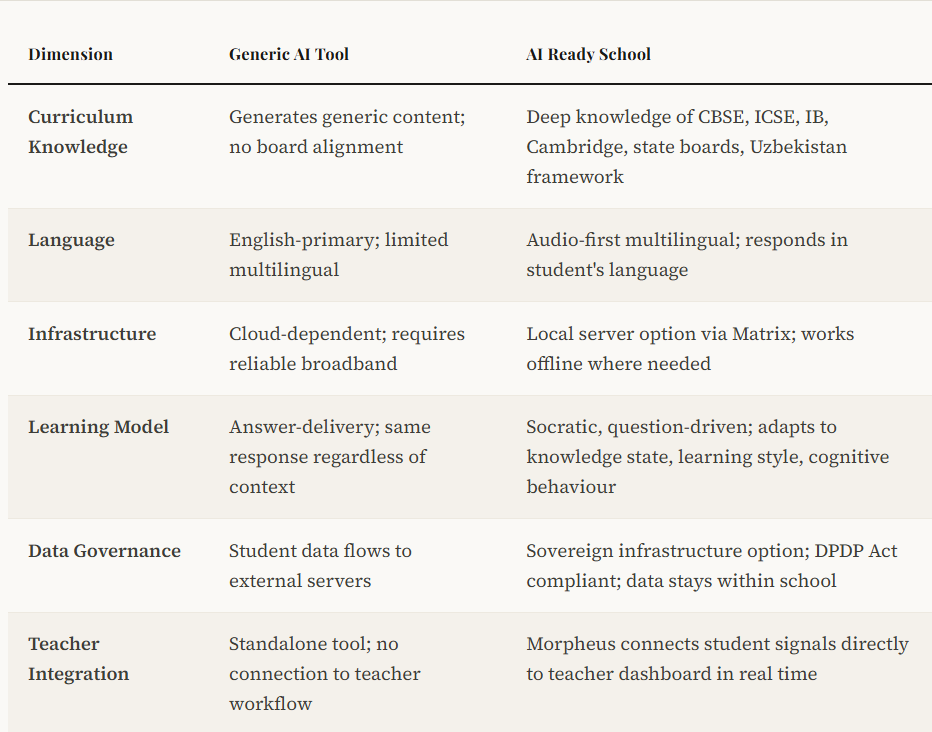
India's AI curriculum mandate covers every school in the country — from elite private schools in metro cities to government schools in Tier 3 towns where 42% of students cannot access reliable internet at home. A platform that works only for the former is not a platform for India. It is a platform for the top 15% of India's school ecosystem. The mandate requires the other 85% to be served too — which means the infrastructure, curriculum alignment, language, and pedagogical model must all be configurable to wildly different realities. That is the standard AI Ready school was built to meet.
What Stays the Same Across Every Context
The implementation in Raipur looks different from the implementation in Hyderabad, which looks different from the implementation in Uzbekistan. The board is different. The language is different. The infrastructure level is different. The student population is different.
What does not change is the philosophy. As articulated in our post on why our philosophy matters more than our technology, the fundamental conviction underlying every AI Ready School implementation is that AI should make students think — not give them answers. That conviction does not change with the board, the language, or the infrastructure level.
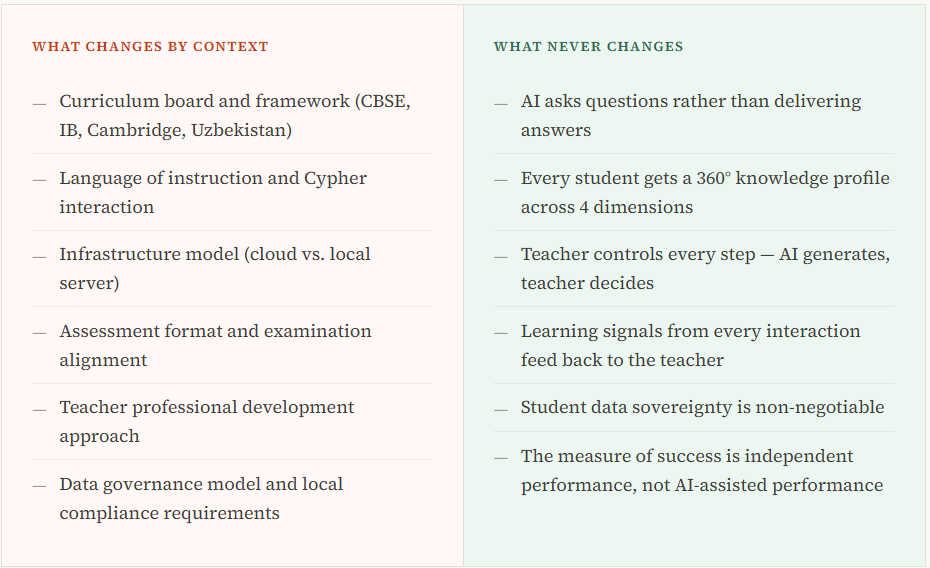
This is why the results in a government school in Raipur and an international school in Hyderabad are different in scale but consistent in direction. The platform adapts to context. The philosophy does not. And it is the philosophy — not the technology — that produces the outcomes.
The five areas where AI creates maximum impact in schools are not unique to any curriculum, language, or infrastructure context. Personalised learning at scale. Teacher productivity. Formative assessment. Early intervention. AI skilling. These are universal needs. The platform's job is to meet them wherever a school exists — not where it is convenient for the vendor to reach.
Scaling Quality Across Campuses Without Losing What Made the First School Work
The story of Deepa Menon—who built her first school in Kochi on intimacy and quality and has watched both get harder to maintain as she expanded to four campuses and 4,200 students—captures the central challenge of education chain operations. The thing that made the first school exceptional was that she knew every teacher, walked every classroom, and could feel the school's quality. That intimacy is gone at four campuses. It is impossible at ten.
AIRS becomes quality infrastructure for chains. A consistent, school-wide intelligence layer that works across all campuses simultaneously—comparing learning outcomes not just by exam results but also by knowledge-state trajectories, engagement patterns, and intervention effectiveness. The intimacy of a single-campus school, replicated by data that behaves like presence.
For government education departments considering system-wide deployment, the Raipur case provides the evidence base. The platform works without high-end infrastructure. It works with teachers who are new to AI. It works for students who have never interacted with a personalised learning system before. The 34% overall improvement and 77% higher-order thinking gains are not the result of optimal conditions. They are the result of standard government school conditions — which is precisely what makes them meaningful for a department evaluating AI adoption at scale.
The Uzbekistan implementation is significant not just as a proof of cross-border scalability but as a signal about where AI education is heading globally. India's AI mandate is being watched closely by education departments across South Asia, Central Asia, and the Middle East. The questions those departments ask — about curriculum alignment, language, infrastructure, data sovereignty, and pedagogy — are the same questions Indian schools ask. A platform that has already answered them across three distinct contexts has a head start that is difficult to replicate quickly. At the India AI Impact Summit 2026, delegations from more than 100 countries attended. The education conversations happening in those delegations are not theoretical. They are active procurement conversations.
What Scalability Actually Requires
We have been direct in previous posts about why piecemeal AI adoption fails schools, about the research showing that most AI tutors make students weaker, and about why AI should make children think rather than give them answers. We apply the same standard to our own scalability claims.
Genuine scalability across diverse contexts requires four things that most platforms do not have:
First, deep curriculum knowledge — not just content generation. Generating a lesson plan about photosynthesis is not curriculum alignment. Knowing the CBSE Grade 7 Science textbook sequence, the specific learning objectives for Chapter 2, the typical misconceptions students bring to that chapter, and how it connects to Chapter 4 – that is curriculum alignment. This requires years of knowledge engineering, not weeks of API integration.
Second, infrastructure independence. A platform that requires stable broadband excludes every school in India's Tier 3 cities and rural areas, every government school, and every international school in a geography where connectivity is variable. Our Matrix sovereign infrastructure product exists specifically because this is not a minor consideration—it is the condition that determines whether AI education is equitable or whether it simply extends the advantage of already-advantaged schools.
Third, a pedagogy that works regardless of context. The Socratic method — asking questions that lead students to construct understanding rather than receive it — works in Grade 7 Maths in Raipur and in IB Chemistry in Hyderabad and in Uzbekistan secondary school Physics. The learning science behind how the brain actually learns does not vary by geography. A platform built on that science travels.
Fourth, teacher empowerment rather than teacher replacement. In every context — government school, international school, Central Asian partner school — the teacher is the most important variable. A platform that sidelines teachers fails regardless of context. A platform that makes teachers more capable succeeds everywhere. This is why Teacher First is not a marketing position for AI Ready School. It is a design constraint.
The mandate is clear. The timeline is compressed. The implementation contexts are diverse. The platform that scales across all of them — not just the convenient ones — is the platform that is actually building the future of education, rather than the future of education for the lucky few.
If you lead an education chain, an international school network, or a government education department, the conversation worth having is not about whether AI belongs in your schools. That question has been settled — by the research, by the mandate, and by the reality that your students are already using AI tools that were not built for them. The question is whether the AI your schools adopt was built to work in your context, at your scale, for your students.
To see how AI Ready School answers every question on this checklist, we invite you to compare AI Ready School against your checklist with our team. Bring your questions. We will bring the evidence.
AI Ready School provides a complete AI ecosystem for K-12 schools, including Cypher (personalised AI learning companion), Morpheus (AI teaching agent), Zion (safe AI tool suite), NEO (AI Innovation Labs), and Matrix (sovereign AI infrastructure). Built to answer every question on this checklist.
To schedule a checklist walkthrough with our team: hey@aireadyschool.com or +91 9100013885.
Human First. AI Next.™

.png)