
Chiranjeevi Maddala
May 29, 2026
You have done the research. You have read the case studies. You have spoken to other principals who have implemented AI and heard what it produced. You are convinced. Now you have 20 minutes in front of your board, and everything you have learned has to fit into a format that people who are not educators, have not read the research, and are responsible for the financial and legal health of the institution can understand, evaluate, and approve. This blog gives you that format.
The gap between a principal who knows AI adoption is the right decision and a board that approves it is not a gap in evidence. It is a gap in translation. The evidence is strong. The case studies are documented. The outcomes are measurable. But evidence that is presented in the wrong format, to an audience whose primary concerns are not pedagogical, in a conversation that has not been adequately prepared, produces hesitation rather than approval even when the underlying case is sound.
This blog is not about how to persuade a skeptical board. It is about how to give a well-prepared board the specific information it needs to make a good decision confidently. The distinction matters because the approach is different. Persuasion optimises for overcoming resistance. Information optimises for enabling good judgment. Boards that feel they are being persuaded become more resistant. Boards that feel they are being given the information they need to exercise their fiduciary responsibility become more engaged and more constructive in their questions.
A board that approves AI adoption because it was genuinely informed is a board that will continue to support the implementation when the inevitable challenges arise. A board that approves because it was persuaded is a board whose approval is conditional on everything going well — which no implementation can guarantee.
The goal of the board presentation is not approval. It is informed approval. The difference determines how much support you have when you need it most.
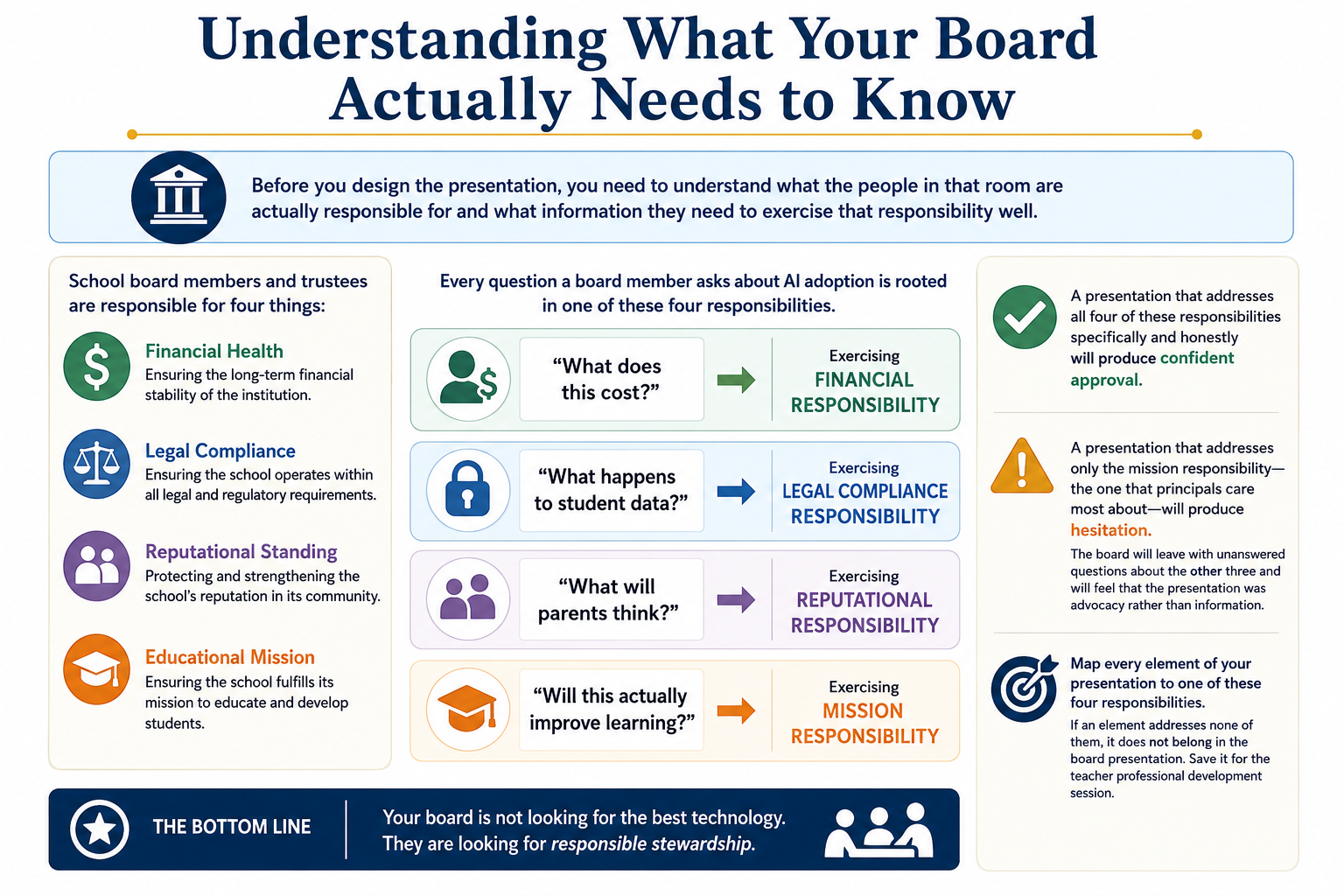
Before you design the presentation, you need to understand what the people in that room are actually responsible for and what information they need to exercise that responsibility well.
School board members and trustees are responsible for four things: the financial health of the institution, the legal compliance of its operations, the reputational standing of the school in its community, and the fulfilment of the school's educational mission. Every question a board member asks about AI adoption — whether they ask it directly or hold it in reserve — is rooted in one of these four responsibilities.
The board member who asks "what does this cost?" is exercising financial responsibility. The board member who asks "what happens to student data?" is exercising legal compliance responsibility. The board member who asks "what will parents think?" is exercising reputational responsibility. The board member who asks "will this actually improve learning?" is exercising mission responsibility.
A presentation that addresses all four of these responsibilities specifically and honestly will produce confident approval. A presentation that addresses only the mission responsibility — the one that principals care most about — will produce hesitation, because the board will leave with unanswered questions about the other three and will feel that the presentation was advocacy rather than information.
Map every element of your presentation to one of these four responsibilities. If an element addresses none of them, it does not belong in the board presentation. Save it for the teacher professional development session.
The most effective board presentation for AI adoption has six components, each of which can be presented in three to four minutes for a total of 20 minutes. The sequence matters. Follow it.
Component 1: The Problem (3 minutes)
Begin with the problem, not the solution. The board will engage more deeply with a solution if they have first been given a specific, honest account of the problem it addresses.
The problem has three dimensions that are all relevant to your board's four responsibilities. The educational dimension: what is your school currently unable to do for students that it should be able to do, and what is the evidence that this inability is producing real consequences? Use your own school's data where possible — assessment trends, remedial program demand, teacher retention patterns — rather than general statistics.
The competitive dimension: what is happening in your peer schools and how does your current position compare? This is relevant to both financial and reputational responsibility. Boards understand competitive positioning. The school that is behind its peer group on a capability that parents are beginning to ask about is a school with a reputational and admissions risk that is as real as any financial risk.
The regulatory dimension: what does India's Ministry of Education's AI curriculum mandate require, and what is your school's current compliance status? This is directly relevant to legal compliance responsibility and it creates a timeline that converts a discretionary decision into a compulsory one. The board that understands the mandate exists is the board that frames the question not as "should we adopt AI?" but as "how do we implement AI in a way that serves our students rather than merely complying with the requirement?"
Component 2: The Solution (3 minutes)
Describe AI Ready School's platform in terms of what it does for the four stakeholder groups the board cares about — students, teachers, parents, and the school as an institution — rather than in terms of its features.
For students: personalised learning that identifies and addresses the specific gaps that traditional assessment misses. For teachers: time savings on mechanical tasks that return hours to the relational and pedagogical work that defines the profession. For parents: real-time visibility into their child's learning that replaces report cards four times a year with continuous, specific information. For the school: evidence-based management intelligence that allows the board itself to see what is happening in learning outcomes rather than relying on end-of-year examination results.
Do not demonstrate the platform in the board presentation. Platform demonstrations are for principals and teachers who will use the tools. Board members need to understand what the platform produces, not how it works. If a board member asks for a demonstration, offer a separate session with the implementation team — do not derail the board presentation with a product walkthrough.
Component 3: The Evidence (4 minutes)
This is the component that most principals under-prepare. The evidence component should contain three things: documented outcomes from comparable implementations, evidence from your own school's baseline that establishes what you are trying to improve, and an independent source that is not AI Ready School.
Documented outcomes from comparable implementations means the Raipur case study — 34% improvement in final class scores, 57% improvement in application-level tasks, 77% improvement in analysis-level tasks — presented with full context. The board needs to know this was a government school in Chhattisgarh, not a premium urban school. That context makes the evidence more impressive, not less, because it establishes that the outcomes are achievable in resource-constrained environments.
Your own baseline data means the specific measurements you took before the presentation — teacher time allocation, current assessment trends, parent satisfaction scores, remedial program demand — that establish what you are comparing against. Without a baseline, the board cannot evaluate projected improvements. With a baseline, projected improvements become specific predictions that the board can hold you accountable for.
An independent source means a research reference that is not produced by AI Ready School — the OECD, Stanford HAI, the World Economic Forum, or the ASER report — that establishes the size of the educational problem you are proposing to address. This demonstrates that your decision is grounded in the broader evidence base rather than in vendor claims.
Component 4: The Cost (3 minutes)
Be specific, comprehensive, and honest. The board needs the total cost of ownership — subscription, infrastructure, implementation support, and opportunity cost of teacher time — rather than the platform subscription alone. A presentation that understates costs produces approval followed by uncomfortable conversations when additional costs become visible.
Present the cost against the return. Use the ROI framework from AI Ready School's economics analysis: teacher time savings quantified as an opportunity cost, reduced remedial program demand quantified against current remedial spending, parent retention improvement quantified against annual fee revenue, and admissions differentiation quantified conservatively. The board that sees a specific, calculated return against a specific, comprehensive cost is the board that can make a financial decision with confidence.
For schools in Tier 2 and 3 cities or government school contexts where Matrix infrastructure is relevant, include the three-year total cost of ownership that shows how the upfront infrastructure investment compares to ongoing cloud subscription costs. The three-year number is usually more compelling than the Year 1 number.
Component 5: The Risk and Mitigation (4 minutes)
This is the component that most principals omit and most boards are waiting for. The board's job is risk management. A presentation that does not address risk forces board members to raise risks themselves — in a less structured and less constructive format than you would have used if you had raised them first.
There are four risks that every board will have in mind and that you should address directly.
Data privacy risk: what student data is processed, where it is stored, who has access to it, and how it is governed under the DPDP Act 2023. This risk is completely mitigated by Matrix on-premises infrastructure and substantially mitigated by AI Ready School's DPDP-compliant cloud deployment framework. Say this specifically.
Implementation failure risk: what happens if the implementation does not produce the outcomes projected? Address this by describing the 90-day pilot structure and the outcome measurement framework. The board that knows you have defined success criteria before the implementation begins and that the first significant investment is a bounded pilot rather than a full deployment is a board that understands its downside is limited.
Teacher resistance risk: what happens if teachers do not engage with the platform? Address this directly using the framework from Day 33 — the three forms of resistance and how each is addressed. The board that knows you have thought about this specifically is the board that is reassured rather than the one that raises it as an objection.
Reputational risk: what happens if parents react negatively to AI in the school? Address this by describing your parent communication strategy — the proactive, specific communication that you will conduct before the implementation begins — and by referencing the parent satisfaction data from schools that have communicated well.
Component 6: The Decision You Are Asking For (3 minutes)
The most common board presentation mistake is not being specific about what you are asking the board to decide. A presentation that ends with "we would love your thoughts on moving forward with AI adoption" has not asked for a decision. It has invited a discussion that may or may not produce one.
Be specific. You are asking the board to approve a 90-day pilot implementation with a defined budget, defined success criteria, and a defined review point at Day 90 where the full deployment decision will be made with 90 days of outcome data. You are not asking them to approve the full implementation today. You are asking them to approve a bounded, evidence-generating pilot that will give them the specific data they need to make the full deployment decision well.
This framing does three things. It reduces the perceived risk of the decision — approving a pilot is less consequential than approving a full deployment. It creates a natural accountability structure — the Day 90 review means the board is not approving something it will not revisit for a year. And it demonstrates that you share the board's commitment to evidence-based decision-making rather than advocacy-based decision-making.
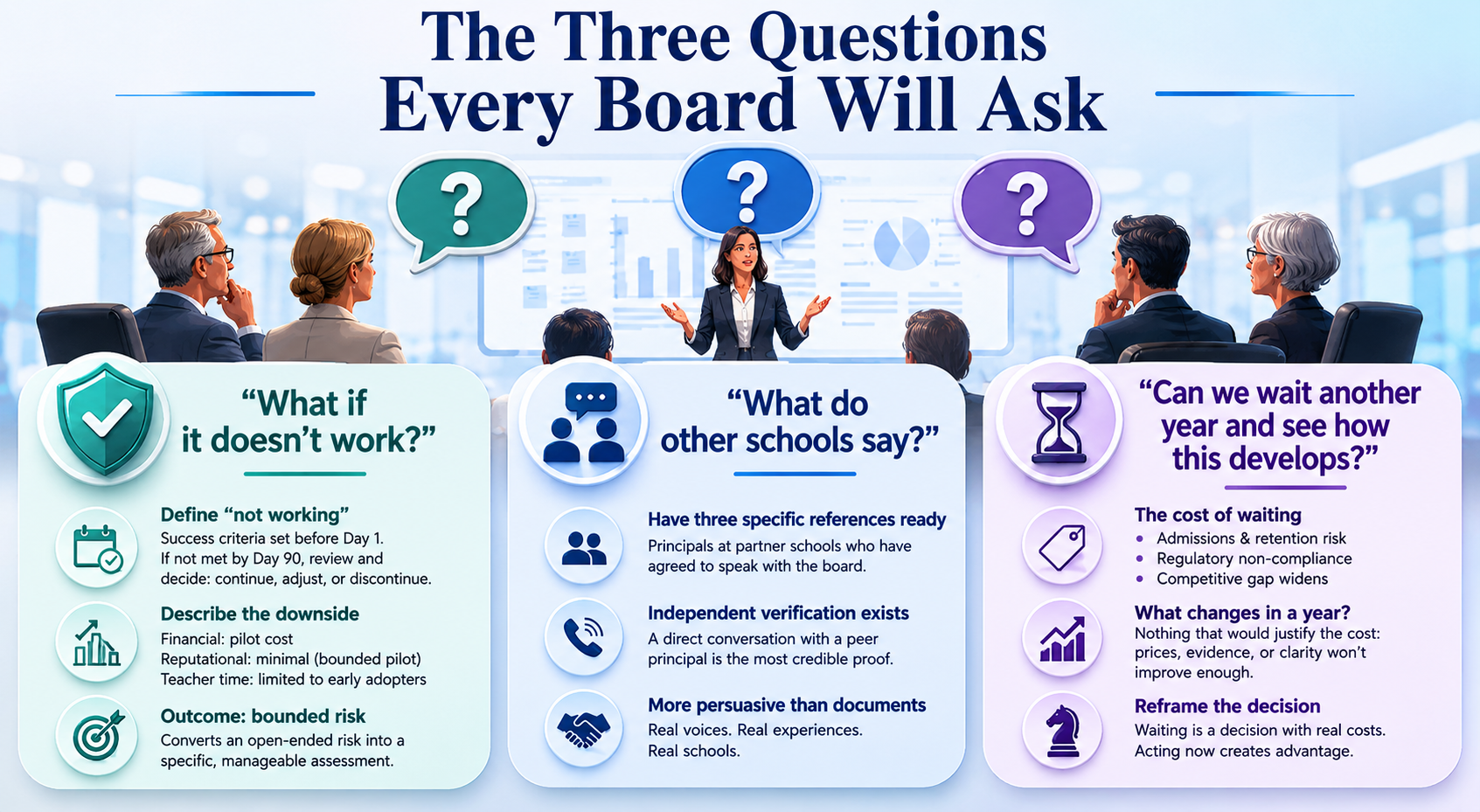
Regardless of how well you have prepared, three questions will come up in almost every board presentation. Prepare for them specifically.
"What if it doesn't work?"
The answer to this question has two parts. First: define what "not working" means. The pilot has defined success criteria established before Day 1. If those criteria are not met by Day 90, the board reviews the evidence and decides whether to continue, adjust, or discontinue. The school does not continue an investment that is not producing outcomes. Second: describe what the downside is. The financial downside of a 90-day pilot that does not produce outcomes is the pilot cost. The reputational downside is minimal because the pilot was bounded and the school communicated its experimental intent to parents. The teacher time downside is real but limited to the early adopter cohort. This framing converts an open-ended risk question into a specific, bounded risk assessment.
"What do other schools say?"
Have three specific references ready. Not testimonials from the AI Ready School website. Names of principals at partner schools who have agreed to speak to your board if asked. The board member who asks this question is asking whether independent verification exists. Offering a direct conversation with a peer principal is the most credible form of independent verification available and is far more persuasive than any case study document.
"Can we wait another year and see how this develops?"
This question requires the most careful handling because it is reasonable on its surface and consequential in its implication. The honest answer has two components. First: what the cost of waiting is. Not in philosophical terms but in specific terms — the admissions and retention consequence of being behind peer schools in a capability that parents are beginning to ask about, and the regulatory consequence of being non-compliant with a mandate that is already in effect. Second: what changes in a year that would make the decision easier. In almost every case, the answer is nothing that justifies the cost of waiting. Prices will not decrease significantly. Evidence will not become substantially stronger. The competitive gap with early-adopting schools will widen. This reframing — from "why not wait?" to "what specifically would be better about deciding in a year?" — often produces the recognition that waiting is itself a decision with real costs.
The presentation itself is only part of the preparation. Four things done before the formal presentation significantly improve its outcome.
Have individual conversations with key board members before the meeting. The board member who hears the AI adoption proposal for the first time in a formal board meeting is in a different position from the board member who has had a 15-minute informal conversation about it in the preceding week. Informal pre-conversations allow board members to ask the questions they would be embarrassed to ask in a formal setting, understand the framing before they have to respond to it publicly, and come to the formal meeting already having processed their initial reactions. This dramatically reduces the adversarial dynamic that sometimes develops in formal board settings.
Identify your board ally. Every board has one or two members who are more open to educational innovation, more familiar with technology, or more aligned with the school's growth ambitions. Have a deeper conversation with this person before the meeting. They will not advocate for you in the meeting — that would be inappropriate — but they will ask constructive questions rather than skeptical ones, and constructive questions create space for you to present your evidence rather than defend your position.
Brief your board chair. The board chair controls the meeting and the quality of the conversation. A chair who has been briefed on the proposal, who understands the structure of what you are presenting, and who has agreed on the decision you are asking for is a chair who will manage the meeting in a way that produces a decision rather than a discussion. Without this briefing, the meeting can drift into a general conversation about AI in education that ends without a specific decision.
Prepare your implementation team. Have AI Ready School's implementation team available for a follow-up call or meeting if the board approves the pilot but wants specific technical questions answered before funds are released. The proposal that can be followed immediately with a technical briefing from the implementation team is the proposal that moves from approval to action in days rather than weeks.
If the board approves: confirm the specific decision in writing within 24 hours. What was approved, what budget was allocated, what the success criteria for the 90-day pilot are, and when the Day 90 review is scheduled. This written confirmation prevents the ambiguity that produces scope creep and budget disputes later.
If the board requests more information: treat this as approval with conditions rather than as rejection. Identify specifically what information would address the board's concerns, commit to a timeline for providing it, and confirm a date for the follow-up discussion. Do not let "we need more information" become an indefinite deferral.
If the board declines: ask for the specific concern that drove the decision and address it directly in the follow-up. Most board declines of AI proposals are not rejections of the principle but rejections of the presentation — a financial concern that was not adequately addressed, a data governance question that was not answered specifically, a risk that was not acknowledged. Understanding the specific concern converts a rejection into a more specific proposal for the next meeting.
A board that declines a well-prepared proposal is giving you information about what they need to approve it. Use that information.
AI Ready School provides a trustee-ready board presentation template as part of every implementation consultation. The template includes the six-component structure described above, the ROI calculation framework for your school's specific size, the data governance documentation for DPDP Act compliance, and the 90-day pilot proposal language that frames the decision as a bounded, evidence-generating commitment.
To get our board presentation template or to discuss your school's board presentation strategy, reach out at hey@aireadyschool.com or call +91 9100013885.
Get Our Board Presentation Template
Human First. AI Next.™

.png)