
Chiranjeevi Maddala
June 16, 2026
CBSE Circular Acad-15/2026 isnot a pilot. It is a mandate. From the 2026–27 academic year, every one ofIndia's 32,900-plus CBSE-affiliated schools must deliver Computational Thinkingand AI to students from Class 3 upward — 50 hours per year for Classes 3–5, and100 hours per year for Classes 6–8. The curriculum was developed by an expertcommittee of IIT Madras, MNIT Jaipur, and Azim Premji University faculty andformally launched by Union Education Minister Dharmendra Pradhan at VigyanBhawan in April 2026. The ambition is real, the timeline is now, and the stakesare national. The only variable that determines whether this reform succeeds orbecomes another chapter in India's long history ofpolicy-without-implementation is the teacher. And the teacher is not ready.
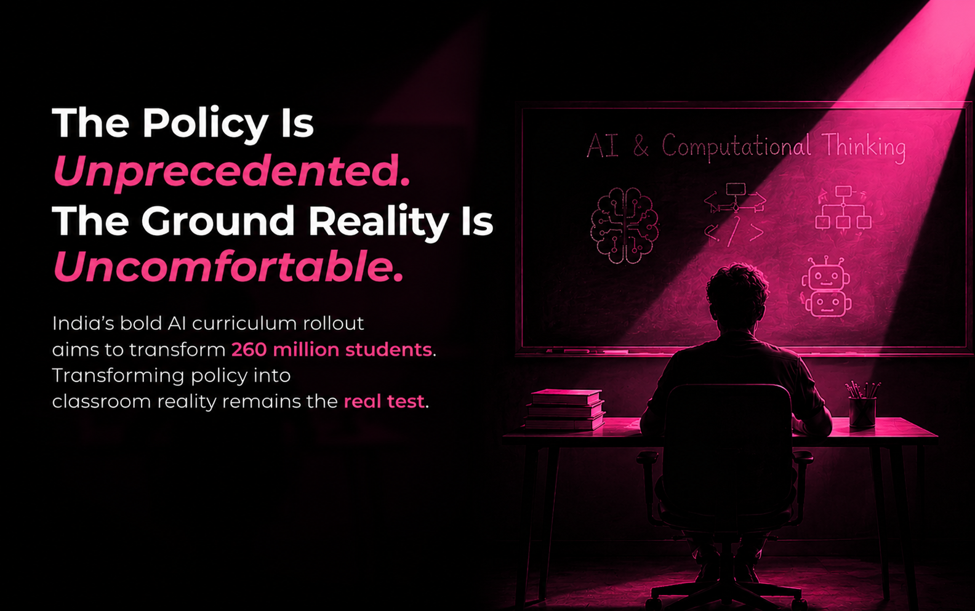
India has 1.5 million schools, more than 10million teachers at the primary and secondary levels, and over 260 millionstudents enrolled across the system. These are not statistics that invite smallthinking. When India decides to integrate AI and Computational Thinking intothe national curriculum from Class 3, it is not announcing a boutique programmefor elite urban institutions. It is attempting the largest transformation of aschool curriculum in the country's post-independence history.
The policy architecture is clear. CBSE's AI& CT curriculum for Classes 3–8 is structured around five competencygroups: foundational CT skills — decomposition, pattern recognition,abstraction, and algorithmic thinking — in Classes 3–5, moving to advanced CT,AI concepts, interdisciplinary projects, and AI ethics in Classes 6–8.Computational Thinking is embedded into Mathematics and The World Around Us. AILiteracy is treated as a distinct thread under Computer teachers. For Classes 9and 10, AI becomes a compulsory subject from 2027–28, eventually becoming afull elective specialisation in Classes 11 and 12. The curriculum is not aboutteaching children to write Python. It is about developing a generation of youngpeople who can think with AI — who understand what it can and cannot do, whoapproach problems with structured reasoning, and who can make ethical judgmentsabout technology that will govern every domain of their adult lives.
The policy is also explicit about teacherpreparation. CBSE Circular Acad-18/2026, issued on April 9, confirmed thatStudent and Teacher Resource Books are live on cbseacademic.nic.in. DistrictLevel Deliberations (DLDs) are now a formal CPD activity carrying 3 to 6 CPDhours each. The NISHTHA programme — National Initiative for School Heads' andTeachers' Holistic Advancement — has been designated as the primary vehicle fortraining delivery, with video-based modules and grade-specific content as its coremethodology. Additionally, the SOAR (Skilling for AI Readiness) initiative,already operating across over 18,000 CBSE schools for Classes 6–8, will beexpanded. The government's commitment, in language, is unambiguous.
The gap between that language and theclassroom is where the real story lives.
According to a 2025 survey by the DigitalEmpowerment Foundation, only 15 percent of educators across India are currentlyAI-fluent. India has approximately 10 million school teachers. That meansroughly 8.5 million teachers need structured, sustained, genuinelytransformative training before they can meaningfully deliver the AI & CTcurriculum to the students now sitting in their classrooms.
The government has acknowledged the gapdirectly. Sanjay Kumar, Secretary in the Union Ministry of School Education andLiteracy, noted at the stakeholders' meeting where the curriculum was presentedthat India currently lacks the qualified AI professionals — estimated at morethan 1.2 million — required to conduct high-scale training at this pace. TheIndia Skills Report 2026, published by ETS in collaboration with CII and AICTE,found that AI Model & Application Development and AI Literacy are now thehardest skills to fill across India's talent market, with AI Literacy cited by38 percent of employers as a critical shortage. India commands 16 percent ofthe global AI talent pool — a number expected to reach 1.25 million qualifiedprofessionals by 2027. But those professionals are entering industry, notclassrooms.
Globally, the picture is no morereassuring. A 2026 survey of educators across multiple countries found that 66percent of teachers report having received no formal training on using AI ineducation. In the United States — a country with significantly moreinfrastructure investment in teacher professional development than India — 96percent of K–12 teachers reported receiving no professional development ortraining related to AI. If the most resourced education systems in the worldhave not solved this, India cannot assume that awareness-level NISHTHA moduleswill do it either.
The question is not whether the gap isreal. It is definitively real. The question is what kind of interventionactually closes it — and what kind of intervention only looks like it does.
NISHTHA is an extraordinary logisticalachievement. It is the world's largest capacity-building teacher trainingprogramme, reaching tens of millions of teachers through the DIKSHA platformwith video-based modules in multiple languages. The programme has demonstratedthat India can move information to teachers at scale. That is a genuine andsignificant capability.
The limitation of NISHTHA is structural,not operational. Video modules and online assessments produce a specificoutcome: a teacher who has been exposed to a concept and can recall it in aquiz. What they do not reliably produce is a teacher whose classroom practicehas changed. The distinction between these two outcomes is the entire problem.
A teacher who has completed a NISHTHAmodule on AI and Computational Thinking knows what decomposition is. They candefine algorithmic thinking. They can describe what a machine learning modeldoes in conceptual terms. What they do not yet know is how to walk into theirClass 5 Mathematics lesson on Monday morning and teach pattern recognitionthrough activities that feel natural in their specific classroom, with theirspecific students, using the resources actually available to them.
That knowledge — the knowledge of howrather than what — cannot be delivered through a video. It is built throughrepeated, specific, personalised practice supported by tools that make theteacher's pedagogical identity the starting point rather than a constraint tobe worked around. And India's 8.5 million under-prepared teachers are not goingto receive that kind of support from NISHTHA alone.
The readiness gap is not aknowledge gap. It is a confidence and practice gap. And those are not closed bythe same interventions.
Dimension 1: The private-governmentdivide is enormous and widening. India's government schools educate nearly70 percent of the country's enrolled students. They are also the schools whereinfrastructure access, digital device availability, reliable electricity, andteacher professional development support are lowest. The government schoolteacher in Chhatarpur or Outer Delhi who is asked to deliver 50 hours of AI andComputational Thinking to Class 5 in 2026–27 faces a fundamentally differentchallenge from the private school teacher in Hyderabad with a computer lab, atechnology coordinator, and a functioning broadband connection. Most of the AIteacher training tools and content available in India today were designed forthe latter. The 70 percent are being served with solutions built for the 30percent.
Dimension 2: Subject teacher identityhas not been addressed. The new CBSE framework is explicit that AI and CTshould not be a standalone subject — it must be integrated across Mathematics,The World Around Us, Science, and Social Studies. Subject teachers — notcomputer teachers — are responsible for embedding CT into their existinglessons. This is a profound pedagogical shift. A Mathematics teacher who hasspent 20 years teaching arithmetic through conventional problem sets is nowasked to surface the pattern recognition and abstraction in that content andframe it through a Computational Thinking lens. Without tools that help them dothis in a way that feels continuous with their existing approach rather thanimposed on top of it, the integration will be cosmetic.
Dimension 3: Professional trust has notbeen earned. India's teachers have experienced multiple rounds ofeducational technology reform. Interactive whiteboards. Tablet programmes. MOOCaccess. Each arrived with institutional enthusiasm and each, in mostimplementations, required teachers to absorb the cost of learning a new systemwhile delivering no durable improvement to what happened in their classroom.The question for any new AI tool or training programme entering Indian schoolsin 2026 is not whether it has good content. It is whether it has earned theright to ask a teacher to change their practice — by demonstrating, quickly andspecifically, that it makes the teacher's Tuesday better than their Monday.
In February 2026, the Ministry of Educationorganised the Bharat Bodhan AI Conclave in New Delhi — a two-day convening ofpolicymakers, state governments, researchers, philanthropic institutions, andEdTech innovators to deliberate on AI-driven transformation in education. Theconclave was notable not only for who attended but for the four specificpriorities it foregrounded: foundational literacy and numeracy, teachereffectiveness, governance efficiency, and multilingual inclusion.
Teacher effectiveness was not anafterthought. It was one of four structural pillars. The Ministry understandsthat curriculum without teacher capacity is architecture without foundations.What the conclave also revealed is that the government is actively seekingecosystem partners — it cannot train 10 million teachers through centralinitiative alone and knows it. NISHTHA will deliver awareness at scale. Whatschools need alongside NISHTHA is specific, tool-level,classroom-practice-level support that operates at the level of the individualteacher in their individual context.
Separately, Microsoft announced in February2026 that India would be the first country in Asia to receive its Elevate forEducators programme — a commitment to train two million teachers across 200,000schools by 2030, with all 75 CM Shri schools in Delhi as an early adoptercohort. The entry of a technology company at this scale signals both the sizeof the opportunity and the scale of the gap. Two million trained teachers by2030 is a meaningful number. It is also, against a base of 10 million teacherswith a 2026–27 implementation deadline, a number that underscores how muchremains to be done, and how urgent the need is for solutions that can operateat school level, term by term, rather than waiting for a multi-year nationalprogramme to reach them.
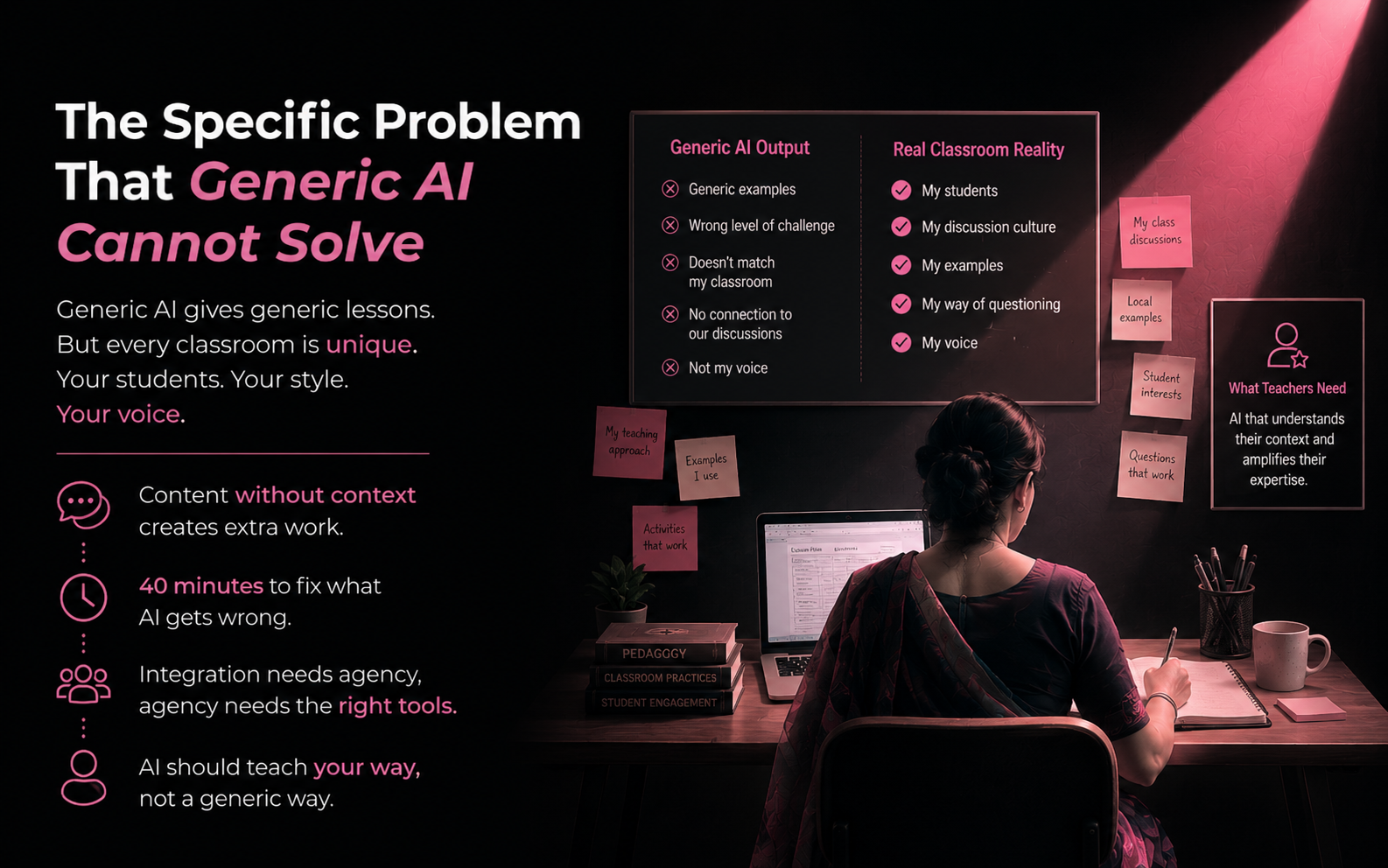
There is a common experience among Indianteachers who have tentatively engaged with general-purpose AI tools for lessonplanning. They type in their board, grade, subject, and chapter. The outputarrives: comprehensive, well-formatted, and immediately recognisable assomething that was written for no one in particular. It does not reflect theway that teacher runs their classroom. It does not account for the specificdiscussion culture they have spent years building. It does not carry theirvoice — the examples they use, the level of challenge they know their class canhandle, the way they frame a question to make it accessible without making ittrivial.
The teacher now has two options. They canadopt the output as it stands — which requires them to teach in a way thatfeels foreign, and which students will notice is somehow not quite right. Orthey can spend 40 minutes reshaping it until it sounds like them, at whichpoint the AI has increased their workload rather than reduced it. Neitheroutcome builds confidence. Neither reduces the preparation burden the mandatehas just doubled.
This is the design failure at the heart ofmost EdTech AI responses to the teacher readiness challenge. Tools were builtaround content — the what of teaching — and missed the most important variablein the room. The how. The teacher's pedagogical identity. The way they havelearned, through years of practice with specific students in specific schoolsin specific communities, to create the conditions in which those students learnbest.
The AI & CT mandate requiresintegration across subjects. Integration across subjects requires teacheragency. Teacher agency requires tools that teach the teacher's way, not ageneric way. This chain of dependencies is the reason that the mandate's successcannot be decoupled from the question of which tools Indian schools choose togive their teachers.
This is the precise problem that Morpheus, AI Ready School’s AITeaching Agent, was designed to solve. And the solution is not a feature. It isan architectural decision about what the starting point of AI-assisted lessonpreparation should be.
Most AI teaching tools allow educators tospecify what to teach. Board, grade, subject, chapter. The output is generatedto those specifications. This is useful. It is not what closes the readinessgap.
Morpheus allows educators to specify howthey teach — and then holds every output it generates to that specification.The Teaching Methods feature allows a teacher to encode their pedagogicalidentity as a directive. A teacher who favours inquiry-based learning encodesthat; every Morpheus lesson plan begins with a real-world phenomenon or problembefore the concept is named. A teacher who uses Socratic questioning encodesthat; every Morpheus question set is designed to reveal thinking rather thantest recall. A teacher whose school has adopted a specific differentiatedinstruction framework encodes that; every assessment Morpheus generates iscalibrated to multiple learning levels from the outset.
The AI teaches their way. Not a genericway. Not a curriculum committee's standardised way. The teacher's way.
This matters for the readiness gap becauseconfidence in AI and professional identity are the same thing in the teachingprofession. A teacher who feels that the AI is producing outputs that soundlike them — that reflect the judgments they have developed through years ofpractice — is a teacher whose anxiety about AI is replaced by ownership of it.And a teacher who owns a tool uses it, improves it, and advocates for it. Thatis the only version of AI adoption that is durable.
Jayesh Agrawal, PGT Physics at NH GoelWorld School in Raipur, had a specific and long-standing challenge: his mosteffective lessons were built around observable physical phenomena before theformal concept was introduced. Students who needed the concrete anchor firstwere consistently left behind by lessons that opened with the abstraction.Generic AI-generated lesson plans arrived concept-first every time. WithMorpheus encoding his phenomenon-first approach as a Teaching Method directive,every Morpheus Physics lesson he generates now begins with the observable,questionable, investigable experience. The formal concept follows. His studentswho needed that sequence still need it. Now they have it, reliably, in everylesson.
Mansi Sharma, TGT English at the sameschool, described her experience plainly: "I used to spend every Sundayevening preparing lesson materials for Monday. Now I spend that time thinkingabout how to actually teach the lesson — not just assembling it." Thedistinction she draws — between assembling content and thinking about pedagogy— is the distinction that generic AI misses entirely. It is also thedistinction that determines whether AI in Indian schools produces betterteachers or simply more efficient content generators.
For the government school context — wherethe AI & CT mandate is most challenging and most consequential — themultilingual capability built into Morpheus addresses a reality that most AItools ignore: students in Chhattisgarhi, Hindi, or Telugu-medium schools arebeing asked to engage with concepts in a language that is not the languagetheir understanding is built in. A teacher who can generate content thatscaffolds concept development in the student's first language beforetransitioning to the formal language of assessment is not using a nice-to-havefeature. They are addressing the single largest determinant of whether the AIcurriculum actually lands or simply passes over the students it was designed toserve.
And at the school leadership level,Morpheus's Teaching Methods feature is not only an individual teacher tool. Aschool leadership team that has invested in a specific pedagogical framework —inquiry-based learning, Project Based Learning, Visible Thinking Routines — canencode that framework at the school level. Every teacher on the platformgenerates content that is already aligned with the school's educationalphilosophy. The 2026–27 mandate does not just require teachers to teach AI. Itrequires school systems to function as coherent pedagogical units. Morpheus isan architecture for that coherence.
The AI & CT curriculum mandate is not asingle-subject problem. It is a whole-school transformation challenge. Andtransformation at that scale requires a coherent ecosystem of tools, not asingle product decision.
Morpheus addresses the teacher’spedagogical identity. Cypher, AIReady School’s AI-powered active learning companion, addresses the student’scognitive development by asking better questions rather than providing fasteranswers — a design principle that maps directly onto the mandate’s own ambitionto develop “critical thinkers” and move students from being technology users tobeing reasoners about technology. Zion,a governed suite of 30-plus AI tools built specifically for school-agelearners, gives students a safe, curriculum-aligned environment for AI-assistedlearning that the teacher has full visibility over — addressing the dataprivacy requirements of India’s Digital Personal Data Protection Act 2023 whilemaking the AI tools accessible rather than blocked. And Matrix, AI Ready School’son-premises AI infrastructure, ensures that none of this is contingent onreliable external connectivity — a non-trivial consideration in the 42 percentof government schools that fall outside India’s 63 percent national internetconnectivity figure.
The architecture works because it wasdesigned around the most important variable in any education reform equation.Not the content, not the technology, not the policy framework. The teacher. Ateacher who is supported — whose professional identity is respected by thetools they are given, whose preparation burden is genuinely reduced, and whosestudents' learning is made legibly visible through real-time monitoring — is ateacher who can deliver the AI & CT curriculum not as compliance but asconviction.
The mandate is live. CBSE CircularAcad-15/2026 launched in April. The 2026–27 academic year has begun. Thequestion for every school principal and trustee in India is not whether to act.It is how to act in a way that produces durable change rather than expensivecompliance.
The first question to ask is not which AItool to procure. It is which teachers are ready and which are not —specifically, in their own classrooms, with their own subjects, at their ownschools. Readiness is not a binary. It is a spectrum, and the schools that willsucceed are the ones that know where their teachers sit on that spectrum andhave a specific, tool-level plan to move them.
The second question is whether the toolsbeing considered teach the teacher's way or impose a generic way. The schoolthat hands its teachers a content generation tool and calls that AI integrationhas not reduced the readiness gap. It has produced a different version of it.
The third question is whether the safetyand data privacy architecture is genuinely in place. The DPDP Act 2023 is notguidance. Students' AI interactions generate data. That data must stay withinschool-controlled infrastructure or with partners who can demonstratecompliance. A school that cannot answer this question clearly is exposed —legally, reputationally, and in terms of parental trust.
The fourth question is what success lookslike in 12 months, in terms that the school board can evaluate and thatteachers themselves would recognise as meaningful. Not hours of trainingdelivered. Not modules completed. Whether teachers walk into Monday with lesspreparation anxiety, more pedagogical clarity, and a real-time picture of whichstudent needs attention that week.
The measure of success in thismandate is not how many schools have checked the compliance box. It is how manyteachers walk into their classroom in June 2027 and feel — specifically andprovably — that the AI is working for them. That is where the readiness gapcloses. Not in the circular. Not in the resource book. In the classroom.
AI Ready School provides a complete K-12 AI ecosystem — Cypher (personalised learning companion), Morpheus (AI teaching agent with Teaching Methods), Zion (safe AI tool suite), NEO (AI Innovation Labs), and Matrix (sovereign AI infrastructure) — designed around the teacher as thefoundational design principle.
To see how AI Ready School cansupport your school’s implementation of the 2026–27 AI & CT mandate, reachout at hey@aireadyschool.com or exploreour schools programme or call +919100013885.
Published by AI Ready School · aireadyschool.com · June 16, 2026
Human First. AI Next.™

.png)