
Chiranjeevi Maddala
June 15, 2026
India has just made the most significant education policy decision in a generation. AI and Computational Thinking is now compulsory for every child from Class 3, in every school, across the country, starting 2026-27. The ambition is extraordinary. The implementation gap is real. And what happens in the next 12 months will determine the educational futures of hundreds of millions of children. This is the honest account of where we are, what is broken, and how it gets fixed.
On October 30, 2025, India's Ministry of Education made an announcement that should have been front page news in every newspaper in the country. India is set to introduce Artificial Intelligence in the school curriculum for all students from Class 3 onwards from the academic year 2026-27. A framework is being developed for AI integration across grades. The government was direct about the scale of the challenge: "We need to move fast so that students and teachers are properly aligned with this technology over the next two to three years. The challenge will be to reach out to over one crore teachers across the country and orient them in imparting AI-related education."
One crore teachers. In two to three years. In a country with 1.5 million schools serving 260 million students. This is not a technology project. It is the largest educational transformation in India's history. And it is happening right now, in the 2026-27 academic year that has just begun, in classrooms across the country where teachers and students are navigating a mandate that arrived faster than the infrastructure, training, and resources needed to deliver it.
This blog is about what that gap looks like from the inside. The problems that CBSE schools across India are facing right now, the problems that have been building for years and are now colliding with a mandate that can no longer be ignored. And the specific, evidence-based approach that is closing those gaps in the schools that have chosen to close them, rather than waiting for the government to solve problems that schools have both the incentive and the ability to solve themselves.
India has the ambition to lead the world in AI education. The question is whether the implementation will match the ambition. That question is being answered, right now, in every school in the country.
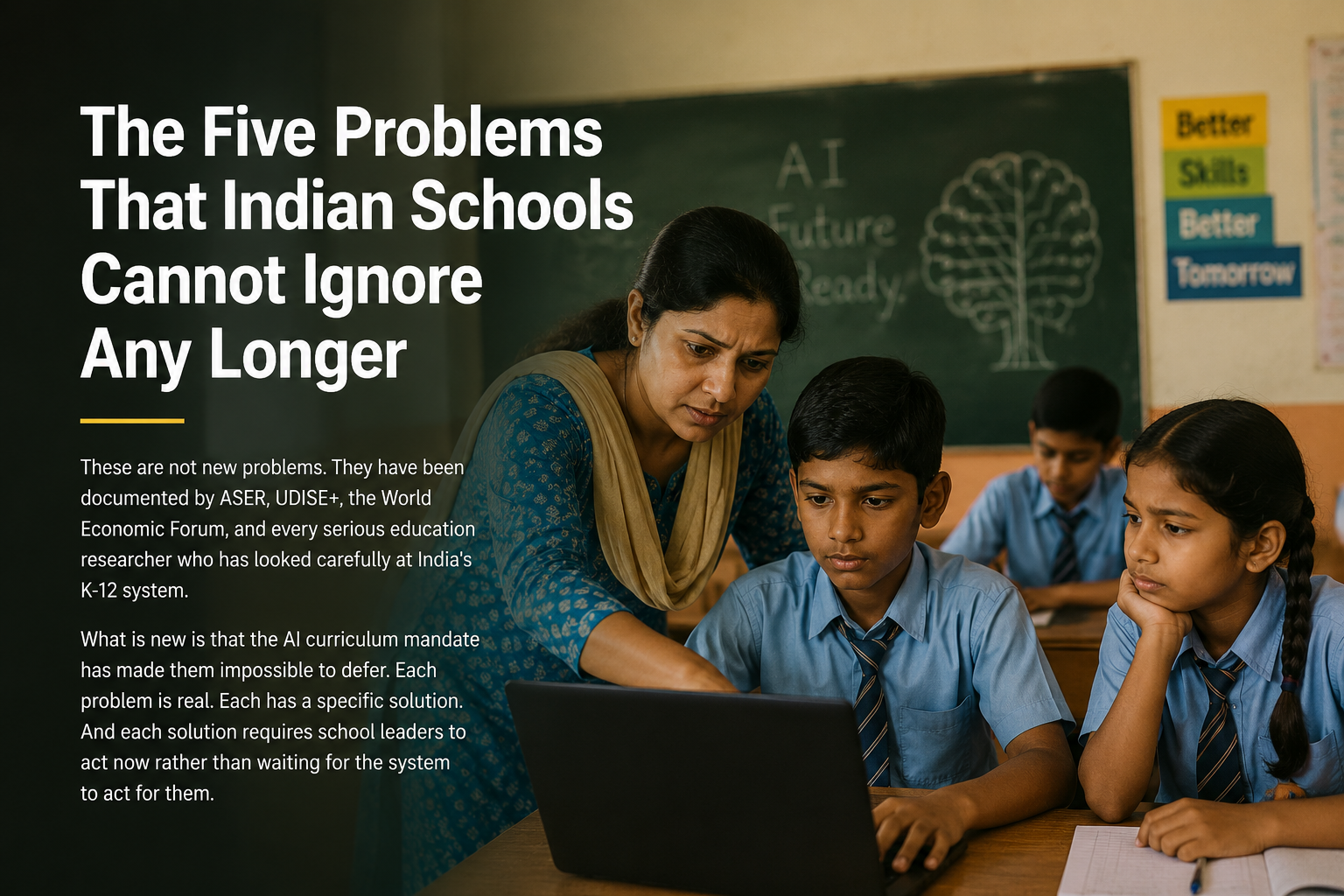
These are not new problems. They have been documented by ASER, UDISE+, the World Economic Forum, and every serious education researcher who has looked carefully at India's K-12 system. What is new is that the AI curriculum mandate has made them impossible to defer. Each problem is real. Each has a specific solution. And each solution requires school leaders to act now rather than waiting for the system to act for them.
According to UDISE+ 2024-25 data, only about 58% of Indian schools have functional computers, and internet access hovers around 64%. More than 7% of schools are single-teacher institutions.
Read that again. About 50% of Indian schools lack basic digital infrastructural necessities like electricity, internet, and computers to ensure equitable access to AI education across both urban and rural settings.
India has just mandated an AI curriculum in schools where the electricity supply is unreliable. This is not a bureaucratic oversight. It is the central implementation challenge of the entire mandate, and it has a specific implication for every school leader reading this: the schools that act on infrastructure now — rather than waiting for government solutions — are the schools that will be able to deliver the mandate in a way that actually benefits students.
The infrastructure solution is not waiting for a broadband connection that may arrive in two years. It is building the local infrastructure that makes AI work regardless of external connectivity. Schools in Tripura face shortages of trained teachers, internet facilities, computer labs, and Bengali textbooks. Tripura is not unique. The same description applies to government schools across Chhattisgarh, Jharkhand, Bihar, Uttar Pradesh, and every state where the digital divide is widest precisely where the educational need is greatest.
The AI Ready School response to this problem is Matrix — on-premises AI infrastructure that runs the complete AI learning ecosystem on school-owned servers without any external internet dependency. The B.P. Pujari Government School in Raipur is not an exception. It is the proof of concept that infrastructure is not destiny — that a government school with unreliable connectivity can deliver AI-powered personalised learning at full quality when the infrastructure decision is made correctly.
The government has announced a plan to train nearly 10 million teachers in AI. Experts argue that before implementing such an ambitious programme, the government should conduct a comprehensive assessment of whether the country currently has enough qualified experts to deliver this training.
The arithmetic here is sobering. India had around 650,000 AI professionals in 2024. But the number of AI professionals required for the ambitious project is more than 1.2 million by 2027. You cannot train 10 million teachers in AI when you do not yet have enough qualified trainers to do the training.
Most school teachers have never used AI tools, and AI pedagogy is not yet part of B.Ed. curriculum requirements. This means that the teachers who are expected to deliver the AI curriculum from Class 3 this year were themselves never trained to teach it, never assessed on it, and have no professional qualification that touches it.
Government school teachers, often over-burdened in single-teacher or small schools, lack training in basic digital tools, let alone AI.
The government's plan to address this through NISHTHA — the national teacher training initiative — is a genuine effort. Educators will undergo structured, grade-specific training programs through NISHTHA and other recognised institutions. But NISHTHA training, delivered at scale through video modules, produces awareness rather than competency. A teacher who has watched a video about AI pedagogy is not a teacher who can facilitate an AI research project, assess AI-Sense development, or use a monitoring dashboard to identify a student's specific conceptual gaps.
The schools that are solving this problem are not waiting for NISHTHA to arrive. They are using tools designed to meet teachers where they are. Morpheus does not require a teacher to be an AI expert. It requires a teacher to specify their subject, board, chapter, and learning objectives — and it generates the complete, curriculum-aligned lesson package from those inputs. The teacher who starts using Morpheus the week the NISHTHA video arrives is infinitely better prepared than the teacher who only has the video.
Before we discuss AI education, we need to be honest about the foundational learning crisis that the AI curriculum mandate is being layered on top of. ASER 2024 reveals high enrolment but serious learning gaps in rural India, with basic reading and math skills still a challenge. Only about 50% of Class 5 students can read a Class 2-level text.
Among Class 8 students, the improvement in basic arithmetic was marginal — from 44.1% in 2018 to only 45.8% in 2024.
This is the context into which India is introducing an AI curriculum. A child who cannot read a text two years below their grade level is a child who will struggle to access an AI learning program delivered in English or even in Hindi. A child who cannot perform basic arithmetic in Class 8 is a child for whom AI-powered mathematics learning is not a luxury enhancement — it is an urgent necessity.
ASER 2024 was based on a survey conducted in 17,997 villages across 605 rural districts, reaching 649,491 children in the 3-16 years age group. The data is not from a small sample. It represents the real learning outcomes of the real children in India's real schools right now.
The implication for AI in education is this: the most powerful application of AI in Indian schools is not teaching children about AI. It is using AI to fix the foundational learning crisis that eight years of traditional schooling has not fixed. When Cypher identifies a specific Grade 6 algebraic misconception that has been compounding silently through Grade 7 and into Grade 8, it is doing something that the traditional assessment system — despite eight years of continuous testing — failed to do. The 34% improvement in final class scores and the 77% improvement in analysis-level tasks at B.P. Pujari Government School are not AI education outcomes. They are AI-enabled learning recovery outcomes. That distinction matters enormously for how the mandate should be implemented.
This stark digital divide means that the benefits of AI risk being cornered by well-resourced urban schools, while rural and marginalised schools are left further behind.
This is the equity crisis at the heart of the AI curriculum mandate. The mandate is universal. The resources to implement it are not. Implementation will be phased — well-resourced schools in urban areas will likely adopt it faster, while others may take one to two years to fully integrate it.
If the adoption timeline reflects the resource gap — if premium urban schools are AI-ready in Year 1 and government rural schools are AI-ready in Year 3 — the mandate will have widened the very inequality it was designed to address. The child in the government school in rural Jharkhand will be two years behind the child in the private school in Mumbai in developing the foundational AI literacy that the labour market is already beginning to price at a premium.
India faces a shortage of approximately one million qualified teachers, concentrated most severely in rural areas, STEM subjects, and early grades. The teacher quality gap — the difference in educational outcomes between students in well-resourced urban schools with experienced, credentialed teachers and students in underserved rural schools — is substantial and well-documented. This is the context that makes AI in education compelling in India.
The AI that is most urgently needed is not the AI that enhances already-excellent education. It is the AI that provides the personalised, adaptive, continuous learning support that rural and government school students have never had access to and that the teacher shortage makes impossible to provide through human means alone.
This is specifically why AI Ready School's implementation began with B.P. Pujari Government School rather than with a premium urban school. Not because the urban market is unimportant, but because the equity argument for AI in education is most powerful — and most testable — in the contexts where the need is greatest and the resources are most constrained.
Many schools assume existing computer labs with basic MS Office training fulfill this curriculum. They don't. CBSE explicitly requires AI tools, data analysis, pattern recognition, no-code machine learning platforms, and interdisciplinary projects. A typing and Office class is not CT and AI education.
This is the most dangerous problem because it is the least visible. A school that has purchased an AI platform subscription has something to show an inspector. A school that has purchased an AI platform subscription and called it AI education has satisfied a compliance requirement without building an educational program.
The real challenge lies not in design but in execution. While the CBSE AI curriculum is progressive and forward-looking, implementing it at scale requires structured tools and workflows. The transition from traditional teaching methods to activity-based, interdisciplinary, and application-driven learning introduces a new layer of operational complexity. Teachers no longer just deliver content — they now design learning experiences, create real-world problem scenarios, assess open-ended responses, and ensure alignment with evolving curriculum objectives. This is not merely a pedagogical shift. It is a systemic transformation that demands new workflows, tools, and support systems.
The compliance-versus-education distinction has specific consequences for students. A student who completes a compliance-oriented AI program learns the vocabulary of AI without the substance. They can define machine learning. They cannot evaluate whether a machine learning model is biased. They know AI is important. They do not know why, or how, or what to do when it produces something wrong.
The NEO AI Innovation Lab curriculum was built specifically to close this gap. Students do not study AI. They do AI — original research, published papers, open-source projects, competitions with external validation. The portfolio they build through NEO is the evidence that distinguishes AI education from AI compliance. It is verifiable, specific, and honest about what the student can actually do rather than what they have been told about.
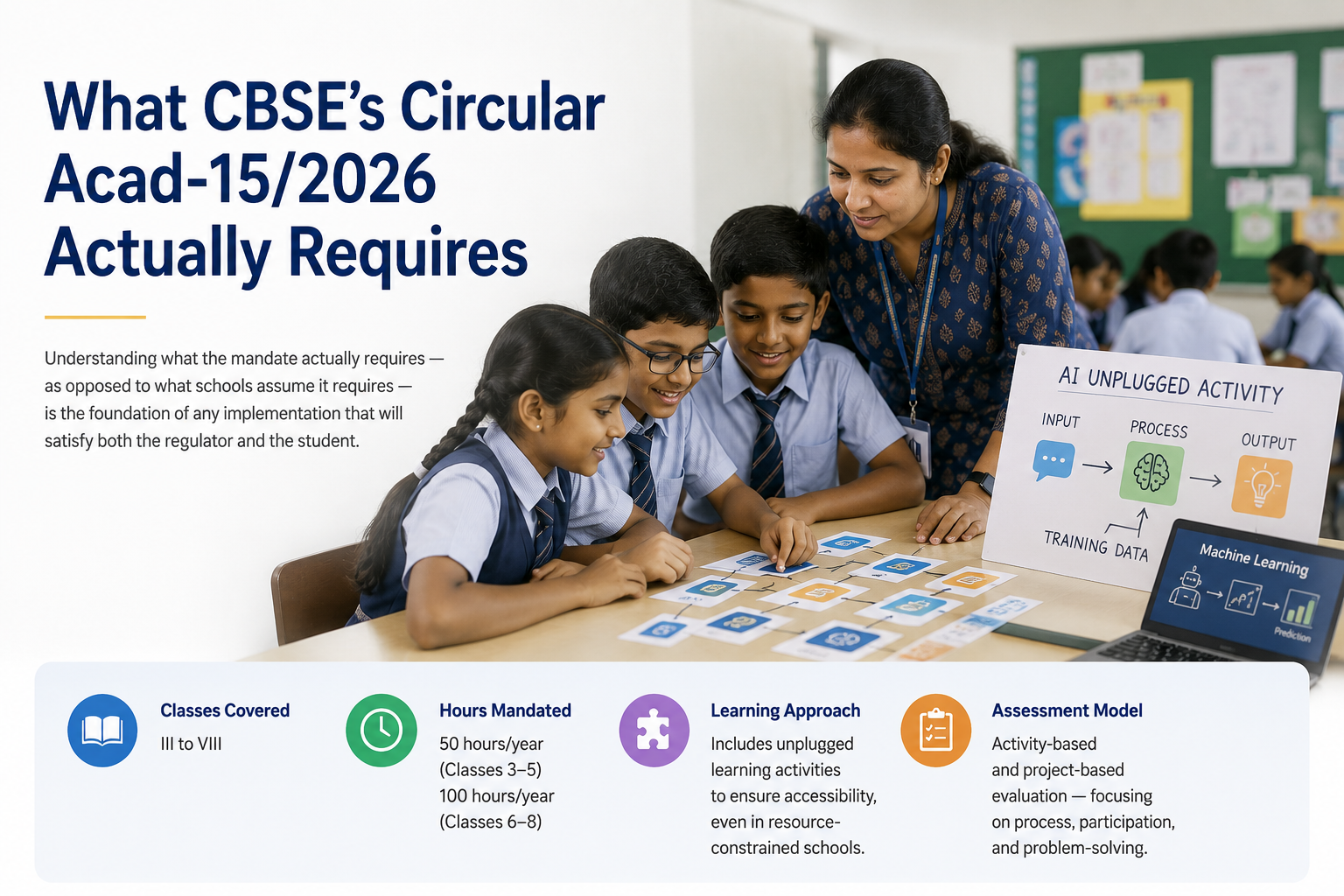
Understanding what the mandate actually requires — as opposed to what schools assume it requires — is the foundation of any implementation that will satisfy both the regulator and the student.
CBSE issued Academic Circular No. Acad-15/2026 on April 1, 2026. Through this circular, the board introduced Computational Thinking and Artificial Intelligence for students from Classes III to VIII. The board wants students to develop logical reasoning, coding awareness, problem-solving abilities, and digital literacy from an early age.
The curriculum structure is specific. CBSE mandates 50 hours per year for Classes 3 to 5 and 100 hours per year for Classes 6 to 8 for CT and AI.
The government is exploring innovative solutions, such as "unplugged learning" activities that teach AI concepts without digital devices, making the curriculum accessible even in schools with limited resources.
This is significant for infrastructure-constrained schools. The unplugged learning component means that AI conceptual education — understanding how AI makes decisions, what training data is, how algorithms work — can be delivered through activity-based methods that do not require devices. The device-dependent component — the hands-on AI tool use, the project building, the research — requires infrastructure but does not need to be the starting point.
The assessment model is also specific: Assessment will be activity-based and project-based — teachers evaluate through puzzles completed, group projects, and class participation. This is a fundamental departure from the examination-centric assessment that most Indian schools are structured around. It requires teachers to evaluate process, not just product — how a student approached a problem, not just whether they got the right answer.
The CBSE is still deliberating whether AI and CT assessments for Classes 9-10 will be internal evaluations or part of board examinations. For Classes 3-8, the assessment approach remains even less defined. This ambiguity is a challenge for schools trying to plan assessment frameworks, but it is also an opportunity: schools that build genuine, portfolio-based assessment systems now will be ahead of whatever the board's final framework requires, because genuine assessment of AI capability will always be more defensible than compliance-based testing.
By the time the 2027-28 academic year begins — when the AI curriculum expands to Classes 9 and 10 — India's school landscape will have sorted itself into three distinct categories. Understanding which category your school is heading toward is the most important strategic question any school leader can ask right now.
Category 1: The AI-Educated School
These schools treated the mandate as an educational opportunity rather than a compliance requirement. They built a complete AI curriculum with specific learning objectives, trained teachers, cross-curricular integration, portfolio-based assessment, and documented outcomes. Their students are developing genuine AI-Sense — the ability to evaluate AI output critically, understand AI limitations, build with AI, and reason about AI ethics. Their teachers are using AI to reclaim time for the relational and pedagogical work that defines great teaching. Their parents have real-time visibility into their children's learning journeys. And their boards have evidence-based governance intelligence that makes AI investment decisions accountable rather than aspirational.
These schools will attract the families that are most invested in genuine educational quality. They will retain those families because the visible, specific, continuously updated evidence of their children's development is the most compelling school marketing that exists. And they will produce graduates who enter the 2030 labour market with documented AI capability that their peers without genuine AI education cannot match.
Category 2: The AI-Compliant School
These schools purchased platforms, conducted training events, and satisfied the mandate's surface requirements. Their students use AI tools. Their teachers have attended AI workshops. Their prospectus mentions AI education. But the implementation is superficial — the tools are not connected to learning outcomes, the teachers are not genuinely confident, the assessment framework measures activity rather than capability, and the data the school has about its AI implementation tells it nothing useful about whether students are actually learning.
These schools will face increasing pressure from two directions: parents who are becoming more informed about what genuine AI education looks like and will begin to ask the specific questions that compliance-oriented programs cannot answer, and the competitive differentiation created by Category 1 schools that makes Category 2 schools' AI claims look thin by comparison.
Category 3: The AI-Waiting School
These schools are observing. They are waiting for the mandate to become enforced, for the government training to arrive, for the competitive pressure to become unavoidable, for a colleague's positive experience to reduce the uncertainty. Their waiting is understandable. It is also expensive in ways that do not appear on any balance sheet: the learning gaps that are compounding undetected in their student population, the teacher professional capacity that is being consumed by mechanical tasks that AI could handle, the families that are choosing other schools because the AI program looks more serious elsewhere.
The 12-month window to move from Category 3 to Category 1 — or at least to Category 2 on the way to Category 1 — is the window that closes in 2027-28 when the mandate expands to secondary school and the competitive differentiation between AI-educated and AI-waiting schools becomes visible in admissions, outcomes, and parent community conversations.
The gap between the mandate's ambition and its implementation reality is real. But it is not unbridgeable. Here is what schools can do right now — this term, not next year — to move from wherever they are toward genuine AI education.
This week: Identify your AI champion. Not the most tech-savvy teacher. The most credible, most curious, most open-to-change teacher who will own the implementation with genuine commitment. Name them publicly. Reduce their existing load proportionally. Give them access to AI Ready School's implementation team. The implementation begins when this person is named.
This month: Measure your baseline. Student assessment performance in the subjects and grades where you will pilot. Teacher time allocation. Parent satisfaction with learning visibility. These three measurements take a week to collect and they are the before numbers that make your outcome story credible at Day 90.
This term: Begin with your early adopter cohort of 10 to 15 teachers. Train them on philosophy before platform. Use Morpheus for lesson planning first — before monitoring, before assessment generation, before anything else. The teacher who saves three hours on Sunday preparation before they see the monitoring dashboard is a teacher who is ready to use the monitoring dashboard as the intelligence tool it is rather than the surveillance tool they feared it was.
This year: Build the measurement framework that converts AI implementation from a cost centre to a documented investment. The board that sees specific outcome data at Day 90 — not login counts but learning gap detection rates, not teacher adoption percentages but teacher time reallocation data — is the board that approves Month 4 investment confidently.
India is not the only country trying to solve this problem. But India's version of the problem is unique in its scale, its diversity, and its urgency.
Under the government of India's Viksit Bharat 2047 vision, the education sector aims to build an inclusive, high-quality system that nurtures both skills and essential life competencies. The world's most populous nation has about 1.5 million schools, supported by over 8.5 million teachers at the primary and secondary levels, and serving more than 260 million students each year.
No other country is attempting to implement an AI curriculum at this scale, in this many languages, across this range of infrastructure levels, in this compressed a timeframe. The countries that are ahead of India in AI education — Singapore, the UK, South Korea — are implementing it in relatively homogeneous, well-resourced, well-connected educational environments. India is implementing it across a 1.5-million-school system that ranges from elite private schools in Mumbai with enterprise-grade infrastructure to single-teacher government schools in rural Bihar with unreliable electricity.
This is not a reason for pessimism. It is a reason for the specific, context-sensitive, infrastructure-independent approach that AI Ready School has spent eight years building. The solution that works in B.P. Pujari Government School in Raipur and in an IB school in Hyderabad and in partner schools in Uzbekistan is a solution that was designed for diversity rather than for ideal conditions.
India's 260 million students are the reason the stakes are so high. They are also the reason the solution matters so much. The child in the government school in rural Chhattisgarh whose potential the traditional assessment system never detected, whose specific learning gap has been compounding silently for three years, who will — with the right AI implementation — finally be seen specifically rather than assessed generically: that child is why this work exists.
The mandate is the opportunity. The implementation is the decision. And the decision is being made right now, in every school in India, by every school leader who is reading this.
India's education system has survived a hundred years of under-investment, bureaucratic inertia, and institutional resistance to change. AI is the first tool that can meet 260 million students where they are, at the same time, in the language they think in, at the level they actually understand. The question is not whether this will change Indian education. It is whether your school will be part of the change or a witness to it.
AI Ready School has active implementations across government schools, private CBSE and ICSE schools, state board schools, and international schools in India and internationally. Cypher closes the learning gap. Morpheus empowers the teacher. Zion gives students the tools. NEO builds the portfolio. Matrix solves the infrastructure. Together, they are the complete answer to the five problems that India's schools cannot ignore any longer.
To discuss your school's specific implementation context, reach out at hey@aireadyschool.com or call +91 9100013885.
Join the Schools Getting AI Right
Human First. AI Next.™

.png)