
Chiranjeevi Maddala
August 13, 2026
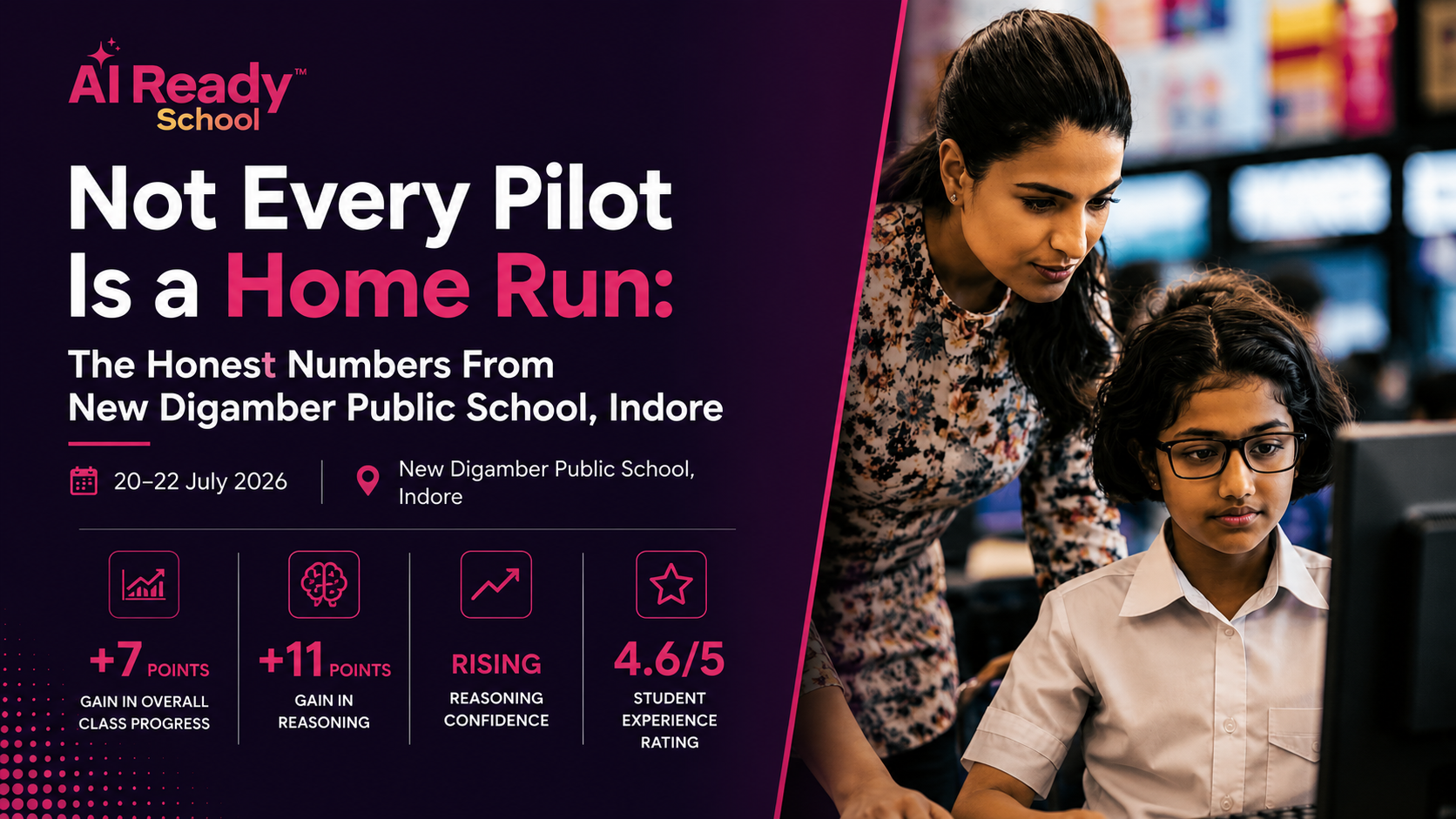
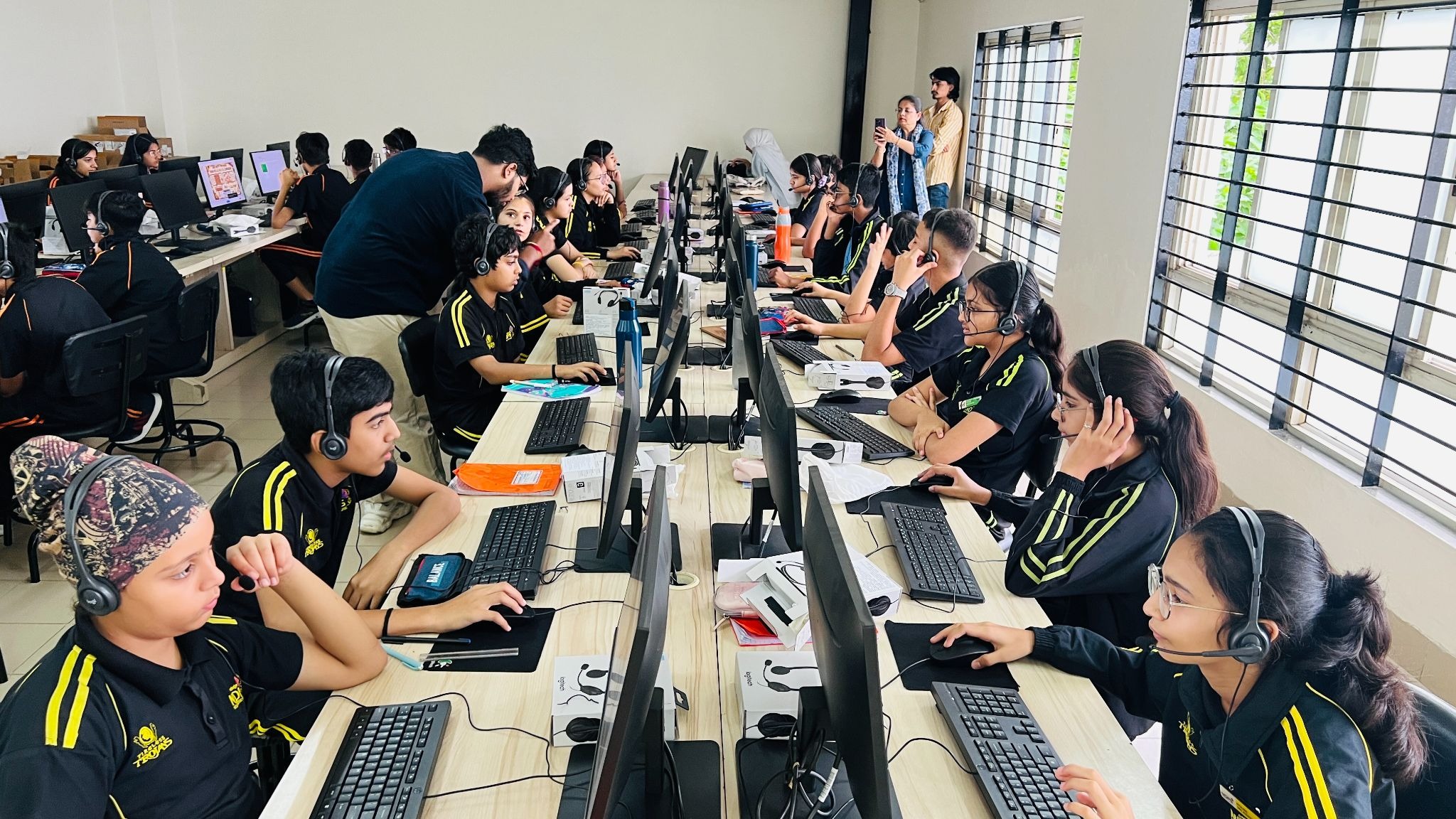
Not every pilot produces a headline number. At New Digamber Public School (NDPS), Indore, 32 Grade 8 students spent three days learning Science through AIRS, and the class average moved from 56% to 63% — a real but modest +7 point gain, next to a few students who slipped backward and a teacher who, reasonably, didn't hand the platform her full trust on day one. That's a more complicated story than our last case study, and it's worth telling exactly as it happened.
AI Ready School (AIRS) is a complete AI ecosystem for K-12 schools, built on five components: Cypher (personal AI learning companion), Morpheus (AI teaching agent), Zion (safe AI tool suite), NEO (AI Center of Excellence lab), and Matrix (local AI infrastructure).
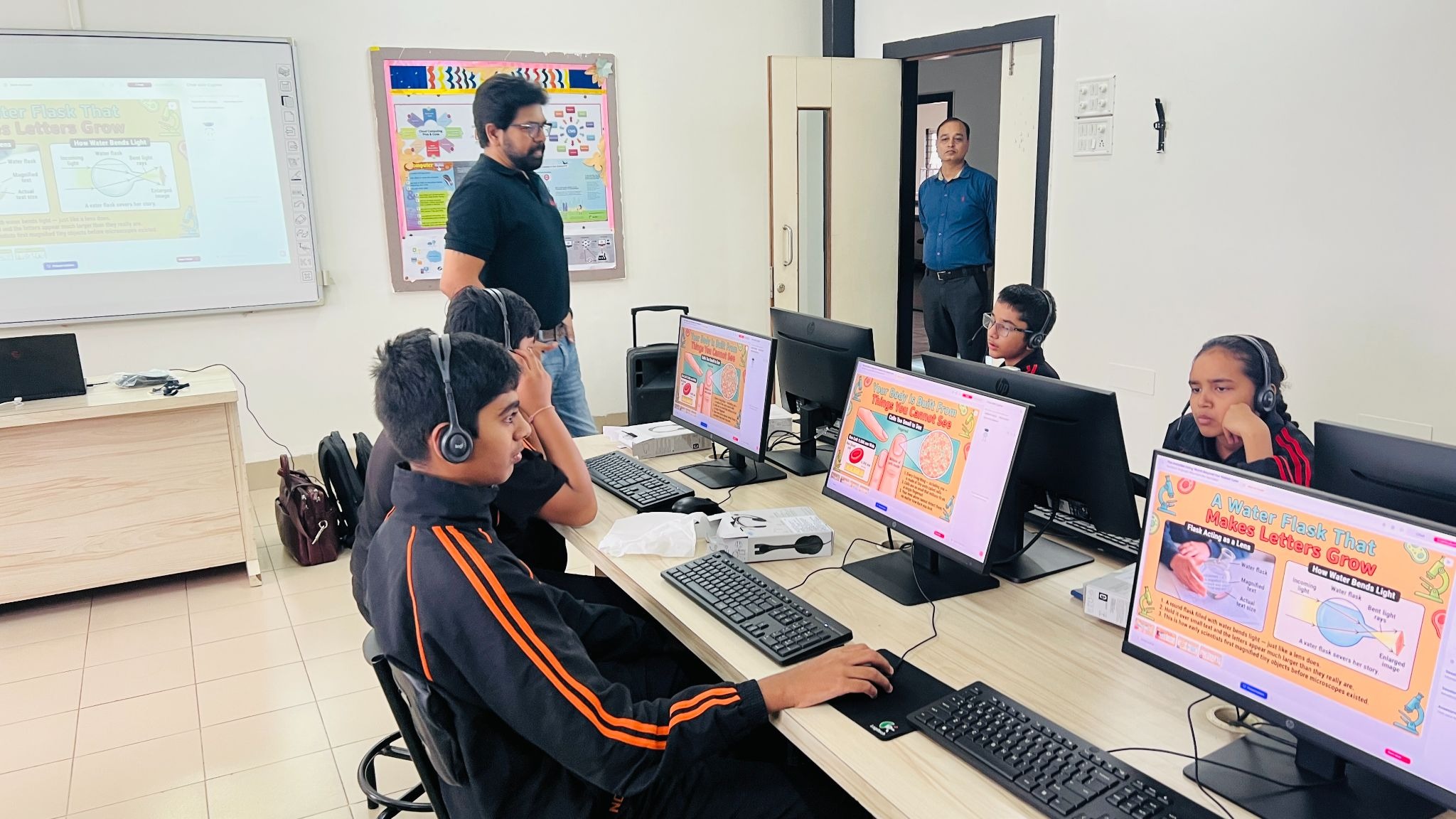
We run three-day pilots so a new school can experience Morpheus and Cypher directly, under real classroom conditions, before deciding whether to adopt them. NDPS was our second such pilot, and it landed differently from the first: a smaller score gain, a wider spread of outcomes across the class, and a teacher whose ratings were genuinely mixed rather than uniformly enthusiastic. We think that's useful information, not a result to soften — a platform that only ever gets published when the numbers are flattering isn't one anyone should trust.
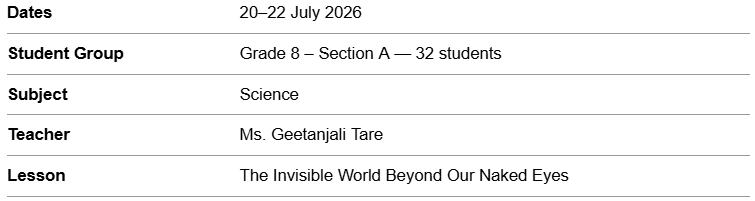
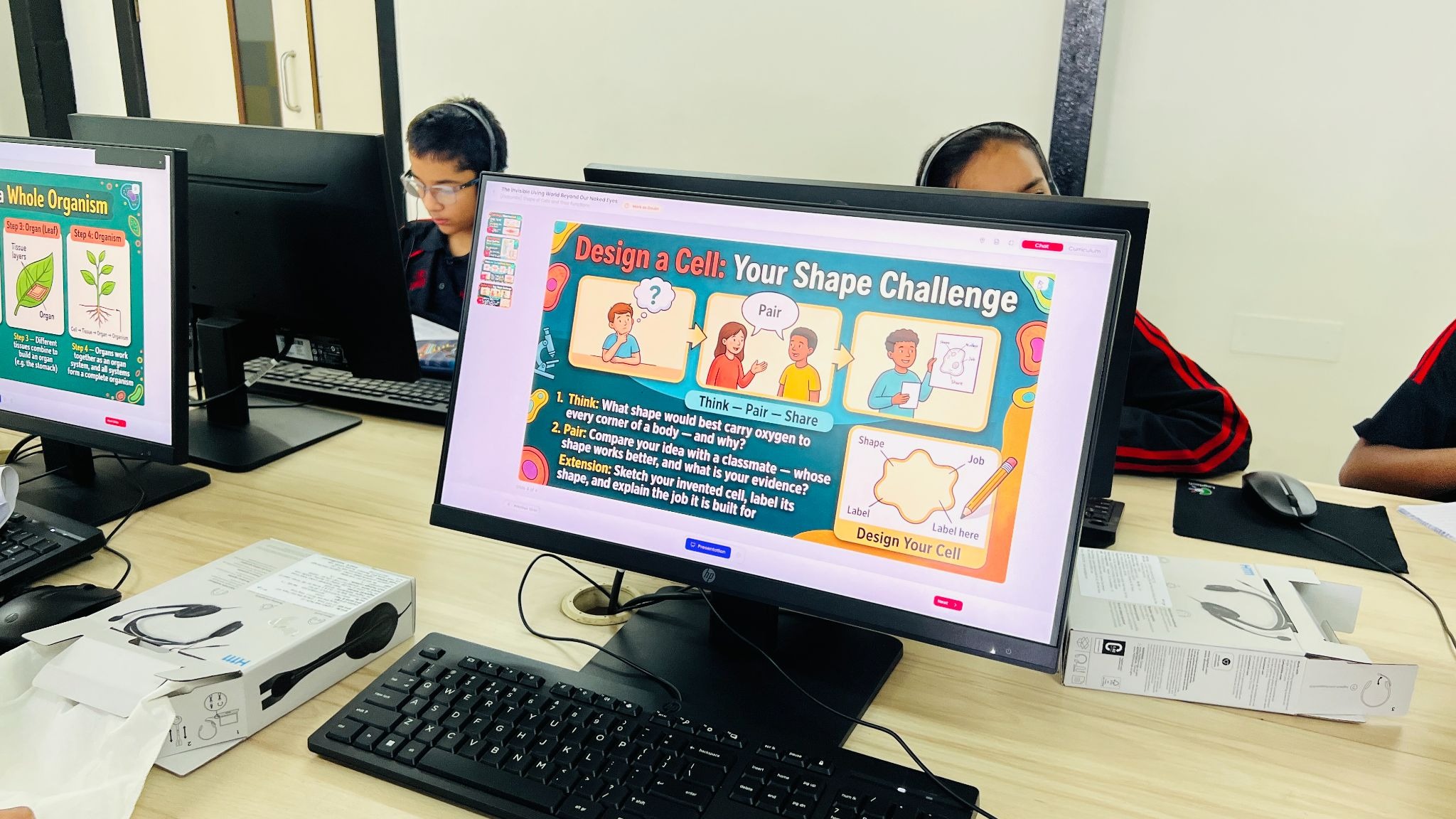
The design matched our standard pilot structure: a baseline test on the lesson, the teacher building a lesson with Morpheus, the lesson assigned to students, students learning the topic through Morpheus and Cypher, and a final test on the same material — measuring, as always, both how much faster a teacher can move with AIRS in the loop, and how much further students progress with platform-driven reinforcement than with the teacher's instruction alone.
In three days and a single lesson, AIRS moved class-wide science scores from 56% to 63% — a +7 point gain — with reasoning confidence rising alongside it and students rating their experience 4.6 out of 5. Eighteen students improved; twelve declined. Both halves of that sentence are part of the same honest result.
The class-wide average rose seven percentage points across the pilot window, from 56% to 63%. Students also finished the final assessment faster than the baseline — 23m 50s down to 22m 1s, about two minutes quicker — while scoring higher on average, so the gain didn't come at the cost of rushing.
The distribution behind that average matters as much as the average itself: eighteen students improved, two stayed flat, and twelve declined. That's a meaningfully wider spread than we'd want to see, and it's the clearest reason this result reads as promising-but-early rather than conclusive — a single three-day pilot with one lesson is a narrow window to separate a real dip in understanding from an off day, a rushed guess, or a student who didn't engage fully with Cypher.

A raw score can hide a lucky guess or a memorized pattern. AIRS also tracks reasoning confidence — whether a correct answer is backed by genuine understanding — and here it moved in the right direction even more than accuracy did.
Reasoning confidence rose from 40/100 to 51/100 — a +11 point change, outpacing the +7 point rise in accuracy. That's a genuinely encouraging signal on its own: students who answered correctly on the final test were, on average, reasoning through the material more soundly than the baseline group was, even though the raw score gain was modest. Twenty-three students landed in the "correct but weak reasoning" band — a large group worth targeted follow-up, since a right answer with weak reasoning is exactly where a future test could go the other way.
Where students excelled
• Yeast fermentation in dough — 75%
• Souring of milk into curd by Lactobacillus — 75%
• Fungi lacking chlorophyll for photosynthesis — 72%
Where AIRS flagged opportunities for reteaching
• Microscope magnification of microorganisms — 22%
• Bacterial cells vs. other cells — 25%
• Shared structures in onion peel and human cheek cells — 31%
• Decomposition into manure / composting — 34%
• Microalgae as major oxygen producers — 44%
• Microorganisms in fruit and vegetable peel decomposition — 47%
Rather than a single opaque score, AIRS traced individual wrong answers back to the specific belief behind them. Five distinct misconceptions surfaced clearly enough across the class to name and act on:
• "Warmth kills bacteria" — 6 students
• "Unicellular means bacteria" — 5 students
• "Bacteria are multicellular" — 4 students
• "Algae produce nitrogen" — 4 students
• "Mould is unicellular" — 3 students
The platform's recommendation to the teacher: reteach microscope magnification, bacterial-cell structure, and decomposition/composting in the same lesson sequence, since these were the weakest areas across both tests. Specifically, a card-sort activity where students match each concept to the correct organism or process, then justify why a school microscope, a bacterium, or a decomposer belongs in that category — turning assessment data into a concrete next lesson, automatically.
Class averages can flatter or hide what actually happened. The class assessment report behind this pilot breaks results down to every individual student — baseline, final, growth, and lesson completion — including the twelve whose scores declined, which we're publishing here rather than leaving out of the story.
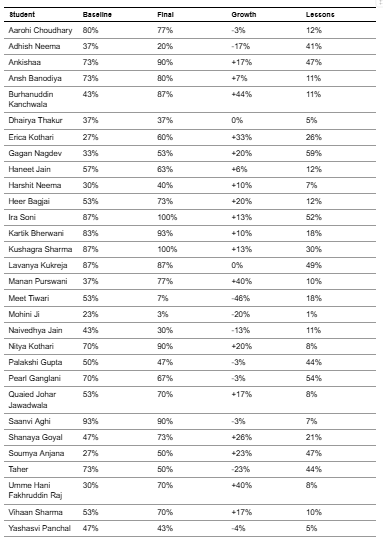
Top improvers: Burhanuddin Kanchwala (+44%), Manan Purswani (+40%), Umme Hani Fakhruddin Raj (+40%), Erica Kothari (+33%), and Shanaya Goyal (+26%). Needs attention: Meet Tiwari, Mohini Ji, Adhish Neema, Naivedhya Jain, Dhairya Thakur, Palakshi Gupta, Pearl Ganglani, Taher, Yashasvi Panchal, Yukti Katariya, and Zahra Gaswala — eleven students whose scores fell or stayed flat, led by Meet Tiwari's drop from 53% to 7%.
One pattern the platform specifically flagged: speed on the final test didn't reliably track with improvement. Quaied Johar Jawadwala improved to 70% while answering in an average of 2 seconds per question, while Yashasvi Panchal stayed low at 43% despite spending 158 seconds per question. Others slowed down and still improved — Burhanuddin Kanchwala went from 58s to 82s per question on his way to +44%, and Umme Hani Fakhruddin Raj from 43s to 120s on her way to +40%. AIRS's own read: pacing alone doesn't explain the spread, which points toward individual engagement and comprehension as the bigger factors — exactly the kind of thing a longer pilot window would help isolate.
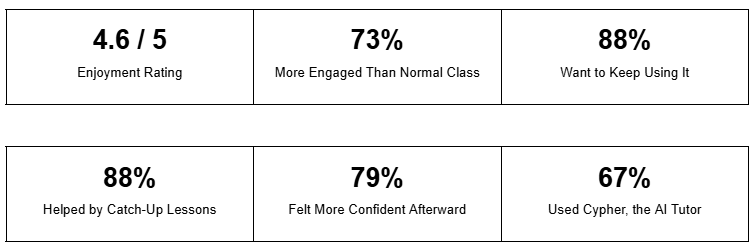
Whatever the score spread looked like, the students themselves reported a genuinely positive three days. Thirty-three responded to the end-of-pilot survey — more responses than there were students in the class, likely reflecting a couple of re-submissions, but a strong response rate regardless.
What students valued
• Cypher improved their thinking by offering hints instead of direct answers
• The Creative Hub made learning feel fun and hands-on
• Videos and flashcards made difficult content easier to understand
• Interactive tools made the lesson feel enjoyable rather than routine
• Immediate assessment feedback helped them see and fix their own mistakes
100% of students said their quiz results and explanations helped them understand their mistakes — and 88% said a catch-up mini-lesson helped when they were struggling.
Their concerns were specific rather than vague: some said Cypher's answers were occasionally confusing (42% reported at least one wrong or unclear response, though 100% still said the platform helped them understand their mistakes overall), some found long presentations and slow videos frustrating, and a few felt strict assessment checking worked against them. A recurring, low-effort request: more games.
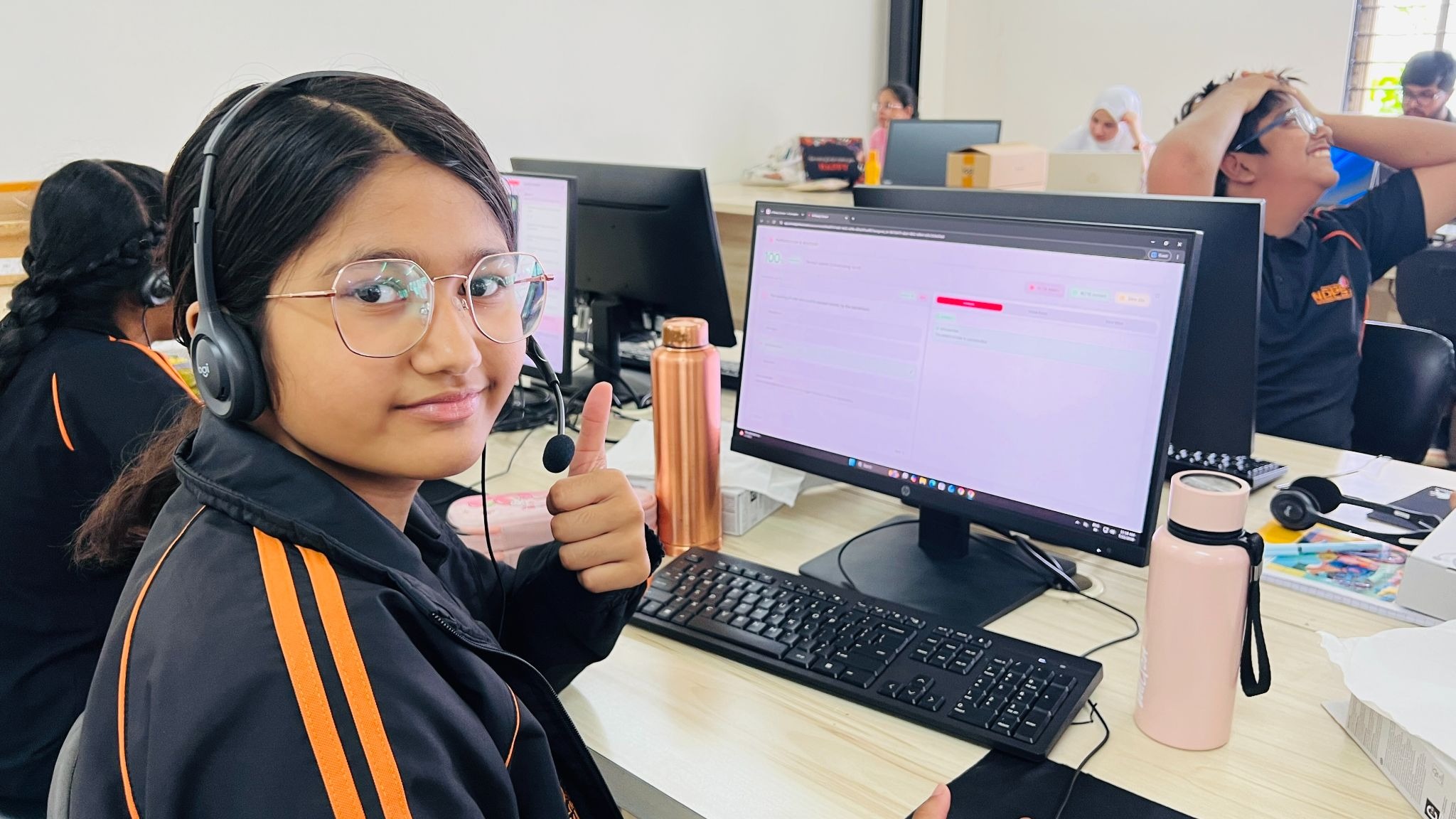
This is where the NDPS pilot tells a different story than a typical case study, and it's worth sitting with rather than smoothing over. Ms. Geetanjali Tare rated her overall experience 4 out of 5 — solid, not glowing. She rated lesson accuracy and curriculum alignment a full 5/5, and Live Classroom Control's screen-sync during teach-mode instruction also a 5/5. Those are the fundamentals, and they held up.
But her ratings on tracking visibility and intervention quality were more moderate — 3 out of 5 on both — and unlike a teacher who trusts Morpheus's auto-built interventions as-is, she edited them before sending them to students. She also said it was too early to tell whether the interventions actually helped struggling students catch up, and reported that Morpheus saved her none of her usual prep time on this particular lesson.
We think the most honest read of this is time, not capability. A three-day pilot gives a teacher one lesson cycle to learn a new tracking dashboard, a new intervention-review workflow, and a new way of reading student data — that's a narrow window to build the kind of trust that comes from repetition. It's a genuinely different result from a teacher who had more runway to explore the same tools, and we're treating it as a signal about pilot length rather than a verdict on the platform.
Because of that, AIRS is now planning a month-long pilot with NDPS. A longer runway will give Ms. Tare time to explore lesson planning, live intervention review, and the progress dashboard under real classroom conditions across multiple lessons — and should surface AIRS's full value on the teaching side, not just the learning side that the three-day window was able to show.
The headline ratings above come from a longer survey covering every stage of the platform. The detail underneath is where the real operational learning sits — including the places NDPS's experience diverged from what we've seen elsewhere.
A. Creating lessons (teacher)
• Lessons built through a mix of approaches rather than one single method
• First draft from Morpheus rated 3.0/5 — usable, with moderate editing required before it was classroom-ready
• Lesson accuracy and curriculum alignment rated a full 5.0/5
• Overall ease of using Morpheus to build the lesson: 3.0/5
B. Enriching (teacher)
• Used every content type available — video, presentation, glossary, flashcards, and a mini app
• AI-generated content quality rated 4.0/5 as good enough to use as-is
• Agent-mode requests worked reliably, rated 5.0/5
• Favorite tool: the Morpheus Lesson Planner
C. Assigning, pacing & live classroom control (teacher)
• Assigning lessons to students rated 5.0/5 for ease
• Used Session Flow locks and found them useful
• Taught live using Classroom Control, with screens staying in sync at 5.0/5
D. Tracking, dashboard & interventions (teacher)
• Visibility into student scores, doubts, and analysis rated 3.0/5
• "Mark as Doubt" flags were only "somewhat" useful for spotting where students got stuck
• Did read students' Cypher chat threads, and found that useful for understanding their struggles
• Auto-built interventions rated 3.0/5 for relevance, and were edited before reaching students
E. Getting around & Cypher (students)
• Finding and opening lessons rated 4.5/5 for ease
• 67% of students learned using both the Learn page and Cypher together; 24% mainly on their own
• 55% said Cypher explained things in a way they understood; 58% said it never gave a wrong or confusing answer
• 52% said chatting with Cypher felt like having a helpful tutor; a further 48% said "kind of"
F. Lessons, quizzes & catch-up (students)
• 82% found the lessons interesting to work through; videos were the most-used content type (64%)
• 73% said the lesson felt "much more engaging" than a normal class
• 100% said quiz scores and explanations helped them understand and fix their own mistakes
• 88% of students who got a catch-up mini-lesson said it helped
• 45% said they did much better on the final than the baseline; 18% said a little worse
G. When students got stuck
• 55% didn't use "Mark as Doubt" when confused, and 18% didn't know the feature existed
• 91% still said it was easy to get help, either from Cypher or by raising a hand
• 79% said Morpheus made them feel more confident about the subject; 21% said it felt the same
• 88% of students said they'd want to keep using the platform going forward
The written feedback matched the numbers: students named Cypher's hints, the Creative Hub, and videos and flashcards as what they valued most, while their concerns clustered around AI responses that were occasionally confusing, long or slow-paced presentations, and assessment checking that felt strict — plus a simple, recurring request for more games.
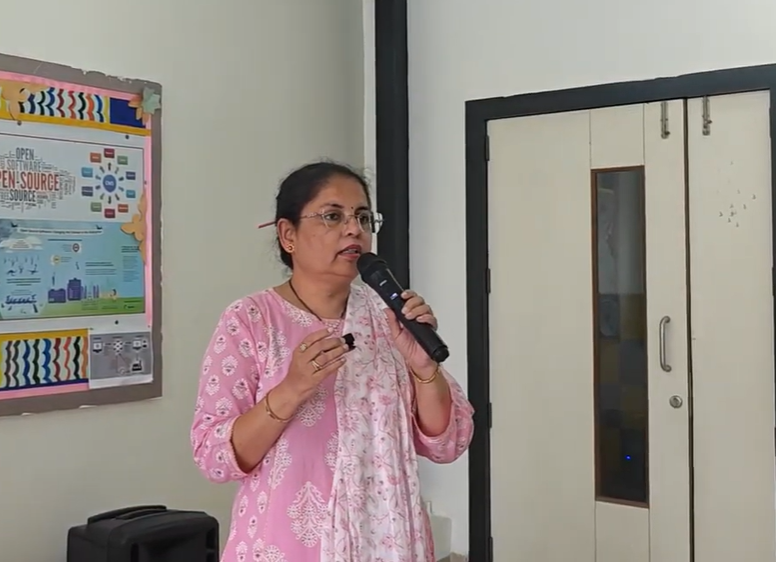
A +7 point gain in overall class progress, a +11 point gain in reasoning confidence, and a 4.6/5 student experience rating — set against a wider spread of individual outcomes and a teacher who is, fairly, still forming her judgment — is a genuinely useful second data point for AIRS, not a triumphant one. It tells us the platform's fundamentals hold up in a second, independent classroom: lesson accuracy, curriculum alignment, and student engagement all stayed strong. It also tells us that a three-day window is a real constraint, both for separating a temporary dip from a genuine gap in a handful of students, and for giving a teacher enough time to build trust in a new tracking and intervention workflow.
That's precisely why the misconception data matters more than the headline percentage. AIRS didn't just report a +7% average — it named the exact five misconceptions behind the class's weakest topic, ranked eleven students who need a different kind of follow-up than the eighteen who improved, and handed the teacher a specific reteaching plan built directly from the assessment data. That's the same underlying mechanism that produced a much larger jump in our first published pilot; here, it surfaced a smaller win and a clearer set of open questions, which is exactly what it's supposed to do when the result actually is more mixed.
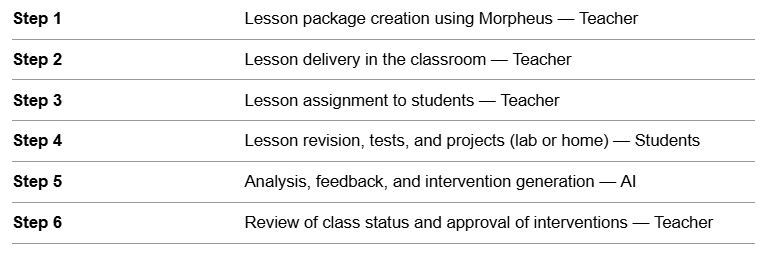
The pilot tested an ideal condition — whether students could work through the concepts largely on their own. For everyday use, the platform is designed differently: it assists teachers in configuring lessons, assigning them, and reviewing outcomes from a central place, which removes the need to manually run each of those steps and frees teachers to focus on the creative parts of teaching.
Beyond the month-long follow-up pilot, the proposed rollout for NDPS follows the same three-stage structure we use with every partner school, with two months of free access, training, and support included:

Stage 3 onward proceeds under standard pricing — Rs. 2,500 per account per year, with Rs. 500 worth of AI credits included and rechargeable as needed — unless otherwise agreed with the school. The first two months of lesson creation and student access remain free; the Creative Hub and Project Hub sit outside that free tier.
This case study is one part of a five-product ecosystem — Cypher, Morpheus, Zion, NEO, and Matrix — spanning academics, skills, operations, safety, and future-readiness across a school. NDPS, Indore saw one slice of it, in one class, over three days, and the honest version of what that slice looked like is above.
See What a Free 3-Day Pilot Actually Looks Like
TIPS, Dehradun saw a dramatic gain. NDPS, Indore saw a modest one, with real questions still open. We publish both because a free 3-day pilot is meant to show your school exactly what AIRS does with your own students and your own teachers — not a polished demo. Pick one class, one subject, and one lesson, and we'll run the full baseline-to-final cycle at no cost.
What's included in your free 3-day pilot:
• A baseline test, an AI-built lesson delivered through Morpheus and Cypher, and a final test — the same design used at NDPS and TIPS
• A full class assessment report: student-by-student growth, surfaced misconceptions, and a Cypher-based class learning profile
• Direct teacher and student feedback surveys, published honestly — so your staff decides if it's working, not a vendor deck
• No cost, no obligation to continue — plus 2 free months of platform access if you choose to move forward
Book your free pilot program, or contact us directly — most schools go from first conversation to pilot week in under two weeks.
Human First. AI Next.™