
Chiranjeevi Maddala
May 23, 2026
Every school that has successfully implemented AI has one thing in common that no vendor will tell you about and no platform can provide. It is not the right subscription. It is not the right infrastructure. It is the right person. This blog is about finding them.
In the twelve months since AI Ready School began tracking implementation outcomes across partner schools, one pattern has emerged more consistently than any other. The schools whose implementations produced documented, sustained, school-wide outcomes are not the schools with the best technology or the largest budgets. They are the schools where the right person was identified, empowered, and supported in the AI coordinator role before a single teacher opened a platform.
The schools whose implementations stalled, produced inconsistent results, or became expensive shelf furniture — and there have been implementations in all three categories — share a different pattern. In almost every case, the AI coordinator role was either not filled at all, filled by the wrong person, or filled by the right person without the institutional support that the role requires.
This is not a peripheral observation. It is the central insight of everything we have learned about AI implementation in schools. The technology is the instrument. The AI champion is the musician. And you cannot produce music without both.
This blog gives you the framework to identify your AI champion, the criteria that actually predict success in the role, the common mistakes schools make when filling it, and the institutional support structure that allows the right person to produce the outcomes the role makes possible.
The question is not whether your school has the right platform. It is whether your school has the right person to make the platform matter.
Let us be specific about what an AI champion actually does, because the role is frequently misunderstood. The AI champion is not a technology trainer. They are not a platform administrator. They are not the person who fixes login problems and resets passwords when teachers cannot access their dashboards.
The AI champion is the person who makes the implementation real for the teachers who are doing the actual teaching. They are the person whose answer to a colleague's question – "Is this actually useful, or is it just another thing management wants us to do?" – determines whether that colleague becomes an engaged user or a polite resister. They are the person who sees the monitoring dashboard showing a student's declining engagement before the teacher has noticed it and knows how to start that conversation. They are the person who stands in a staff meeting and says, honestly, "Here is what I found genuinely useful this week, and here is what I am still figuring out" and is believed because their colleagues know they are not feigning enthusiasm.
This is a different role from any technology role your school has previously filled. It requires a combination of professional credibility, pedagogical intelligence, interpersonal warmth, comfort with uncertainty, and genuine belief in the educational value of what they are doing that is difficult to find and impossible to mandate. You cannot create an AI champion by assigning the role to whoever is available or whoever asked for it. You can only find them by looking carefully at who is already in your school.
The good news is that in every school we have worked with, that person exists. They are not always obvious. They are not always senior. They are not always the person who would occur to you first. But they are there, and finding them is worth more to your implementation than any amount of additional platform spending.
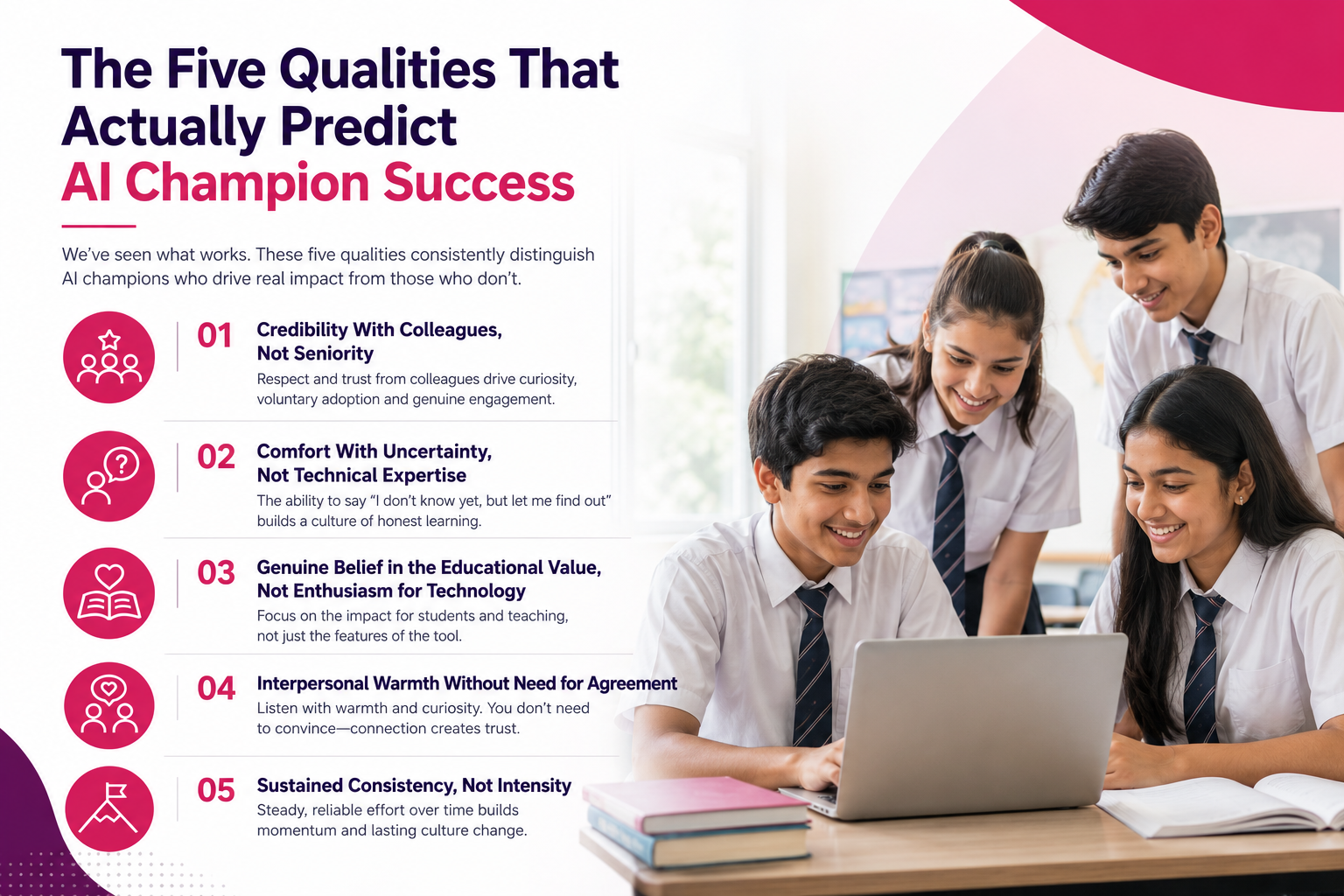
We have worked with enough AI champions across enough schools to have a clear picture of what predicts success in the role and what does not. The qualities that predict success are not the qualities that most principals assume predict success.
Quality 1: Credibility With Colleagues, Not Seniority
The most important quality an AI champion can have is the respect of their colleagues — not the authority of their position. These are different things, and in the context of AI adoption, the difference matters enormously.
A head of department who mandates AI usage produces compliance. A teacher whose colleagues genuinely respect their professional judgement and who says "This has changed how I prepare lessons" produces curiosity. Curiosity produces voluntary adoption. Voluntary adoption produces genuine engagement. Genuine engagement produces the outcomes that justify the implementation.
Your AI champion does not need to be the most senior teacher in your school. They need to be the teacher whose colleagues most trust their professional assessment of what works and what does not. This person is often a mid-career teacher — experienced enough to have genuine pedagogical credibility and not so senior that their enthusiasm will be dismissed as institutional performance.
At NH Goel World School in Raipur, the early adopter cohort that drove the implementation's expansion was not led by department heads. It was led by teachers whose colleagues had watched them teach, had seen what they produced for students, and trusted their judgment about tools that were genuinely useful. When those teachers described what Morpheus had done for their Sunday preparation time, their colleagues paid attention in a way that they would not have paid attention to a management announcement about the same platform.
Quality 2: Comfort With Uncertainty, Not Technical Expertise
The second quality that most distinguishes successful AI champions from unsuccessful ones is their relationship with not knowing. AI tools evolve continuously. Implementations produce unexpected outcomes — both positive and negative. Students ask questions that the platform was not designed to address. Teachers encounter situations where the data shows something the champion has not seen before and cannot immediately interpret.
The AI champion who is comfortable saying "I do not know yet, but let me find out" is infinitely more valuable than the AI champion who has memorised the platform's feature set but is destabilised when something does not work as expected. The former builds a culture of honest engagement with a genuinely complex new capability. The latter builds a culture where problems are hidden rather than surfaced, because nobody wants to be the person who exposed a gap in the champion's expertise.
Technical knowledge about the platform is learnable and is provided by AI Ready School's implementation team. Comfort with uncertainty is dispositional. It is either present or it is not. Look for teachers who approach difficult classroom situations with curiosity rather than anxiety, who are willing to tell their department that something did not work as expected and explain what they learned from it, and who frame professional development as an ongoing process rather than a qualification they have already achieved.
Quality 3: Genuine Belief in the Educational Value, Not Enthusiasm for Technology
There is a category of teacher in every school who loves new technology for its own sake. They are usually the first to adopt any new platform, the most vocal about its features, and the most visible in any technology-related initiative. They are rarely the best AI champions.
The reason is that technology enthusiasm without pedagogical grounding produces demonstrations rather than implementations. The AI champion who is excited about what the platform can do is less effective than the AI champion who is excited about what the platform helps teachers do for students. The first talks about features. The second talks about outcomes. Teachers listen to the second.
Your AI champion should be someone who, when you ask them why they are interested in the role, talks about specific students or specific teaching situations rather than about the platform itself. They should be able to articulate what they believe AI-powered learning could do for the students in your school that traditional instruction cannot do at scale. And they should be genuinely uncertain about whether the platform will deliver on that belief, rather than already convinced before they have tried it.
Genuine belief in the educational value — combined with appropriate skepticism about whether any specific tool will deliver on it — produces the honest, outcome-focused engagement that makes implementations work. Enthusiasm for the technology without that grounding produces impressive demos that do not sustain.
Quality 4: Interpersonal Warmth Without Need for Agreement
The AI champion will, over the course of your implementation, have many conversations with colleagues who are skeptical, resistant, or simply exhausted by the addition of another professional development demand to an already demanding professional life. The effectiveness of those conversations depends entirely on how the AI champion conducts them.
The quality that matters in these conversations is not persuasiveness. It is warmth combined with non-defensiveness. The AI champion who is genuinely comfortable with a colleague's skepticism — who can hear "I tried it and I did not find it useful" without becoming defensive, who can explore the specific reason for that experience with genuine curiosity rather than trying to overcome an objection — produces more eventual adoption than the AI champion who has a prepared answer for every concern.
Teachers who feel that their skepticism is being treated as a problem to be solved disengage from the conversation and from the implementation. Teachers who feel that their skepticism is being treated as valuable information — as data about what is and is not working that the implementation can learn from — remain engaged even when they are not yet convinced.
Look for teachers who handle disagreement with grace in other professional contexts. The head of department who facilitates curriculum review discussions in a way that makes every participant feel heard even when the final decision does not go their way. The classroom teacher who makes a challenging student feel respected even while holding a firm boundary. These interpersonal qualities translate directly to the AI champion role.
Quality 5: Systematic Thinking Without Perfectionism
The final quality that predicts AI champion success is the ability to think systematically about implementation problems without being paralysed by the impossibility of perfect solutions. AI implementation in schools is a complex, evolving, imperfect process. It will produce unexpected outcomes. Some teachers will have excellent experiences and some will have frustrating ones. Some students will engage deeply and some will not. Some monitoring data will be immediately interpretable and some will raise more questions than it answers.
The AI champion who approaches these complexities systematically — who asks "what pattern does this represent and what does that tell us about what to do differently?" rather than "how do we fix this so it never happens again?" — is the AI champion who produces sustained improvement. The one who approaches them with perfectionism — who sees every unexpected outcome as a failure that should not have occurred — produces a culture of anxiety around the platform that undermines adoption before it can mature.
Look for teachers who approach classroom challenges as problems to be understood rather than failures to be corrected. The teacher who, when a lesson does not go as planned, analyses what happened and adjusts rather than abandoning the approach. This systematic, non-perfectionist orientation toward professional challenge is exactly what the AI champion role requires.
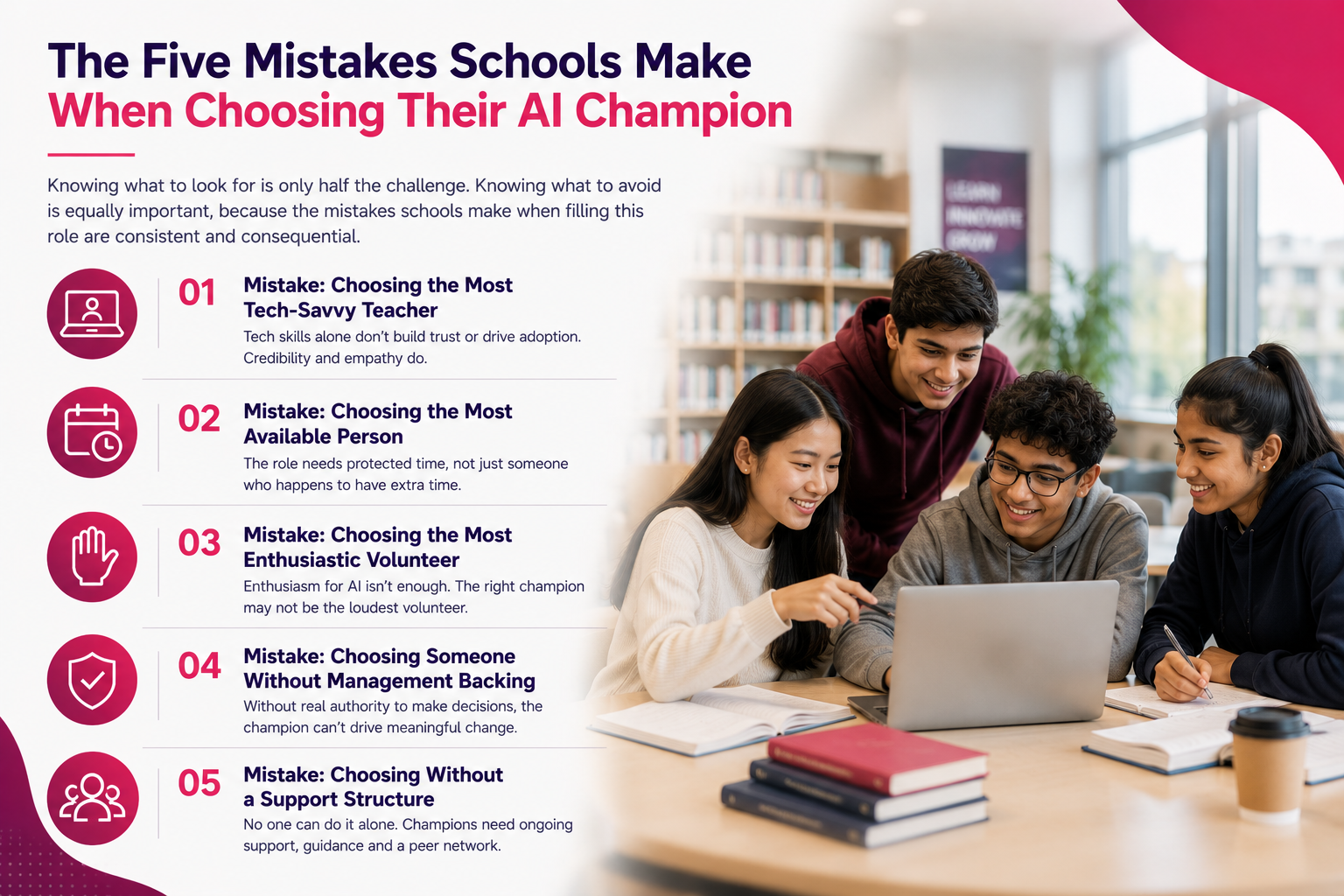
Knowing what to look for is only half the challenge. Knowing what to avoid is equally important, because the mistakes schools make when filling this role are consistent and consequential.
Mistake 1: Choosing the Most Tech-Savvy Teacher
The most common mistake is equating technology comfort with AI champion suitability. The teacher who is already using AI tools, who can discuss LLMs fluently, who set up the school's social media accounts and manages the student app — this teacher seems like the obvious choice. They are rarely the right one.
The problem is not that technology comfort is irrelevant. It is that it is insufficient, and that teachers who are already comfortable with AI often have fixed opinions about what AI can and cannot do that make them less effective at supporting colleagues who are starting from a different place. The AI champion who says "this is easy, you just need to try it" to a skeptical colleague has lost that colleague in the first 30 seconds. The AI champion who says "I understand why this feels like a lot — let me show you the one thing that saved me the most time last week" has opened a conversation that can go somewhere.
Technology comfort is a threshold quality, not a differentiating one. Once a candidate meets a minimum threshold of comfort with digital tools, additional technology expertise does not predict AI champion success. Professional credibility, pedagogical intelligence, and interpersonal warmth predict it.
Mistake 2: Choosing the Most Available Person
The second mistake is filling the role with whoever has the lightest teaching load or the most flexible schedule. The implicit reasoning is that the AI champion role requires time, so it should go to someone who has time to spare.
This reasoning is correct about the time requirement and wrong about the conclusion. The AI champion role requires time, which means the person in the role needs protected time created for them — not time they happened to have because they were less involved in the school's core work. A teacher with a light schedule is often a teacher with less invested in the school's educational program and less credibility with colleagues who are fully engaged in it.
The right AI champion is almost certainly someone who does not currently have obvious spare time. They are doing important work that colleagues value. When you ask them to take on the AI champion role, you need to be prepared to reduce their other responsibilities proportionally. A reduction of one class section, two committee assignments, or equivalent administrative load is reasonable. An expectation that they add the AI champion role to a full existing load is not — and it signals to them and to their colleagues that the school does not actually consider the role important.
Mistake 3: Choosing the Most Enthusiastic Volunteer
When principals ask their staff who is interested in taking on an AI-related role, they typically receive responses from two types of teachers: those who are genuinely suited to the AI champion role and those who are enthusiastic about AI for reasons that may not translate to effective implementation support.
The challenge is that the most vocal volunteers are often in the second category. They have heard about AI, they are excited about it, and they want to be involved. Their enthusiasm is genuine but it is enthusiasm for the technology rather than enthusiasm for the educational transformation that the technology can enable. As discussed above, this distinction matters.
The right AI champion may not volunteer at all. They may need to be approached directly, with a specific explanation of why you think they are the right person for the role and what institutional support you are prepared to provide. The teacher who responds to a direct approach with "I am genuinely interested, but I want to understand what this actually involves before I say yes" is demonstrating exactly the systematic, non-perfectionist, uncertainty-comfortable orientation that the role requires.
Mistake 4: Choosing Someone Without Management Backing
The fourth mistake is filling the AI champion role without giving the person who fills it genuine institutional authority. The AI champion who can identify what is not working in the implementation but cannot change it — because every decision requires approval from a department head who was not consulted, or a principal who is too busy to respond quickly, or an IT coordinator who controls platform access — becomes frustrated and ineffective in a matter of weeks.
The AI champion role requires the ability to make specific, bounded decisions independently. Access changes for individual students or classes. Adjustments to the training schedule for the second cohort. The decision to pause a specific feature rollout because teacher feedback suggests the timing is wrong. These are not major strategic decisions — they are operational decisions that need to be made quickly and that should not require escalation to senior leadership every time.
Before you name your AI champion, decide what decisions they can make independently and communicate that clearly to them and to the colleagues they will be working with. A champion who operates with genuine authority is a champion whose colleagues take seriously.
Mistake 5: Choosing Without a Support Structure
The final mistake is naming an AI champion and then leaving them to figure out the role alone. The AI champion is not a self-sufficient function. They need regular access to the AI Ready School implementation team. They need a monthly conversation with school leadership about what the implementation data is showing and what decisions need to be made. They need a peer — even one person at another school who is doing the same role — with whom they can discuss challenges honestly.
The AI champion who is isolated in their role burns out. The implementation they are responsible for may continue to function on the surface while quietly losing the depth and intentionality that produces outcomes. By the time the burnout is visible, the implementation has often developed structural problems that are expensive to correct.
Build the support structure before you name the champion. Confirm with AI Ready School's implementation team what regular support is available. Identify a peer in the partner school network who your champion can connect with. Schedule a monthly 30-minute check-in with the principal that is protected from cancellation. These are small investments that produce large returns in champion effectiveness and implementation sustainability.
Given the qualities to look for and the mistakes to avoid, here is a practical process for identifying your AI champion.
Step 1: Observe Rather Than Ask
Before you ask anyone whether they would like the role, spend two weeks observing. Who do teachers go to informally when they have a professional question that is not about a specific administrative process? Who facilitates difficult curriculum conversations in a way that makes everyone feel heard? Who approaches a failed lesson or a difficult student situation with curiosity rather than defensiveness? Who is genuinely excited about student outcomes rather than about their own professional performance?
Make a list of five to eight teachers who consistently demonstrate these qualities. This is your candidate pool.
Step 2: Have Conversations, Not Interviews
For each candidate on your list, have a 20-minute conversation that is explicitly framed as exploratory rather than evaluative. Describe the AI champion role specifically — what it involves, what support you are prepared to provide, what authority it carries. Ask them what they think about AI in education — not whether they support it, but what questions they have about it, what they are uncertain about, what they think could go wrong.
Listen for the qualities described above. Does their response demonstrate genuine interest in educational outcomes rather than technology enthusiasm? Are they comfortable acknowledging uncertainty? Do they ask questions that reveal systematic thinking about what implementation actually involves?
At the end of the conversation, do not make an offer. Ask if they would be willing to continue the conversation after they have had time to think about what you discussed. The candidate who comes back with specific questions — about the time commitment, about the decision-making authority, about the support structure — is demonstrating exactly the orientation the role requires.
Step 3: Make the Offer With the Support Structure Already in Place
When you make the offer to your chosen champion, have the support structure already established. Tell them specifically what decisions they can make independently. Tell them about the monthly check-in with you that is protected from cancellation. Tell them about the connection to the AI Ready School implementation team. Tell them about the peer in the partner school network they will be connected with.
The message this sends is not just that you have thought about what they need to succeed. It is that you consider the role important enough to have thought carefully about it before asking them to fill it. That message determines the seriousness with which they approach the role and the seriousness with which their colleagues will take them in it.
The relationship between a school principal and their AI champion is the most important relationship in the implementation. Here is what that relationship needs to provide.
Protected time. A minimum of four hours per week of time that is genuinely protected from other responsibilities. This is not time carved out of an existing full load. It is time created by reducing that load. The message that you are serious about the role is conveyed most clearly not by what you say but by what you are willing to give up to support it.
Decision-making authority. Clearly defined, genuinely granted authority to make the operational decisions the role requires without escalation. The AI champion who has to ask permission for every change is not a champion. They are an administrator of someone else's decisions.
Honest access. The ability to bring you problems as they arise rather than at the end of the quarter when they have compounded. This requires a standing channel — a brief weekly message, a brief monthly meeting — where the AI champion can surface implementation challenges before they become crises.
Public backing. The visible, explicit support of school leadership in staff settings. The AI champion who stands in front of their colleagues to facilitate a platform training session and looks over at the principal for reassurance and sees genuine engagement rather than divided attention is an AI champion whose colleagues take seriously. The one who cannot be sure whether leadership is behind the implementation is an AI champion whose colleagues hedge their commitment accordingly.
The AI champion you choose will determine more about your implementation's outcomes than any other single decision you make. Choose with the care that decision deserves.
AI Ready School provides structured AI champion training as part of every implementation partnership. The training covers the platform, the pedagogical philosophy, the monitoring dashboard, common implementation challenges, and the peer learning community that connects AI champions across partner schools.
To discuss your school's AI champion identification process or to book a champion training session, reach out at hey@aireadyschool.com or call +91 9100013885.
Schedule a Champion Training Session
Human First. AI Next.™

.png)