
Chiranjeevi Maddala
May 18, 2026
Most predictions about AI in education are made by people who are watching from the outside. This one is made by people who are building from the inside. Here is what the next 12 months actually look like — not as a technology forecast, but as an operational reality that every school leader, investor, and policymaker in Indian education needs to be ready for.
There is a particular kind of forecasting that dominates EdTech conferences: the kind that describes a future so distant and so dramatic that nobody in the audience feels the urgency to act today. AI will transform everything. Classrooms will be unrecognisable. The teacher as we know them will cease to exist. These predictions are simultaneously too large to evaluate and too far away to act on. They are also, in our experience, almost always wrong in their specifics while being directionally vague in ways that allow their authors to claim vindication regardless of what actually happens.
This blog is a different kind of prediction. It is grounded in what we are seeing in our own implementations, in the policy signals coming from the Ministry of Education, in the technology trajectory of the models and infrastructure we deploy, and in the specific conversations we are having with school leaders who are making decisions right now. The 12-month horizon is deliberate. We are not describing what education will look like in 2035. We are describing what it will look like in the 2027-28 academic year — specific enough to act on, close enough to matter, grounded enough to be wrong in ways that are verifiable.
We are also being transparent about something that most forecasters do not acknowledge: we have a stake in this future. AI Ready School is building for the scenario we are describing. Our product roadmap, our infrastructure investments, and our partnership decisions are all calibrated to the 12-month trajectory we believe is coming. If we are wrong, we will be wrong in ways that affect our own business as much as our partners' schools. That alignment of risk is, we believe, the most honest form of forecasting available.
Predictions made by people who have nothing at stake are entertainment. Predictions made by people who are building for the future they are describing are something closer to commitment.
India's Ministry of Education mandate requiring AI and Computational Thinking from Class 3 effective 2026-27 is not a future event. It is a current reality that the majority of Indian schools have not yet fully acted on. Over the next 12 months, this gap will become impossible to ignore.
The mandate is clear in its requirements and specific in its timeline. CBSE's expert committee has finalised the curriculum framework. NCERT's pedagogical review is complete. The academic year 2026-27 is the first year of compulsory implementation, which means that schools entering the 2026-27 academic year without a structured AI curriculum are already non-compliant.
What we are seeing in our school conversations right now reflects a specific distribution: roughly 15% of schools have genuine AI curriculum implementation underway, meaning structured programs with defined learning objectives, trained teachers, and ongoing student engagement. Approximately 35% have made initial purchases — a platform subscription, some teacher training events, perhaps a dedicated lab space — without yet building the curriculum structure that converts those purchases into genuine programs. The remaining 50% are at various stages of awareness without action, ranging from schools whose leadership has read the mandate and is deciding what to do, to schools that are not yet fully aware of the scope of what is required.
Over the next 12 months, the 35% who have purchased without building will face the specific pressure that reveals the difference between having AI tools and having AI education. Parent questions will get more specific. Board discussions will require evidence of outcomes rather than activity. Regulatory awareness will increase as inspections begin to include AI curriculum compliance. The schools that respond to this pressure by deepening their implementation — building curriculum structure, developing teacher competency, and measuring outcomes — will emerge from the 12 months stronger. The schools that respond by purchasing more tools without building more structure will find themselves in the same position at the end of the year, only more expensively equipped.
What this means for school leaders: The compliance question you need to answer is not "do we have an AI platform?" It is "do we have an AI curriculum — with learning objectives, progression pathways, trained teachers, and assessment methods — that meets the Ministry of Education's framework?" If the answer to the first question is yes and the answer to the second is no, the next 12 months are the window to close that gap before the regulatory and reputational consequences of the gap become visible.
What AI Ready School is building for this: The NEO AI Innovation Lab curriculum framework, mapped specifically to the Ministry of Education's AI and Computational Thinking requirements, with grade-by-grade learning objectives from Class 1 through Class 10, is the most complete implementation of the mandate currently available for Indian K-12 schools. We are expanding curriculum mapping resources for all boards over the next 12 months to make compliance documentation as clear and auditable as possible.
Twelve months ago, schools that had on-premises AI infrastructure — local AI servers that ran AI processing without cloud dependency — were early adopters who had made a forward-thinking infrastructure investment. Twelve months from now, they will be the standard. Schools that are still dependent on cloud connectivity for their AI tools will be the ones explaining to boards and parent communities why their AI program goes down when the internet does.
The drivers of this shift are three and they are all accelerating simultaneously. First, the DPDP Act 2023 enforcement environment is maturing. The regulatory framework that creates legal obligations for schools processing children's data through external cloud servers is increasingly well-understood by the legal advisors that school boards and trustees consult. As those advisors begin including DPDP compliance in their technology governance recommendations, cloud-only AI deployments will face questions they currently avoid. Second, the open-source AI model ecosystem has matured to the point where locally deployed models are competitive with cloud models on the tasks that matter most for K-12 education — reasoning, explanation, question generation, and adaptive personalisation. The capability gap that made cloud AI preferable 18 months ago has substantially closed. Third, the cost structure of local infrastructure has improved as hardware costs have decreased and deployment expertise has accumulated. The Matrix infrastructure investment that required significant capital 18 months ago is meaningfully more accessible today and will be more accessible still in 12 months.
The schools that have already made this investment — the B.P. Pujari Government Schools, the government school networks in Chhattisgarh — have something that will become increasingly visible over the next 12 months: AI programs that work consistently, in any connectivity environment, with data that stays on campus, under governance that the school fully controls. That combination of reliability, privacy, and governance will shift from being a differentiator to being the baseline expectation of every school board that is doing its fiduciary duty.
What this means for school leaders: The question your board needs to ask about your AI infrastructure is not "does it work?" It is "does it work when the internet is unreliable, does it keep student data on our campus, and can we show our legal advisor a data governance framework that satisfies DPDP requirements?" If the answer to any of those three questions is no, the next 12 months are when that gap becomes a governance issue rather than a technology preference.
What AI Ready School is building for this: Matrix is now deployed across government school networks and private school campuses in multiple states. We are investing in simplified deployment pathways that reduce the time from decision to operational infrastructure, and in expanded model libraries that give schools access to the best open-source reasoning models — including DeepSeek and its successors — on their own hardware.
The AI tools that most schools currently use are text-in, text-out systems. A student types a question, an AI system produces a text response. This interaction model, while genuinely useful, represents the first generation of AI classroom tools rather than the generation that will define the next 12 months.
The shift we are already observing in our most advanced implementations — and that will become mainstream across the Indian school market over the next 12 months — is the move to multimodal AI agents. Agents that can receive input as text, voice, image, video, or code. Agents that can generate output across the same range of modalities. Agents that can take actions in a digital environment, not just produce text responses. Agents that maintain persistent context across multiple sessions rather than starting fresh with each conversation. And agents that coordinate with each other — a student's learning companion coordinating with their teacher's monitoring system, which coordinates with the school's curriculum management, which coordinates with parent-facing reporting — rather than operating as isolated tools.
Cypher already operates in this direction. Students can interact through text, voice, images, and code. The session context is persistent. Cypher coordinates with Morpheus to share signals. But what is coming in the next 12 months is a deeper version of this capability — agents that can observe a student's project in progress across Zion and adapt their learning conversation accordingly, agents that can generate not just text explanations but visual diagrams, audio explanations, and coded simulations tailored to the specific concept a student is struggling with, and agents that proactively reach out to teachers and parents when specific patterns emerge rather than waiting to be queried.
For students, this shift means an AI learning environment that meets them in their preferred mode of engagement rather than requiring them to adapt to the mode the tool was designed for. For teachers, it means monitoring tools that proactively surface the insights that matter rather than dashboards that require manual interrogation. For school management, it means governance systems that flag emerging issues before they compound rather than reporting on outcomes after they have occurred.
What this means for school leaders: If your current AI tools require students to adapt to their interface rather than adapting to students, you are using first-generation tools in a second-generation environment. The schools that will lead in the next 12 months are the ones that are already asking: what does it look like when the AI comes to the student, rather than the student coming to the AI?
What AI Ready School is building for this: Our current roadmap includes expanded voice interaction through Cypher's audio conversation capability, enhanced image and video analysis in Zion's Research Hub, proactive alert generation in Morpheus that surfaces insights without requiring teacher-initiated queries, and cross-platform agent coordination that allows the signals from every part of the ecosystem to inform every other part in real time.
The dominant use case for AI in schools over the past three years has been content delivery: generating lesson plans, producing assessment questions, summarising textbooks, creating explanations. These are genuinely useful capabilities. They are also, in terms of the trajectory of AI in education, the least transformative thing AI can do in a school.
The shift we are predicting — and that we are already seeing the leading edge of in our most advanced partner schools — is from AI as a content delivery tool to AI as a competency measurement system. Rather than using AI primarily to produce educational content more efficiently, schools will increasingly use AI to understand, in real time and with granular specificity, what students actually know, can do, and are becoming capable of. The question AI will increasingly answer in schools is not "can we generate a lesson on photosynthesis?" but "do the students in this school actually understand photosynthesis, and how do we know?"
This shift has profound implications for assessment, for curriculum design, for teacher professional development, and for the evidence that school boards and management use to make decisions. Traditional assessments measure a sample of student knowledge at discrete points in time. AI-powered competency measurement tracks the full topology of student understanding continuously — which concepts are solid, which are fragile, which are missing, and how that profile changes over time. The result is not a score. It is a map. And unlike a score, a map tells you not just where a student is but how to get them somewhere better.
The NEO AI Innovation Lab portfolio assessment framework is the most developed expression of this shift in the current AI Ready School ecosystem. Rather than assessing students through examinations that measure reproduction of curriculum content, NEO tracks the development of AI capability through documented research, working projects, competition participation, and mentor-annotated portfolio entries. Each of these is a competency measurement event rather than a content recall event. Together they constitute a continuous competency record that tells a university admissions officer, an employer, or a scholarship committee something specific and verifiable about what this student can actually do.
Over the next 12 months, this approach will move from the innovation lab into the mainstream classroom. Schools that lead will be the ones that shift their question about AI from "how do we generate more content more efficiently?" to "how do we know, specifically and continuously, what our students are actually capable of?"
What this means for school leaders: The most important AI capability to build in your school over the next 12 months is not content generation. It is competency visibility. The schools that will have the most compelling story to tell parents, boards, and prospective families in 2027 are the ones that can show a continuously updated, multi-dimensional picture of what each student knows, can do, and is developing — not a report card four times a year.
What AI Ready School is building for this: The four-dimension Cypher learner profile — Knowledge, Learning Style, Cognitive Behaviour, and Skills — is the foundation of our competency measurement architecture. Over the next 12 months we are expanding the Skills dimension specifically to track the AI-Sense competencies that the Ministry of Education's curriculum framework identifies as foundational: output evaluation, limitation awareness, bias recognition, and ethical reasoning. These will be measurable, reportable, and documentable in student portfolios by the end of the 2026-27 academic year.
Twelve months from now, the question "does this teacher know how to use AI tools?" will not be sufficient for a school hiring conversation. The question will be "what is this teacher's pedagogical philosophy about AI, and how do they design AI-human learning experiences that develop student capability rather than create dependency?"
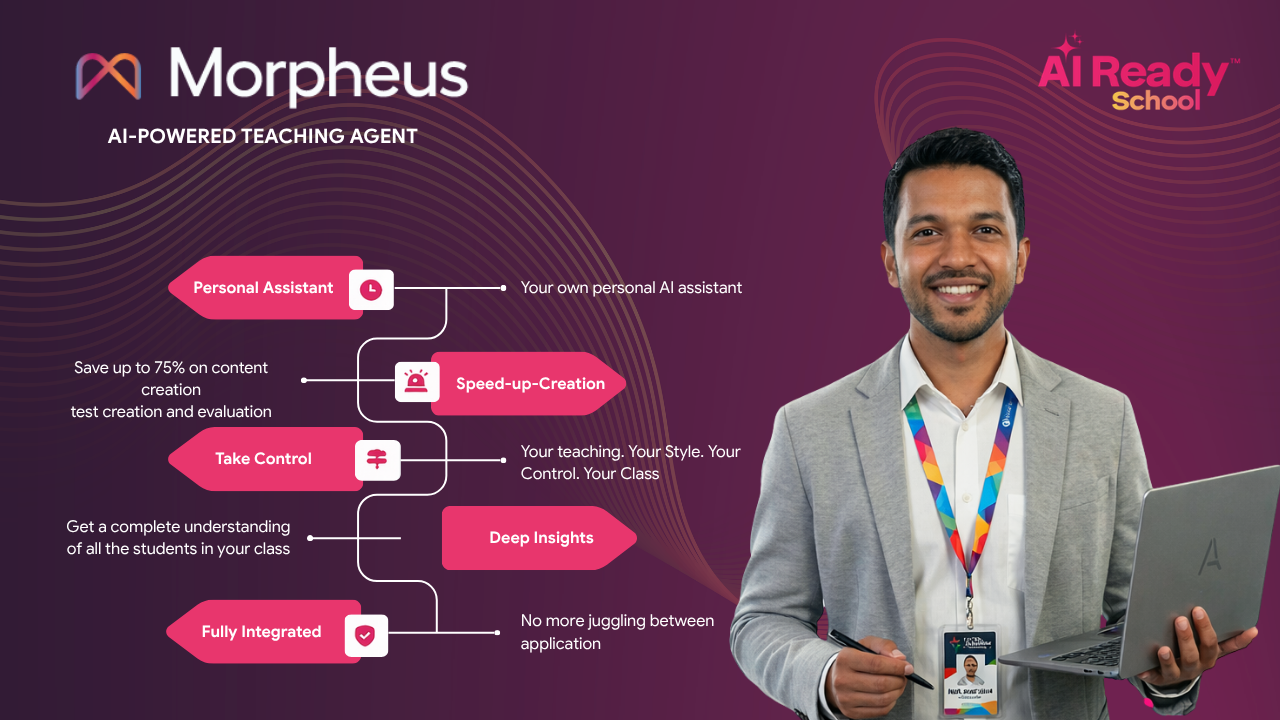
This shift is already visible in the conversations our partner schools are having about teacher professional development. The schools that implemented AI seriously 18 months ago now have a cohort of teachers who have developed genuine AI pedagogical competency — who understand not just how to use Morpheus to generate a lesson plan but how to design a learning sequence that uses AI assistance for the mechanical layer while preserving the teacher's irreplaceable role in the relational and pedagogical layers. These teachers are becoming internally valuable in ways that affect hiring and retention decisions.
At the same time, the AI curriculum mandate creates a qualification expectation that the teacher training system has not yet fully caught up with. A school that needs to deliver AI and Computational Thinking from Class 3 needs teachers who can do that credibly — who can answer student questions about how AI works, who can facilitate original AI research projects, who can assess AI-Sense development rather than just AI tool usage. These teachers are scarce. The schools that have invested in developing them internally have a significant advantage over the schools that are competing in a thin external market.
The World Economic Forum's Future of Jobs Report 2025 identifies teaching as one of the most resilient professions to AI displacement — precisely because the relational and pedagogical dimensions of teaching cannot be automated. But it also identifies AI-specific pedagogical competency as the most important capability for teachers to develop to maintain that resilience. A teacher who can design, deliver, and assess AI education is a teacher who has added a capability that the labour market is beginning to value significantly. A teacher who cannot risks being displaced by teachers who can.
What this means for school leaders: The professional development investment that matters most over the next 12 months is not platform training. It is pedagogical development — helping your teachers develop a genuine philosophy about AI in learning, a genuine competency in designing AI-human learning experiences, and a genuine capability to assess AI-Sense development in students. Platform training produces teachers who can use a tool. Pedagogical development produces teachers who can lead an AI education program.
What AI Ready School is building for this: The Morpheus platform is expanding its teacher professional development capabilities, including structured pedagogical frameworks for AI lesson design, peer learning community tools that connect teachers across partner schools, and competency assessment frameworks that allow schools to document and develop teacher AI pedagogical capability in ways that are meaningful for both professional development and hiring decisions.
Over the next 12 months, the gap between what parents expect from a school that says it uses AI and what most schools actually provide will become the most visible source of differentiation in the Indian private school market.
Parents are increasingly AI-literate themselves. They use AI tools in their professional lives. They understand, at a practical level, the difference between using an AI tool and building genuine AI capability. When a school describes its AI program as "we have ChatGPT for students," a parent who uses AI professionally recognises immediately that this is not an educational program. It is a subscription. The schools that will attract and retain the most demanding parent segments over the next 12 months are the ones whose AI programs are specific enough, measurable enough, and philosophically coherent enough to withstand informed parent scrutiny.
The parents we are seeing engage most deeply with the AI Ready School partner school conversations are not asking whether their child's school has AI. They are asking whether their child is developing genuine AI-Sense — the ability to evaluate AI output critically, understand AI limitations, recognise AI bias, design effective human-AI collaborations, and reason about the ethical dimensions of AI systems. These are parents who have read the same March 2026 research papers that showed AI tool usage without pedagogical structure produces dependency rather than capability. They are not reassured by platform subscriptions. They are reassured by educational philosophy, documented outcomes, and the specific question "what will my child understand about AI that they did not understand before?"
What this means for school leaders: The parent conversation that matters over the next 12 months is not about what AI platform you use. It is about what your AI program is trying to produce in students and whether you can show evidence that it is producing it. Schools that can answer this question specifically — with reference to a defined framework, documented outcomes, and a coherent philosophy — will have a significant admissions and retention advantage over schools that answer it with platform names and subscription counts.
What AI Ready School is building for this: We are developing parent-facing reporting capabilities that translate the Cypher 360-degree learner profile and Morpheus monitoring data into clear, accessible narratives about each child's AI-Sense development. These reports will be specific, evidence-based, and designed to answer the questions that informed parents are now asking — not reassurance, but evidence.
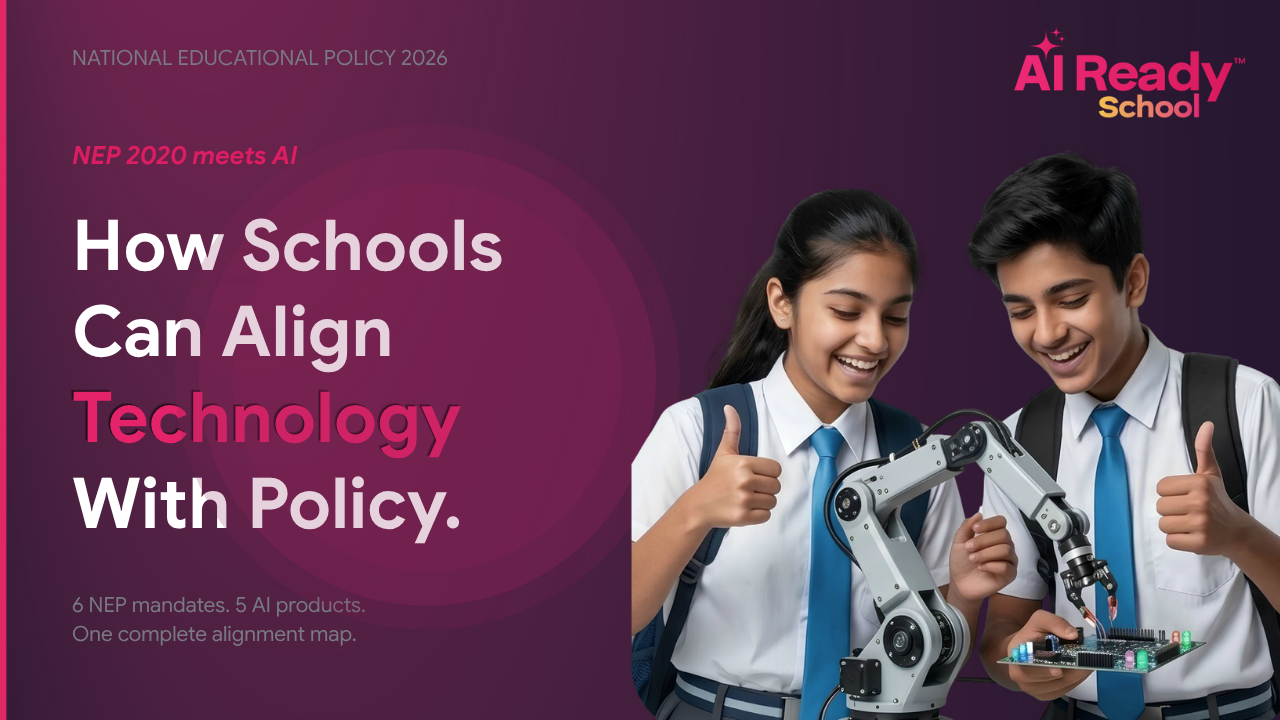
The B.P. Pujari Government School implementation in Raipur was, when it began, an outlier. A government school in Chhattisgarh implementing AI-powered personalised learning was not the scenario that most EdTech companies were designing for. Over the next 12 months, it will stop being an outlier and start being the leading edge of a state-level policy wave.
The evidence from Raipur — 34%, 57%, and 77% improvements across three cognitive levels — is the kind of evidence that state education departments respond to. Not because they are moved by percentages, but because they are moved by what those percentages represent: students in government schools producing analytical outcomes that the system had never expected of them. This evidence, combined with the Ministry of Education's AI curriculum mandate and the decreasing cost of Matrix local infrastructure deployment, creates the conditions for state-level government school AI initiatives that would have seemed implausible 24 months ago.
We are already in conversations with state education departments about multi-school, multi-district deployments. The infrastructure model is clear — Matrix local servers eliminate the connectivity dependency that had previously made government school AI deployment unreliable. The curriculum model is clear — the NEO framework, mapped to state board requirements, provides the structured program that ad hoc tool deployment cannot. The teacher development model is clear — train-the-trainer programs that build internal school capacity rather than creating permanent external dependency.
What has changed is the evidence base and the policy environment. Together, they are creating the conditions for government school AI deployment at a scale that the Indian EdTech ecosystem has not yet seen.
What this means for EdTech investors and policy makers: The government school AI opportunity in India is not a future possibility. It is a current pipeline. The companies that have built for the real conditions of government school deployment — multilingual capability, offline functionality, teacher-first implementation, genuine outcome measurement — are positioned to participate in this expansion. The companies that built for premium urban schools and are now trying to adapt for government school contexts will find that the adaptations required are architectural, not cosmetic.
What AI Ready School is building for this: Multi-school, multi-district deployment capabilities in Matrix, expanded multilingual support in Cypher that extends to more Indian regional languages, and a government partnership framework that positions AI Ready School as a long-term institutional partner rather than a vendor in a transactional relationship.
Each of these seven predictions requires something specific from school leaders who want to be on the right side of the transition rather than the wrong one.
The mandatory curriculum rollout requires a shift from tool acquisition to curriculum architecture. The local infrastructure shift requires a board-level conversation about data governance and compliance before the conversation is forced by a regulatory event. The multimodal agent shift requires a reassessment of whether your current tools are first-generation or second-generation. The competency measurement shift requires a new question about what your AI program is trying to know about students rather than what it is trying to generate for them. The teacher competency shift requires investment in pedagogical development rather than platform training. The parent expectation shift requires the ability to answer specific, informed questions about what your AI program produces rather than what it costs. And the government school expansion requires policy makers to understand that the infrastructure model that makes AI work in government schools is available and proven.
None of these require waiting to see what happens. They require acting on what is already happening.
The schools that will be described, 12 months from now, as the schools that got AI right are not the schools that made the best predictions. They are the schools that acted on accurate predictions before the predictions became obvious. The window for that action is the next 12 months. It will not stay open indefinitely.
The future of AI in education is not uncertain. It is just unevenly distributed. The schools that are already building for it are the schools that will define what it looks like for everyone else.
AI Ready School is building the infrastructure, the curriculum, and the philosophy that the next 12 months require. Cypher for personalised, multimodal student learning. Morpheus for AI-empowered teacher practice and proactive monitoring. Zion for the complete AI tool ecosystem that students and teachers need. NEO for the AI Innovation Lab curriculum that satisfies the mandate and builds genuine AI-Sense. Matrix for the sovereign on-premises infrastructure that makes all of it work in any connectivity environment, under any data governance requirement, at any school size.
To partner with us for the future that is coming, reach out at hey@aireadyschool.com or call +91 9100013885.
Partner With Us for the Future
Human First. AI Next.™

.png)