
Chiranjeevi Maddala
June 22, 2026
This one is for you, not about you. Every other piece written about AI in schools is addressed to your principal, your teacher, or your parent. This one is addressed to you — because by the time you finish Class 12, you will have used AI to write, to research, to study, and to plan your future, whether or not anyone ever explained to you how it actually works. That gap between using something every day and understanding it is exactly where most people get into trouble. Here are five things worth understanding before you walk out of school gates for the last time.
Here is the single most important fact about how the AI tools you use actually work, and almost nobody explains it clearly: a large language model like the one powering ChatGPT, Gemini, or Claude is not looking something up in a database the way Google does. It is predicting, one piece of a word at a time, what is statistically most likely to come next, based on patterns it learned from enormous amounts of text. When you ask it a question, it is not retrieving a stored fact. It is generating a plausible-sounding answer based on probability.
This explains something you have probably already noticed without having the words for it: AI can sound completely confident while being completely wrong. Researchers call this "hallucination" — when a model generates a fabricated fact, a fake citation, or a wrong date with exactly the same fluent, assured tone it uses when it is correct. There is no little flag that appears when the model is guessing versus when it is certain. The sentence looks the same either way.
Once you understand that AI is a prediction engine rather than a knowledge engine, a lot of its behaviour stops being mysterious and starts being predictable. It is excellent at tasks where the most statistically likely answer is also the correct one — summarising a well-known topic, drafting a standard format, explaining a widely taught concept. It is unreliable exactly where the correct answer is rare, recent, highly specific, or requires verified precision — a particular date, a particular statistic, a particular citation, a worked mathematics proof with no room for a plausible-sounding error.
The students who get the most value out of AI are not the ones who trust it completely or distrust it completely. They are the ones who have learned to predict, task by task, whether they are in AI's strength zone or its blind spot.
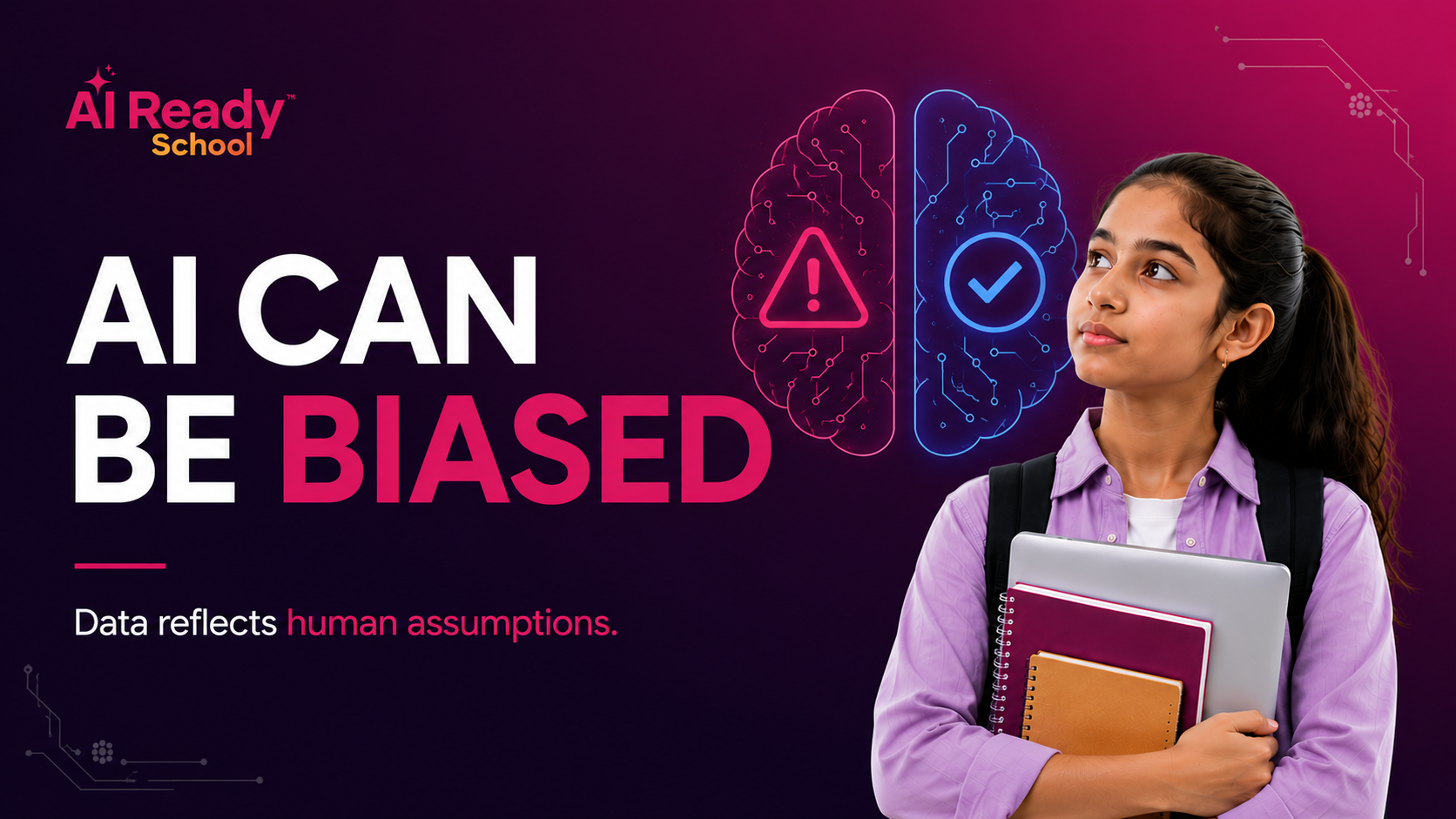
Every AI model is trained on data that someone collected, and every dataset reflects the world that produced it — including that world's imbalances. This is not a hypothetical concern. It is one of the best-documented problems in AI, and the examples are specific enough that you should know them by name.
In 2018, MIT researcher Joy Buolamwini published a study called Gender Shades that tested major commercial facial recognition systems from companies including IBM and Microsoft. The systems correctly identified the gender of light-skinned men with well over 99 percent accuracy. For dark-skinned women, the error rate climbed as high as 35 percent. The cause was not malicious intent. It was a training dataset that simply contained far more images of light-skinned men than anyone else, so the model learned light-skinned male faces best and everything else less well.
A second example matters specifically because of who it happened to: Amazon built an AI tool to screen job applicant resumes, hoping it would speed up hiring. The company discovered the tool was systematically downgrading resumes that included the word "women's" — as in "women's chess club captain" — and penalising graduates of all-women's colleges. Amazon eventually scrapped the tool. The system had learned its preferences from a decade of past hiring decisions at a company, like most companies in that era, that had hired predominantly men into technical roles. It was not designed to be biased. It learned bias from history, and then it repeated that history at scale, automatically, on every resume it touched.
Here is why this matters directly to you, today, in your own classroom: AI writing assistants have been shown to still associate words like "nurse" with women and "engineer" with men far more often than actual employment statistics support. If you ask an AI tool to write a short story about a doctor, a CEO, or a scientist with no other details, pay attention to who it imagines by default. Notice whose name it picks, whose background it assumes, whose accent it implies. That default is not neutral. It is a reflection of the data the model was trained on, and the data was collected by humans living in a particular place, at a particular time, with particular assumptions.
This is not a reason to distrust every AI output. It is a reason to ask, specifically, of any AI-generated content that touches people, identity, or judgment: whose perspective am I looking at right now, and whose is missing?
There is a version of AI anxiety that goes: "AI can write essays, solve equations, and generate code — so what is even left for me to be good at?" It is a reasonable question, and it has a real answer, but the answer is not what most people expect.
AI is extremely good at producing a plausible, well-structured answer once a problem has been clearly defined. It is far weaker at defining the problem in the first place — deciding what actually matters, what the real question underneath the stated question is, what a "good" answer would even look like in a messy, ambiguous, real-world situation. A recent industry guide for engineers entering India's AI job market in 2026 makes exactly this point about what separates a hireable candidate from an unemployable one: the skill that survives automation is judgment, problem definition, and the ability to talk through a decision honestly, not the ability to recite a list of AI tool names.
This is true whether you end up in engineering, medicine, law, design, business, or the arts. AI can draft a contract clause; it cannot decide whether the deal is fair. AI can generate a hundred logo variations; it cannot tell you which one will make a stranger feel something specific. AI can summarise a patient's symptoms against medical literature; it cannot sit with a frightened patient and decide, in the moment, how much to say and how to say it. The line between "AI does this well" and "AI cannot do this at all" runs directly through judgment, context, ethics, and lived human experience — exactly the things a sixteen-year-old is still actively building, every single day, in ways an AI model never will.
The practical implication for how you use AI in your schoolwork right now is straightforward: use it to handle the mechanical parts of a task — drafting, formatting, summarising, generating options — but make sure you are the one doing the parts that require judgment: deciding what the assignment is actually asking, which option is genuinely best and why, what you believe and can defend. If AI is doing your thinking instead of your typing, you are training the wrong muscle.
A pattern researchers have started documenting carefully is what some now call "cognitive debt" — the specific risk that comes from outsourcing too much thinking to AI for too long. Studies on students who rely heavily on AI for writing have found measurably reduced engagement in the brain regions tied to memory, creativity, and sustained reasoning, and that those same students, when later asked to write without AI help, often struggle to recall their own arguments and stay locked into the AI's suggested phrasing rather than generating their own.
This is the clearest argument for a habit worth building now, while you are still in school and the stakes of practising are low: deliberately do some of your hardest thinking without AI at all. Write a first draft with no AI open. Attempt the difficult maths problem fully before checking anything. Sit with confusion for ten minutes longer than feels comfortable before asking for help. The discomfort you feel in that gap is not wasted time. It is the specific mental effort that builds the capability you will need in situations — an exam, an interview, a live debate, a moment with no internet access — where there will be no AI tool to lean on, and where what will matter is what is actually in your own head.
The skill of the next decade is not "knowing how to use AI." Almost everyone will know how to use AI. The skill that will actually distinguish you is knowing precisely when to use it, when to set it aside, and being honestly able to do both.
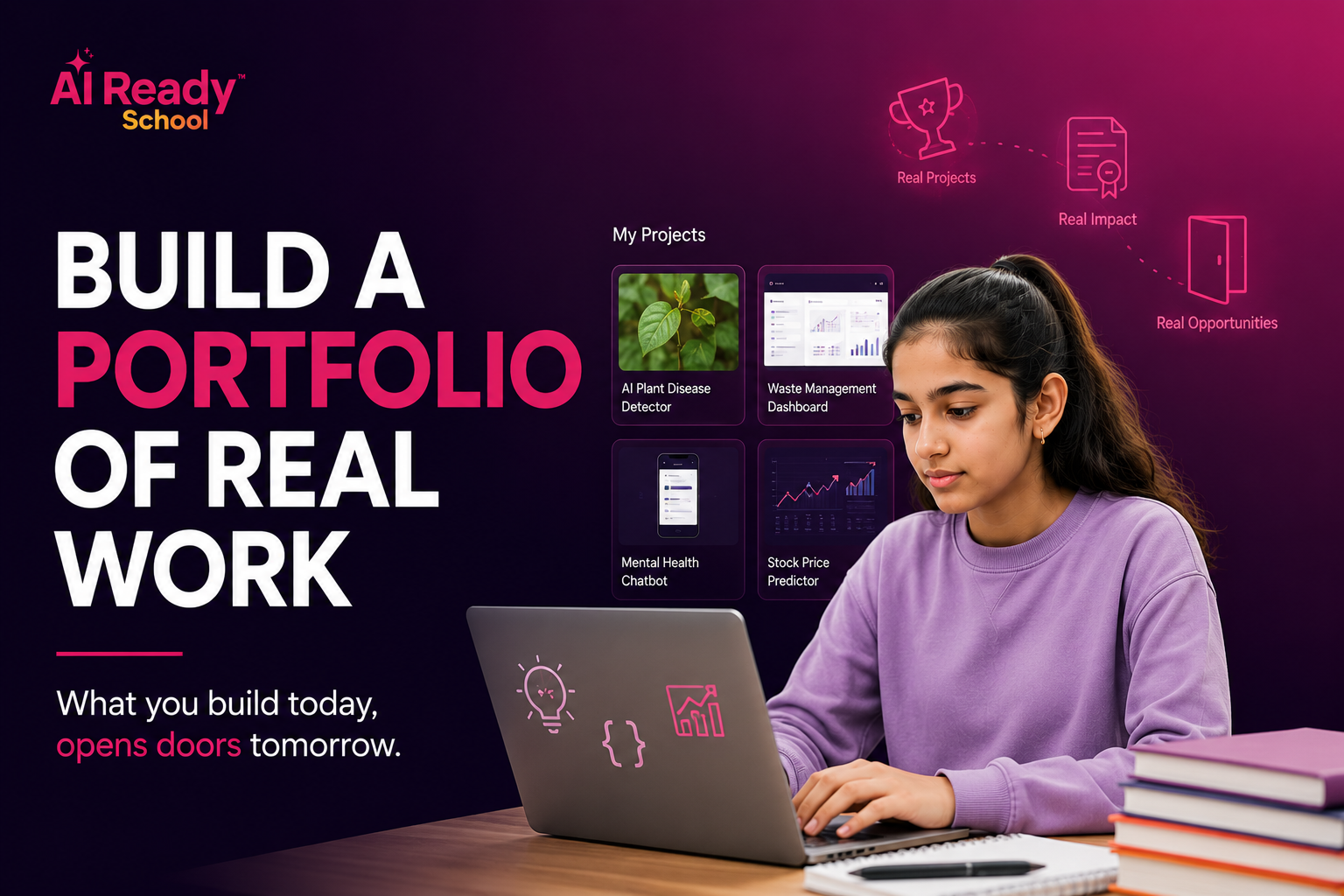
Here is a shift happening right now in how universities and employers evaluate people, and it works directly in your favour if you understand it early. Hiring in India is moving, deliberately and measurably, away from filtering candidates by credentials — which college, which board, which marks — and toward evaluating demonstrated capability: what have you actually built, and can you explain the decisions behind it. Recruiters now openly describe rejecting candidates who list "AI skills" and certificates with nothing to show for them, while moving forward candidates with one specific, real, finished project they can speak about in detail.
This same shift is coming for university admissions and will only accelerate by the time you are applying. A portfolio — a real project you built, a problem you solved, a published piece of writing, a working prototype, a research note with your own analysis in it — says something that a percentage score cannot: that you can take an idea from a question to a finished thing. That is precisely the capability that AI cannot manufacture for you, because the moment you stop directing it and start simply accepting its output, the thing stops being yours.
This is exactly why building something real, early, matters more than it might seem to right now. NEO, AI Ready School's AI Innovation Lab pathway, is structured around precisely this principle: not consuming AI lessons, but building, testing, and publishing real AI projects across every stage of school — from early exploration in the younger grades through to research-level, portfolio-ready work by Class 10 and above. Students in NEO labs have published research papers, built tools used by real organisations, and presented finished work at platforms like the AI Startup Show Juniors. None of that started with a certificate. It started with one specific problem someone decided to actually solve.
If you take one thing from this entire piece, take this: the most valuable thing you can do with your remaining years in school is not collect more AI tool names. It is finish one real thing, end to end, that you can explain, defend, and improve. Start now. The portfolio you have by Class 12 will open more doors than any single exam score, and it is the one thing about your education that AI genuinely cannot do for you — because the moment it does, it is no longer evidence of what you can do.
AI is a powerful prediction engine, not a source of certain truth — check anything that matters. It reflects the data and the world it was trained on, including that world's blind spots and unfairness — notice whose perspective is missing. The skills that will matter most for you are the ones AI genuinely cannot replicate: judgment, problem definition, ethical reasoning, and the willingness to sit with a hard question before reaching for a shortcut. Practise thinking without AI on purpose, regularly, so that skill stays sharp. And build something real — because a portfolio of things you have actually made will say more about you, to any university or employer worth working for, than any score or certificate ever will.
You do not need to fear AI, and you do not need to worship it either. You need to understand it clearly enough to decide, every single time, whether it is helping you think or thinking for you. That decision, made well and made often, is what AI-sense actually means.
AI Ready School helps students build genuine AI capability through hands-on learning, not passive consumption — Cypher (personalised learning companion that builds independent thinking), NEO (AI Innovation Labs where students build, research, and publish real projects), Zion (a safe, governed suite of 30+ AI tools for school-age learners), Morpheus (AI teaching agent for educators), and Matrix (sovereign AI infrastructure) — built on the belief that AI should make students sharper thinkers, not passive ones.
To explore the NEO AI Innovation Lab pathway for your school, reach out at hey@aireadyschool.com or call +91 9100013885.
Human First. AI Next.™

.png)