
Chiranjeevi Maddala
June 9, 2026
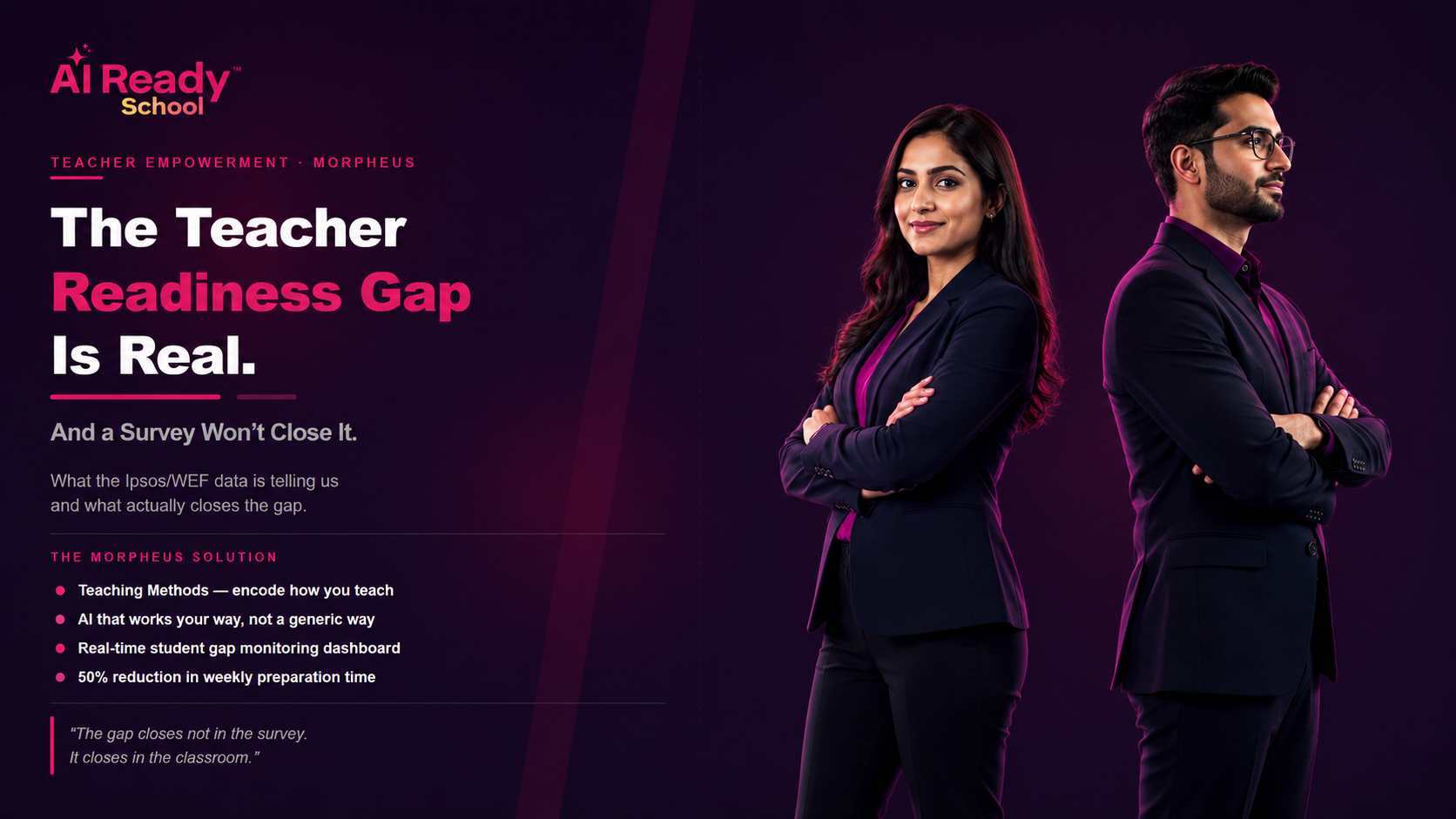
The data is in and it is uncomfortable reading. Teachers around the world acknowledge AI's growing role in education. A striking proportion feel underprepared, anxious, and unsupported when it comes to actually using it. India is no exception. And the dominant response from the EdTech industry — more frameworks, more training modules, more professional development literature — is making the gap wider, not narrower. This blog is about what actually closes it.
An Ipsos survey conducted for the World Economic Forum found exactly what anyone who has spent time in a real school already knew intuitively: teachers are not resistant to AI. They are not technophobes hiding behind chalkboards. They are skilled, committed professionals who have been handed the most significant paradigm shift in the history of their profession and told, in essence, to figure it out.
The numbers from that survey are worth sitting with. The majority of educators acknowledge AI's growing role in the classroom. They want AI to reduce their administrative burden. They want it to help differentiate instruction. They believe — correctly — that their students are already using AI and will use it throughout their careers. The aspiration is genuine and consistent.
But belief in AI's potential is not the same as confidence in one's own ability to deploy it effectively. The anxiety surfaces at the point of practice. When a teacher asks the question that actually matters — "But how do I use this in a way that reflects my pedagogical approach, my school's values, my students' specific needs?" — current tools offer either generic outputs or silence.
In India, this gap has a specific and urgent context. India's Ministry of Education has mandated AI and Computational Thinking from Class 3, effective 2026-27. CBSE Academic Circular Acad-15/2026 requires 50 hours per year for Classes 3-5 and 100 hours per year for Classes 6-8. One crore teachers need to be oriented to AI in two to three years. And the NISHTHA training programme, which will deliver much of this orientation, produces awareness rather than competency — the difference between a teacher who has watched a video about AI pedagogy and a teacher who can walk into their classroom on Monday morning and use AI to make that Monday's lesson genuinely better.
That difference is enormous. And it is the difference that determines whether India's AI curriculum mandate produces genuine educational transformation or expensive compliance theatre.
Teachers are not the obstacle to AI adoption in schools. They are the conduit through which AI adoption either transforms education or fails to. The tools we give them determine which outcome we get.
To be precise about what the Ipsos findings reveal: teachers are not uniformly pessimistic about AI. Many see real potential. The anxiety is not about AI itself. It is about the specific question of professional identity — whether AI in education will amplify what teachers do or replace it, whether the tools being built are designed around teachers or designed around a vision of education in which teachers are increasingly peripheral.
This anxiety is rational. The history of EdTech is full of products that were announced as teacher empowerment tools and deployed as teacher replacement mechanisms. Interactive whiteboards were going to transform pedagogy. Tablet programs were going to personalise learning. MOOCs were going to democratise education. Each technology arrived with genuine potential and each, in most implementations, was absorbed into existing structures with minimal impact on the quality of what happened in classrooms — because the technology was not designed around the teacher's professional reality.
The teachers who are anxious about AI are not anxious without reason. They are anxious because the pattern is familiar: a new technology arrives, generates enormous enthusiasm among administrators and vendors, is rolled out at institutional speed, and leaves individual teachers to figure out — on their own time, with their own cognitive resources — how to make it work in the specific, complex, relationship-intensive environment of their own classroom.
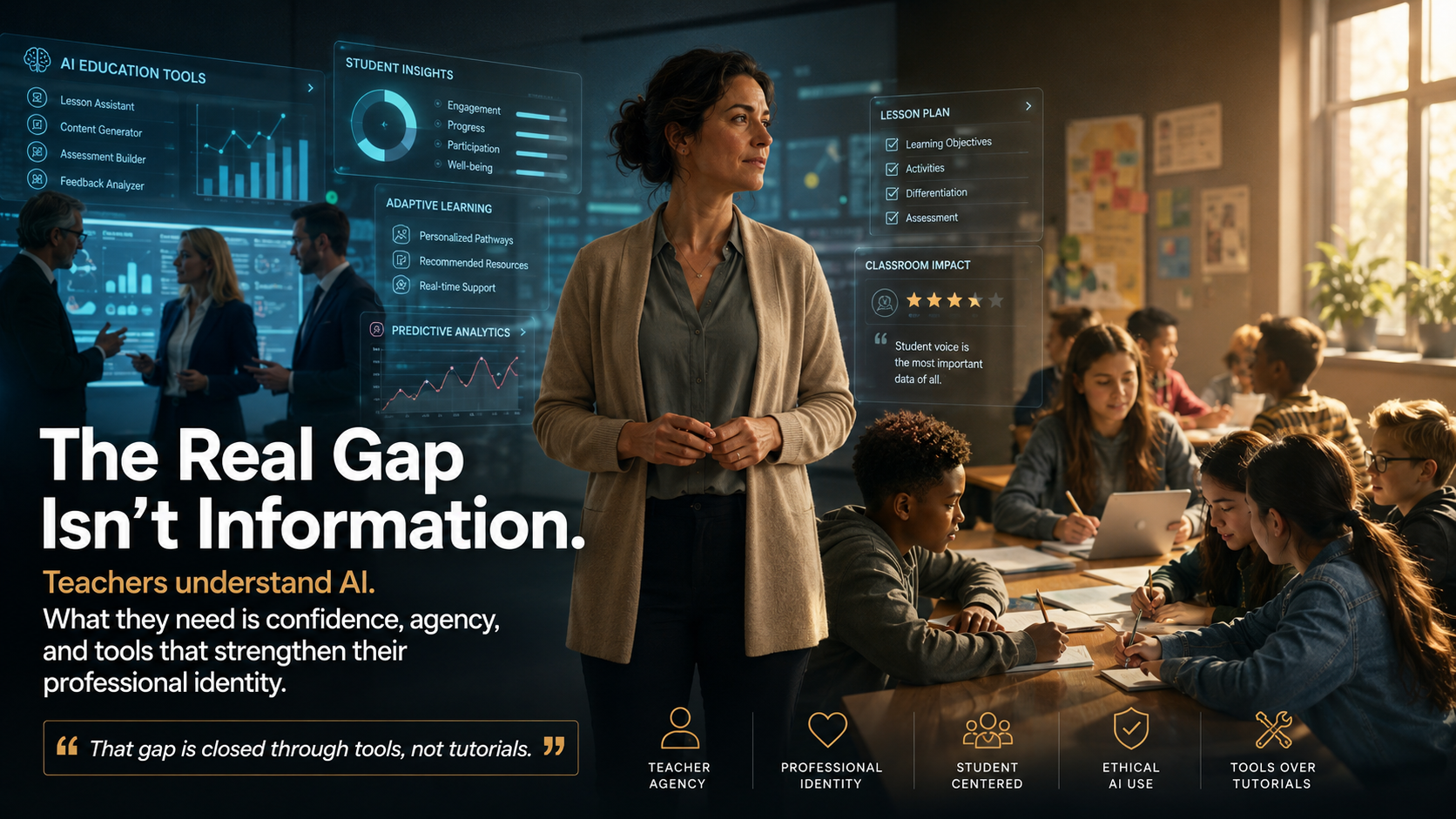
What the data is not telling us is that teachers need more information about AI. The information is not the gap. Awareness is not the gap. Every teacher with a smartphone has access to unlimited information about AI in education. The gap is confidence and agency — the specific belief that they can use AI effectively in a way that reflects their professional identity and serves their students rather than being dictated by a technology that does not know them.
That gap is closed through tools, not tutorials.
Consider what happens when a teacher, tentatively beginning to engage with AI, uses a general-purpose tool to generate a lesson plan. The output arrives: competent, comprehensive, well-formatted, and completely divorced from the way that teacher actually runs their classroom.
It does not reflect their preferred Socratic questioning approach. It does not account for the discussion-heavy, argument-driven culture they have spent years building with their students. It does not carry their voice — the specific way they frame problems, the examples they use, the level of challenge they know their particular class can handle. It is a lesson plan that could have been written for any teacher, which means it was written for no teacher in particular.
The teacher now faces a choice. They can adopt the AI-generated lesson as it stands — which feels foreign, which requires them to teach in a way that is not natural to them, and which produces a lesson that their students will notice is somehow different and somehow less. Or they can spend forty minutes reshaping it until it sounds like them, at which point the AI has added to their workload rather than reducing it.
Neither outcome builds confidence. Neither outcome reduces the preparation burden. Both outcomes quietly reinforce the suspicion that AI is a tool designed for someone else — for a generic teacher who does not exist, teaching a generic class that has no individual students, delivering a generic curriculum that has no specific context.
This is not a technology failure. It is a design failure. The tools were built around content delivery — around the what of teaching — and missed the most important variable in the room: the how. The teacher's pedagogical identity. The way they have learned, over years of practice, to create the conditions in which their specific students learn best.
When Mansi Sharma, TGT English at NH Goel World School in Raipur, describes what changed for her after using Morpheus: "I used to spend every Sunday evening preparing lesson materials for Monday. Now I spend that time thinking about how to actually teach the lesson — not just assembling it." That distinction — between assembling content and thinking about pedagogy — is the distinction that generic AI misses entirely. And it is the distinction that determines whether AI in schools produces better teachers or more efficient content generators.
India's teacher readiness challenge is not identical to the challenge described in the Ipsos survey, but it shares the same core structure. The specific Indian version has three dimensions that compound each other.
Dimension 1: Volume and speed. Training one crore teachers in two to three years is a logistical challenge of extraordinary scale. The NISHTHA platform will deliver training at scale. But scale-delivered training — video modules, standardised content, common assessments — produces the minimum viable outcome: a teacher who has been told about AI. It does not produce the outcome that actually matters: a teacher whose professional practice has been genuinely changed by AI.
The schools that will close the teacher readiness gap are the schools that go beyond NISHTHA. They are the schools that give teachers tools that work, immediately, in their specific teaching context. Because a teacher who saves two hours on Sunday night using Morpheus has more evidence that AI is useful to them than any number of hours of NISHTHA video can provide.
Dimension 2: Diversity of context. India's teacher population is more contextually diverse than almost any other country's. A CBSE teacher in a premium private school in Hyderabad, an ICSE teacher in a rural school in Maharashtra, a Hindi-medium state board teacher in Chhattisgarh, and an IB teacher in an international school in Bengaluru are not four versions of the same professional. They teach different curricula, in different languages, with different student populations, under different assessment frameworks, with different resource levels, and with pedagogical traditions shaped by very different professional development contexts.
A single AI tool designed for a generic teacher will fail each of them in specific ways. The tool that generates CBSE-aligned content cannot help the IB teacher. The tool that works in English cannot help the Hindi-medium teacher. The tool that assumes classroom technology access cannot work for the teacher in a single-room school with unreliable electricity.
The teacher readiness gap in India is not one gap. It is many specific gaps, each requiring a specific solution.
Dimension 3: Professional trust. Indian teachers have, on the whole, more reason to be skeptical about technology-driven educational reform than their counterparts in developed countries. They have seen digital initiatives announced, resourced, and then quietly abandoned. They have participated in training events that produced no lasting change in their practice. They have watched EdTech companies arrive, generate enthusiasm, and disappear when the pilot funding ended.
Earning the professional trust of Indian teachers requires demonstrating, specifically and quickly, that the tool makes their Tuesday better than their Monday. Not in theory. In practice. The teacher who sees the Morpheus monitoring dashboard surface a specific student gap that she had not detected in three years of teaching that student — that teacher's relationship with AI has changed permanently. Not because she read about it. Because she saw it work.
This is the specific problem that Morpheus, AI Ready School's AI Teaching Agent, was architecturally designed to solve. And the solution lies in a capability that most AI teaching tools do not have: the ability to encode the teacher's pedagogical identity as a directive.
Most AI teaching tools allow educators to specify what to teach. Board, grade, subject, chapter — these are the inputs. The AI generates content aligned to those specifications. This is useful. It is not transformative.
Morpheus allows educators to specify how to teach — and then holds itself to that standard across every output it generates.
Teaching Methods is the feature that operationalises this. It allows educators to define their own pedagogical approach — inquiry-based, Socratic, project-centred, direct instruction, flipped classroom, discussion-driven — and encode that approach as the framework within which all Morpheus outputs must be generated.
A teacher who favours inquiry-based learning encodes that. Every lesson plan Morpheus generates for that teacher opens with a real-world problem rather than a content delivery structure. A teacher who uses the Socratic method encodes that. Every question set Morpheus generates for that teacher is designed to reveal thinking rather than test recall. A teacher whose school subscribes to a specific differentiated instruction framework encodes that. Every assessment Morpheus generates for that teacher is calibrated to multiple learning levels from the outset rather than being uniform and requiring manual differentiation after the fact.
The AI teaches their way. Not a generic way. Not a curriculum committee's standardised way. Theirs.
This matters for the teacher readiness gap because confidence and professional identity are the same thing in the teaching profession. A teacher who feels that AI is producing outputs that sound like them — that reflect the way they have learned to teach, the judgments they have developed through years of practice, the pedagogical commitments that define their professional identity — is a teacher whose anxiety about AI is replaced by ownership of it.
A framework to read is not a problem solved. A tool that works the way you work is.
The abstraction becomes concrete when you see it in specific teaching contexts.
The Physics teacher in Raipur. Jayesh Agrawal, PGT Physics at NH Goel World School, had a specific challenge: his most effective lessons were built around real-world physical phenomena before the formal concepts were introduced. When he used generic AI tools, the lessons arrived concept-first — which worked for students who could manage abstraction but left behind the students who needed the concrete anchor first. With Morpheus and Teaching Methods encoding his phenomenon-first approach, every Morpheus-generated Physics lesson begins with the observable phenomenon his students can encounter, question, and investigate before the formal concept is named.
The Mathematics teacher building problem-solving culture. Ankit Ahuja, PGT Mathematics at Ryan International School in Raipur, had invested years in building a classroom culture where mathematical reasoning was valued over answer-getting. Generic AI-generated assessments undermined this culture — they rewarded correct answers produced through memorised procedures rather than mathematical thinking. With Teaching Methods encoding his reasoning-first assessment philosophy, Morpheus generates assessments that require students to explain their approach, identify where their reasoning could have gone differently, and evaluate the solutions of fictional students. The culture he built is protected rather than eroded.
The multilingual government school teacher. In schools like B.P. Pujari Government School in Raipur, teachers are navigating a linguistic reality that most AI tools ignore entirely: students whose thinking happens in Chhattisgarhi or Hindi are being assessed in a second language. Morpheus's multilingual capability, combined with Teaching Methods that encode first-language scaffolding approaches, allows these teachers to generate content that meets students in the language their understanding is actually built in — before moving to the formal language of assessment.
The school with a shared pedagogical framework. For school networks and chains, Teaching Methods is not just an individual teacher tool. A school leadership team that has invested in a specific pedagogical framework — Project Based Learning, Visible Thinking Routines, STEM integration — can encode that framework at the school level. Every teacher on the platform generates content that is already aligned with the school's educational philosophy. The AI becomes a vehicle for institutional pedagogical coherence rather than a fragmentation tool that produces different approaches in every classroom.
The conversation happening in progressive school systems in India and internationally is consistent in its language: teachers need to feel agency, not anxiety. They need AI tools that make them more effective at what they already do well — not tools that ask them to wholesale reinvent their professional practice to accommodate a technology's design assumptions.
The school leaders asking this question are not asking for more AI pilots to observe. They are asking for implementable, teacher-centred solutions that reduce the readiness gap without adding to teacher burden. They are asking for tools that earn teacher trust by demonstrating value quickly, specifically, and on the teacher's own terms.
AI Ready School's answer to this question is a coherent architecture, not a single product. Morpheus addresses the teacher's pedagogical identity through Teaching Methods. Cypher's Socratic learning model addresses the student's cognitive development by asking better questions. Zion's 30+ governed tools give students a safe, curriculum-aligned environment for AI-assisted learning that the teacher has full visibility over. Matrix ensures that none of this depends on reliable external connectivity and that all student data stays within school-owned infrastructure.
The architecture works because it was designed around the most important variable in the room: the teacher. Not the content. Not the technology. The teacher.

The WEF-Ipsos survey finding is not primarily a finding about teachers. It is a finding about school leadership decisions.
Teachers who feel unprepared, anxious, and unsupported did not choose to feel that way. They feel that way because the tools they were given, the training they received, and the support structures available to them produced those feelings rather than the alternative. The readiness gap is not a teacher gap. It is an institutional design gap.
The school leader who reads the Ipsos data and asks "how do we address our teachers' AI anxiety?" is asking the right question. The school leader who answers that question with more professional development reading material, more AI literacy frameworks, or more training events that do not produce lasting change in practice, is not answering the right question. They are applying a solution to the wrong problem.
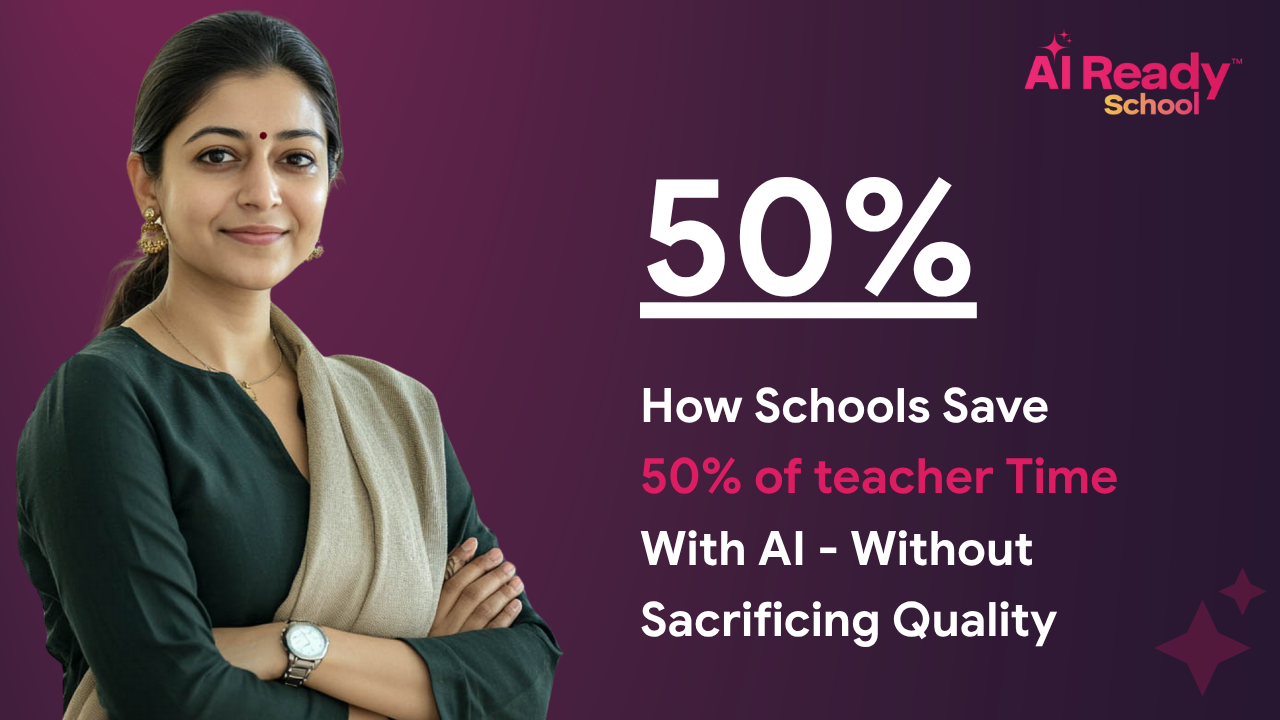
The right answer to teacher AI anxiety is not information. It is a tool that works so clearly and so immediately in the teacher's specific professional context that the anxiety has nowhere to live. The teacher who uses Morpheus on a Friday and saves two hours of weekend preparation has evidence of value that no training document can provide. The teacher who sees the monitoring dashboard surface a student's specific learning gap on a Tuesday and addresses it by Thursday has evidence of value that no framework can replicate. That evidence, accumulating session by session and week by week, is what actually closes the readiness gap.
AI-ready teachers are not teachers who have passed an AI literacy module. They are teachers whose professional practice has been genuinely amplified by AI that understands how they teach, not just what they teach.
The abstract argument becomes concrete in the specific Monday morning experience of a teacher who has gone through AI Ready School's implementation process.
Monday begins not on Monday but on Friday or Saturday, when the teacher opens Morpheus and specifies the week's lesson requirements. Board, grade, subject, chapter, and — critically — Teaching Method. The configuration takes five minutes.
Morpheus generates a complete lesson package aligned to the specified board, the specified chapter, and the teacher's encoded pedagogical approach. The package includes structured lesson notes with the narrative the teacher needs to guide students through the content, activities designed according to the teacher's preferred learning framework, discussion questions calibrated to reveal thinking rather than test recall, and an assessment that can be assigned at the end of the unit.
The teacher reviews the package. They modify the elements that do not fit their specific class — a different example, a different framing of a question, a different challenge level for a specific group of students. The modification takes 20 minutes rather than the two hours the generation itself would have taken from scratch.
On Monday morning, the teacher walks into the classroom with a lesson that sounds like them, is built around their pedagogical commitments, and is fully aligned to the CBSE or ICSE or state board curriculum. They teach. Students learn. And while the lesson is happening — while the teacher is doing the relational, responsive, human work that only teachers can do — Cypher is recording every student interaction, and the Morpheus monitoring dashboard is building the real-time picture of what every student understood, what they are still uncertain about, and what specific gap in which specific student needs teacher attention before next Monday.
That is not a technology transformation story. That is a professional empowerment story. And it is the story that every school in India — from the government school in Raipur to the international school in Hyderabad — should be building for its teachers right now.
The EdTech industry owes teachers more than whitepapers. The Ipsos data reveals not a knowledge gap but a confidence and agency gap — and those are closed through tools, not tutorials.
AI Ready Teachers are not teachers who have passed an AI literacy module. They are teachers whose professional practice has been genuinely amplified by AI that understands how they teach, not just what they teach. They are teachers who have moved from anxious observers of AI's advance to active co-creators of AI-enhanced learning environments.
The measure of success in AI education is not how many teachers have read about AI. It is not how many training events have been conducted, how many certificates have been issued, or how many frameworks have been distributed. It is how many teachers walk into their classroom on Monday morning and feel — for the first time — that the AI is working for them.
That is where the teacher readiness gap closes. Not in the survey. Not in the training module. In the classroom.
The teacher who feels that AI understands how they teach is the teacher who is ready to use AI. Everything else is preparation for that moment.
AI Ready School provides a complete AI ecosystem for K-12 schools including Cypher (personalised learning companion), Morpheus (AI teaching agent with Teaching Methods), Zion (safe AI tool suite), NEO (AI Innovation Labs), and Matrix (sovereign AI infrastructure). Every product in the ecosystem was designed around the teacher's professional identity as the foundational design principle.
To see Morpheus Teaching Methods in action with your school's specific curriculum and pedagogical context, reach out at hey@aireadyschool.com or call +91 9100013885.
Human First. AI Next.™