
Chiranjeevi Maddala
May 30, 2026
The most common reason AI implementations fail in schools is not the technology. It is not the budget. It is not the infrastructure. It is a staffroom conversation that happened in the third week of the rollout, between two teachers who had not been adequately prepared, that produced a conclusion that spread through the school faster than any training session ever could. This blog is about preventing that conversation.
Let us begin with an honest number. Across AI Ready School's implementation experience and the broader EdTech research literature, the same figure appears consistently: approximately 60% of school AI implementations either stall before reaching full deployment or plateau at superficial adoption — teachers who technically have access to the platform but do not use it in ways that change what happens in classrooms.
The vendors who report this figure typically attribute it to change management challenges, which is accurate but not specific enough to be useful. The principals who experience it typically attribute it to resistant teachers, which is specific but not accurate. Teacher resistance is real. But it is almost never what it appears to be, and treating it as the primary problem produces interventions that make it worse rather than better.
This blog gives you the honest diagnosis of why teacher resistance happens, what it actually is beneath the surface, and the specific sequence of interventions that addresses it at the root rather than at the symptom.
Teacher resistance is not the problem you need to solve. It is the signal that tells you which problem you have not yet solved.
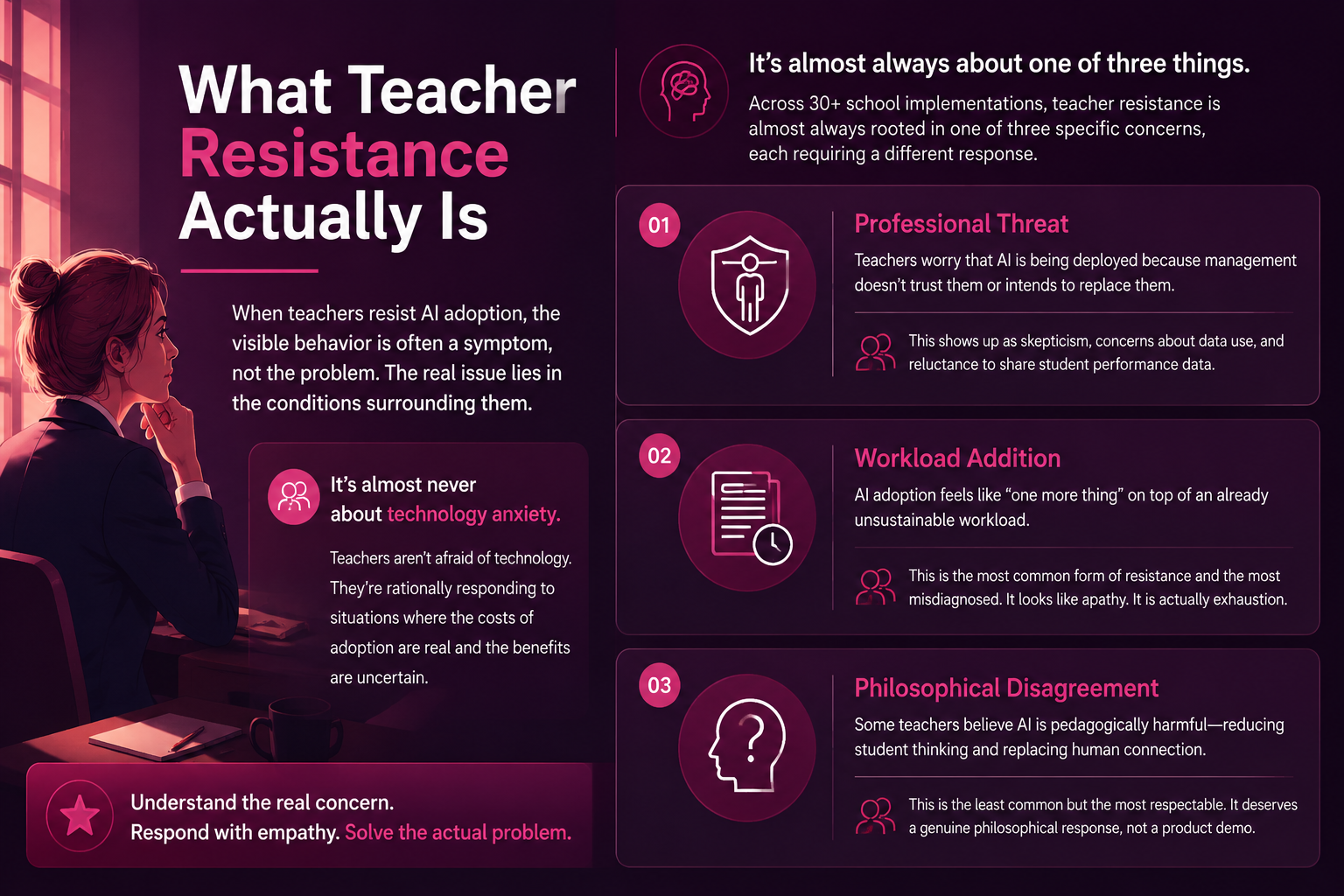
When a teacher resists AI adoption, the visible behaviour — reluctance to engage with training, minimal platform usage, vocal skepticism in staff meetings — looks like a problem with the teacher. The actual problem is almost never with the teacher. It is with one or more of the conditions that surround the teacher.
Understanding this distinction is the foundation of everything that follows, because the interventions that work for the actual problem are completely different from the interventions that work for the apparent problem.
It is almost never about technology anxiety.
The popular explanation for teacher resistance — that teachers are afraid of technology, are not tech-savvy, or are simply too old to adapt — is not supported by evidence and is condescending to a profession that has been adapting to new tools throughout its history. Teachers who appear to resist AI are not, in the vast majority of cases, afraid of the technology itself. They are rationally responding to a situation in which the costs of adoption are visible and the benefits are uncertain.
A teacher who adds a new platform to their professional practice without understanding why it will help them teach better is taking on a real cost — learning time, adjustment time, the risk of looking incompetent in front of students while they are still figuring out the tool — for an uncertain benefit. That is not technology anxiety. That is rational professional calculus.
It is almost always about one of three things.
In our experience across 30+ school implementations, teacher resistance is almost always rooted in one of three specific concerns, each of which requires a different response.
The first is professional threat. The teacher who believes that AI is being deployed because school management does not trust them to do their job well — or because management intends to replace them with a cheaper automated system — will resist AI adoption as an act of professional self-preservation. This concern is rarely stated directly. It appears as general skepticism about the platform, questions about what the data will be used for, and reluctance to have students generate performance data that the teacher believes will be used to evaluate their own effectiveness.
The second is workload addition. The teacher who experiences AI adoption as one more thing added to an already unsustainable professional load — another platform to learn, another dashboard to check, another administrative system to navigate — will resist it with the quiet, persistent non-engagement of someone who has simply run out of capacity. This is the most common form of resistance and the most misdiagnosed. It looks like apathy. It is actually exhaustion.
The third is philosophical disagreement. The teacher who genuinely believes that AI in education is pedagogically harmful — that it reduces student thinking, creates dependency, and substitutes technology for the human relationships that education requires — will resist it as a matter of professional principle. This is the least common form of resistance and the most respectable. It deserves a genuine philosophical response, not a product demonstration.
Form 1: Professional Threat
The teacher who is resisting AI because they perceive it as a threat to their professional standing needs one thing above all others: evidence that the school's leadership genuinely believes what they say about AI empowering teachers rather than replacing them. Not words. Evidence.
Evidence means that the first thing teachers see AI doing is saving them time on tasks they find burdensome, not generating performance data about their students that goes directly to management. Evidence means that teachers control the monitoring dashboard data rather than having it reported over their heads. Evidence means that the teachers who engage most deeply with the platform are recognised and valued rather than used as benchmarks against which others are evaluated.
The sequence matters. If the first AI capability a teacher encounters is a dashboard showing their class's learning gaps — data that feels like surveillance — resistance will deepen. If the first AI capability they encounter is a lesson planning tool that saves them two hours on Sunday evening, skepticism begins to soften. The platform is the same. The order in which its capabilities are introduced determines whether it feels like empowerment or monitoring.
At AI Ready School, Morpheus is always introduced as a teacher productivity tool before it is introduced as a monitoring system. The teacher who has experienced the lesson planning capability and the assessment generation capability is a teacher who has direct, personal evidence that the platform is on their side. That evidence changes how they receive the monitoring dashboard when it is introduced — not as surveillance but as a tool that gives them more specific information about what their students need.
The teacher who has saved three hours of Sunday preparation time before they see their first student monitoring dashboard is a teacher who is ready to use the monitoring dashboard well.
Form 2: Workload Addition
The teacher who is resisting AI because they are experiencing it as an addition to an impossible workload needs two things: time and a visible replacement.
Time means that training, exploration, and the early stages of platform use must be scheduled into protected professional time rather than added to existing responsibilities. The teacher who is expected to learn a new platform during their lunch break, after school, or over weekends while maintaining their full teaching load is not being offered an opportunity. They are being offered another burden. Even the most beneficial tool feels burdensome when the time to learn it is stolen from the few unstructured hours that prevent professional exhaustion from becoming burnout.
Protected professional time for AI adoption is not a luxury. It is the difference between an implementation that succeeds and one that stalls. In schools where implementation has succeeded, leadership has typically found time through reduced administrative meeting loads, restructured professional development schedules, or temporary reductions in non-teaching duties for the early adopter cohort. The message this sends — that the school considers the investment of teacher time as important as the investment of financial resources — is received clearly.
A visible replacement means that teachers can see, specifically, what the AI is doing instead of them. Not what it is doing for them in some abstract future state, but what it is doing instead of a specific task they did last week. The teacher who spent four hours creating a unit assessment last month and can see that Morpheus produces a comparable assessment in 12 minutes is not experiencing AI as an addition to their workload. They are experiencing it as a subtraction from it.
The practical implication is that the first training session for any new teacher cohort should not introduce the full platform. It should introduce the single feature that is most likely to produce immediate, visible time savings for that specific cohort. For most teachers, this is Morpheus's lesson content generator. For assessment-heavy teachers, it is the assessment generator. For teachers who spend significant time on progress reporting, it is the monitoring dashboard's parent report generation capability.
Start with the subtraction, not the addition. Show teachers what AI takes off their plate before you show them what it puts on it.
Form 3: Philosophical Disagreement
The teacher who is resisting AI because they genuinely believe it is pedagogically harmful deserves a genuinely philosophical response. Not a product demonstration. Not a feature list. A real engagement with the pedagogical argument.
The argument most commonly made by philosophically resistant teachers is one of two: either that AI makes students dependent and reduces the cognitive effort that produces genuine learning, or that AI in education reduces the human relationships that are central to how children develop. Both arguments are not only legitimate but are explicitly acknowledged in AI Ready School's philosophy and reflected in product design.
Cypher was built specifically to address the first argument. An AI that gives students answers is an AI that reduces cognitive effort. An AI that asks students better questions — that is designed around the Socratic method rather than the answer-delivery model — develops cognitive effort rather than replacing it. The teacher who is concerned about AI creating student dependency should be shown the specific research on AI learning companions that optimise for engagement versus those that optimise for understanding, and shown where Cypher sits on that spectrum.
The Human First, AI Next philosophy directly addresses the second argument. AI Ready School's position that the teacher is the most important person in any AI implementation — that Morpheus saves teacher time so that teachers have more capacity for the relational work that only they can do — is not a marketing position. It is a design principle that runs through every product decision. The teacher who is concerned about AI reducing human relationships should be introduced to teachers at partner schools who have experienced the opposite: that having AI handle the mechanical layer of their professional life has given them more time and more presence for the students who need human connection most.
Philosophical resistance that is engaged with honestly and specifically does not always convert to enthusiasm. But it frequently converts to the respectful engagement of a professional who does not agree with every decision but trusts that the decisions are being made thoughtfully. That is enough. You do not need every teacher to be an advocate. You need every teacher to be a fair witness to what the implementation actually produces.
The single most effective change schools can make to reduce teacher resistance before it develops is to invert the standard onboarding sequence. Most AI implementations begin with platform training. They should begin with philosophy.
Philosophy first means that before any teacher opens a dashboard, they understand three things specifically.
First: why this school decided to adopt AI, in the specific language of what the school believes about the relationship between AI and education. Not the vendor's language. The principal's language. The school's own articulation of what it believes AI can do for its teachers and students and what it will not allow AI to do. Teachers who hear their principal say, in their own words, "we believe this tool should save you time so you can spend more of it doing the work that only you can do" receive a different message than teachers who receive a vendor presentation about platform features.
Second: what the school's explicit commitments are about how AI data will and will not be used. Teachers need to hear, directly and specifically, that monitoring dashboard data about student learning will not be used to evaluate teacher performance, that platform engagement statistics will not appear in performance reviews, and that the data belongs to the students and the teachers who serve them rather than to management systems that evaluate them. These commitments should be written down and distributed, not just spoken in a meeting.
Third: what the school is prepared to do to make adoption achievable. Not what teachers are expected to do to adopt the platform — what the school is prepared to do to make that adoption possible. Protected time. Reduced administrative load during the implementation period. Clear access to support when things do not work as expected. An explicit acknowledgment that the first three months will involve learning that includes uncertainty and occasional frustration, and that this is expected rather than a sign that someone has failed.
This sequence — the school's commitment before the platform's features — does not eliminate resistance. Nothing eliminates it entirely. But it shifts the starting position from skepticism to cautious openness, and cautious openness is all you need to produce the early wins that then do the work of shifting cautious openness to genuine engagement.
Every successful AI implementation we have seen across 30+ schools has expanded through the same mechanism: peer-to-peer learning driven by visible, specific, honest testimony from a trusted colleague. None of them have expanded primarily through top-down mandates, training events, or administrative requirements.
The implication is practical and counter-intuitive. The most important investment in reducing teacher resistance is not a better training program. It is the creation of conditions where the teachers who have genuinely positive early experiences share those experiences honestly with colleagues who have not yet had them.
This requires three specific structures. The first is protected informal time. Peer learning does not happen in scheduled professional development sessions. It happens in staffrooms, in corridors between classes, over lunch. The school that restructures its professional schedule to create more unscheduled time for teachers to interact with each other — not about administrative matters but about their actual teaching experience — creates more peer learning than any amount of structured professional development.
The second is a storytelling culture. Teachers need to hear specific, honest, personal stories about what AI tools have done for their colleagues — not success narratives designed to persuade, but genuine accounts of what worked, what did not, and what changed. The AI champion who says "here is the specific thing I tried this week and here is exactly what happened — including the part that did not go as expected" creates more adoption motivation than the one who says "this platform is amazing and you should all try it."
The third is public recognition without pressure. The teachers who are doing interesting work with AI tools should be recognised — in staff meetings, in school communications — in ways that create aspiration without creating pressure. Recognition that says "look at the interesting thing this teacher is doing" creates curiosity. Recognition that says "look at how this teacher is doing it right, implying others are doing it wrong" creates resentment.
The peer learning model works because it bypasses the defensive reactions that official communications trigger. A management announcement about AI adoption activates professional self-protection instincts. A colleague saying "honestly, this thing saved me two hours on Sunday and I did not expect it to" activates professional curiosity. The same information, delivered through different channels, produces completely different responses.
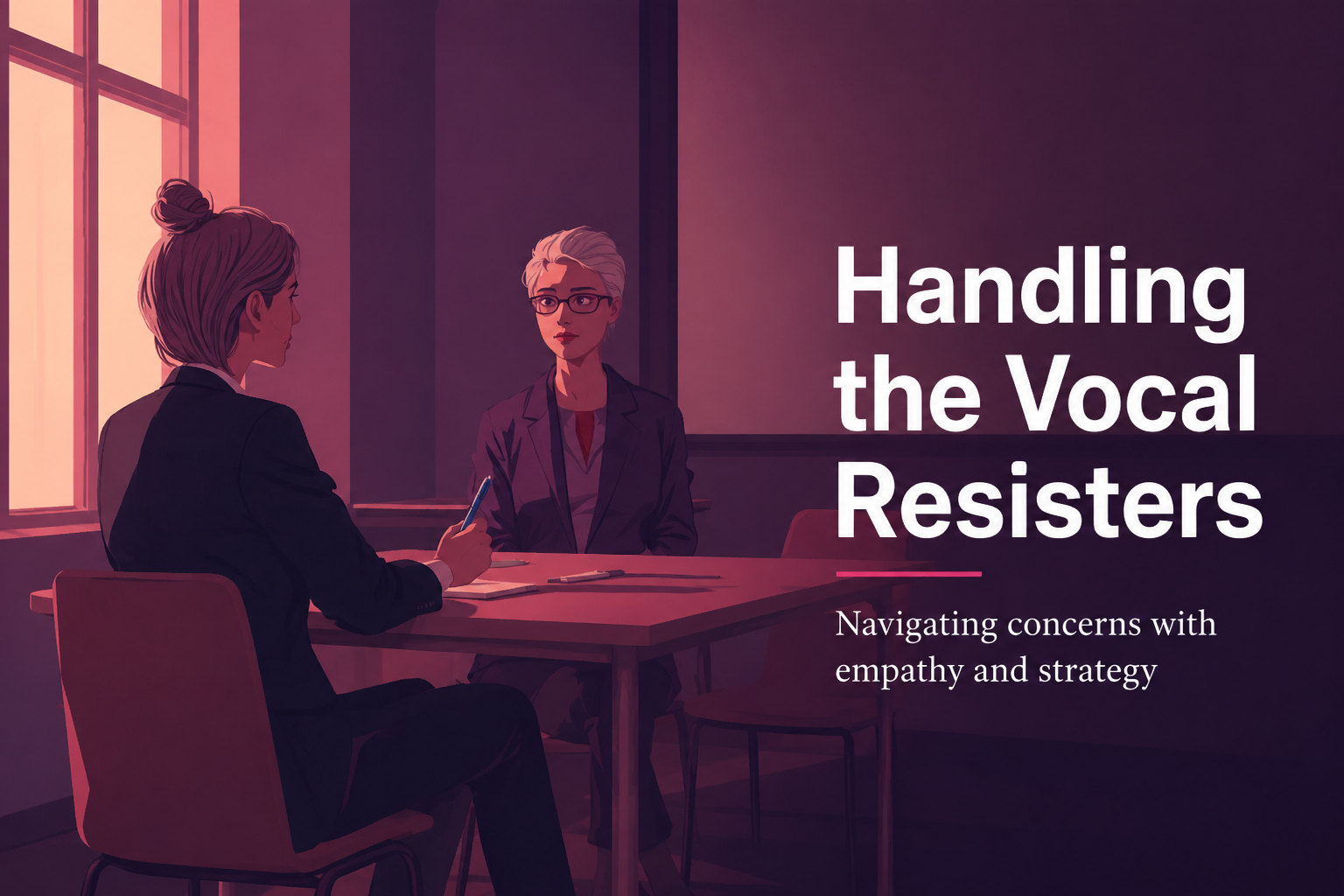
Every implementation has two or three teachers whose resistance is public, persistent, and — if not handled well — contagious. These teachers are not a majority. They are a visible minority whose volume can distort an outsider's assessment of the whole staff's position. Handling them well is different from silencing them, which is both impossible and counterproductive.
The framework that works has four steps.
Step 1: Listen specifically. The vocal resister deserves a private conversation in which you genuinely try to understand the specific basis of their objection. Not to overcome it, not to reassure them, but to understand it. Ask what specifically concerns them, what they have seen or experienced that has produced the concern, and what they would need to see to change their assessment. Take notes. They will notice that you are taking notes.
Step 2: Respond to the specific objection, not to the resistance. If the objection is about data governance, respond with the specific data governance framework. If it is about pedagogical harm, respond with the specific research. If it is about workload addition, respond with the specific plan to protect time. Do not respond to vocal resistance with enthusiasm about the platform. Respond to the specific concern with specific evidence.
Step 3: Give them a bounded experiment. Invite the vocal resister to try one specific, bounded use of the platform — not the full implementation, but one feature, in one class, for four weeks — and agree in advance that they will report honestly on what they found at the end of that period. This is not a trap. It is a genuine offer of controlled engagement that gives the resister agency and gives you the opportunity to demonstrate rather than assert.
Step 4: Accept the outcome. If the vocal resister completes the bounded experiment and maintains their negative assessment, accept that assessment with genuine respect. A teacher who tried something in good faith and found it genuinely unhelpful for their specific teaching context has earned the right to their conclusion. The school that respects that conclusion — while continuing the broader implementation — will find that the public resister often becomes a private respecter, which is enough.
What you must not do is argue, dismiss, pressure, or publicly counter the vocal resister's concerns in staff settings. Every one of these responses entrenches resistance rather than reducing it, and makes every other teacher in the room wonder whether their own concerns would be treated with similar dismissal.
Resistance does not disappear. It evolves. Understanding the typical timeline helps leaders know whether what they are observing is normal or signals a structural problem that needs attention.
Weeks 1 to 3: Resistance peaks. The platform is new, the training was recent and may not have produced genuine confidence, and the early adopters are still in the phase where problems are more visible than benefits. This is the period when the staffroom conversations most need to be shaped by honest, specific positive testimony from the early adopter cohort. Leaders who interpret this phase as evidence that the implementation is failing and either accelerate pressure or retreat from commitment produce the worst outcomes.
Weeks 4 to 8: Resistance among the early adopter cohort begins to ease as genuine capability develops and the first visible benefits accumulate. Resistance in the broader staff remains stable or increases slightly as the early cohort's growing confidence makes the gap between them and their colleagues more visible. This is the period when peer learning conversations begin to shift from "how is that new thing going?" to "show me what you did."
Weeks 9 to 16: If the peer learning structures are in place, organic expansion begins. The second cohort starts their training with a fundamentally different starting position than the first — they have colleagues who have genuine experience to share. Resistance in the remaining staff settles into the three categories described above, each of which can now be addressed specifically because the implementation has enough real experience behind it to provide genuine responses.
Months 5 and beyond: The implementation has either become part of how the school works or it has stalled. The difference between these two outcomes is almost entirely determined by decisions made in Weeks 1 to 8. Schools that invested in philosophy before platform, protected time before training requirements, and peer learning structures before top-down mandates during those early weeks are in the first category. Schools that did not are in the second.
Teacher resistance is information. It tells you what your teachers need to trust the implementation, what the school has not yet communicated clearly, what support has not yet been provided, and what philosophical questions have not yet been genuinely engaged with. The school that responds to resistance as information — that asks "what is this telling us?" rather than "how do we overcome this?" — builds the implementation on a foundation of genuine teacher engagement that produces outcomes durable enough to survive the inevitable challenges that every implementation faces.
The school that responds to resistance as a problem to be managed produces compliance that looks like adoption until the principal's attention moves to the next priority, at which point the compliance quietly dissolves and the expensive platform returns to shelf furniture status.
Your teachers are not the obstacle to AI adoption in your school. They are the conduit through which AI adoption either transforms your school or fails to. Treat them accordingly.
The implementation that addresses teacher resistance honestly will be slower to start and stronger to finish than the implementation that tries to overcome it. Slow and strong is the only kind of implementation worth building.
AI Ready School provides structured teacher onboarding support as part of every implementation partnership, including philosophy-first training frameworks, peer learning community structures, and AI champion development programs. Morpheus is designed to be introduced as a teacher productivity tool before a monitoring system — because we understand that trust precedes adoption, and adoption precedes outcomes.
To access our teacher onboarding framework or discuss your school's implementation approach, reach out at hey@aireadyschool.com or call +91 9100013885.
Access Our Teacher Onboarding Framework
Human First. AI Next.™

.png)