
Chiranjeevi Maddala
August 14, 2026
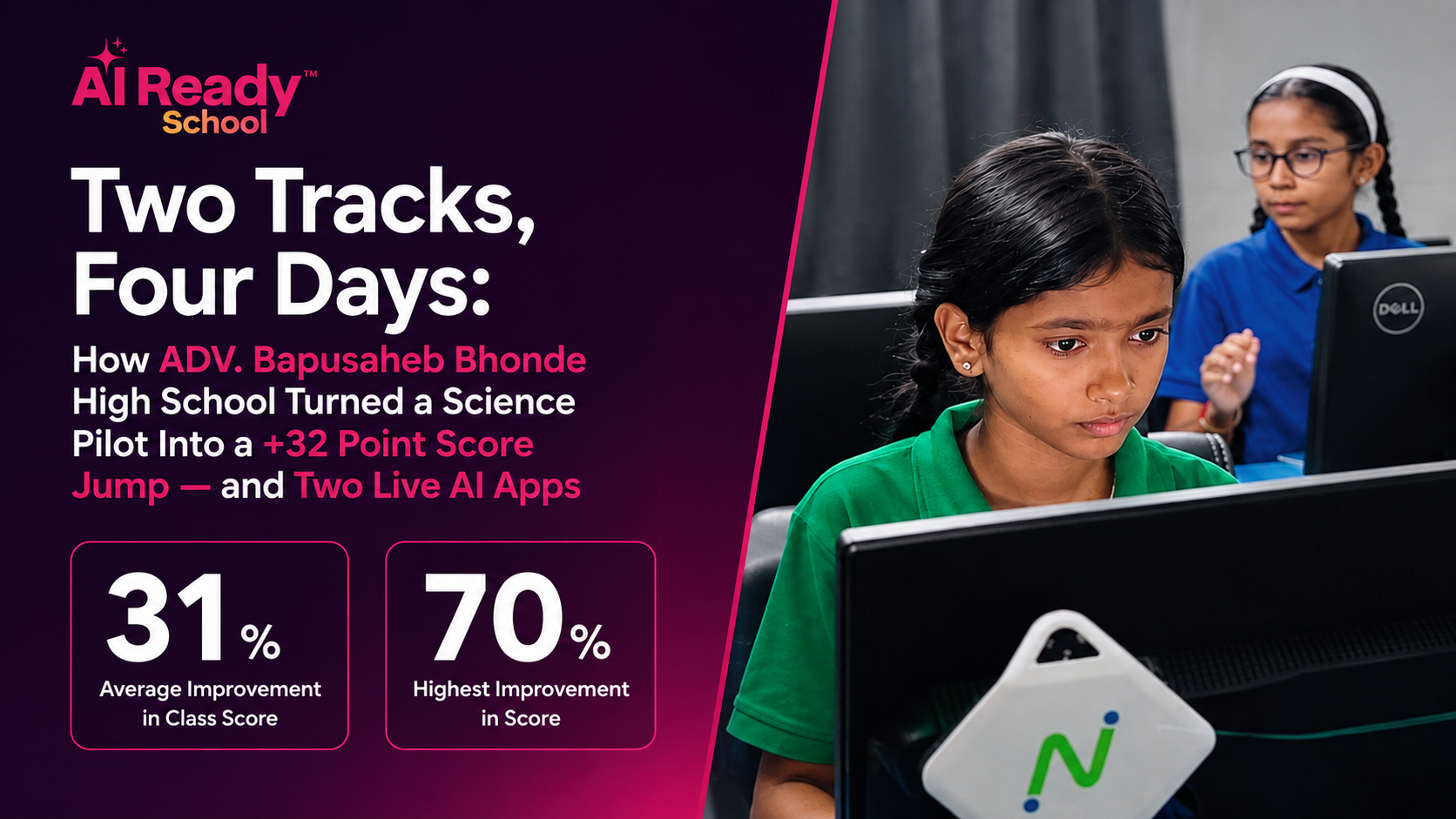
Most AIRS pilots test one thing: can students learn a lesson better with the platform than without it. The pilot at ADV. Bapusaheb Bhonde High School in Lonavala tested that too — and the class average moved from 27% to 59% doing it — but it also ran a second, parallel track most schools don't ask for: eight 13-year-olds built and deployed real, live AI applications in four days. This is the story of both tracks, plus what three teachers told us afterward, on the record, including the parts that weren't glowing.
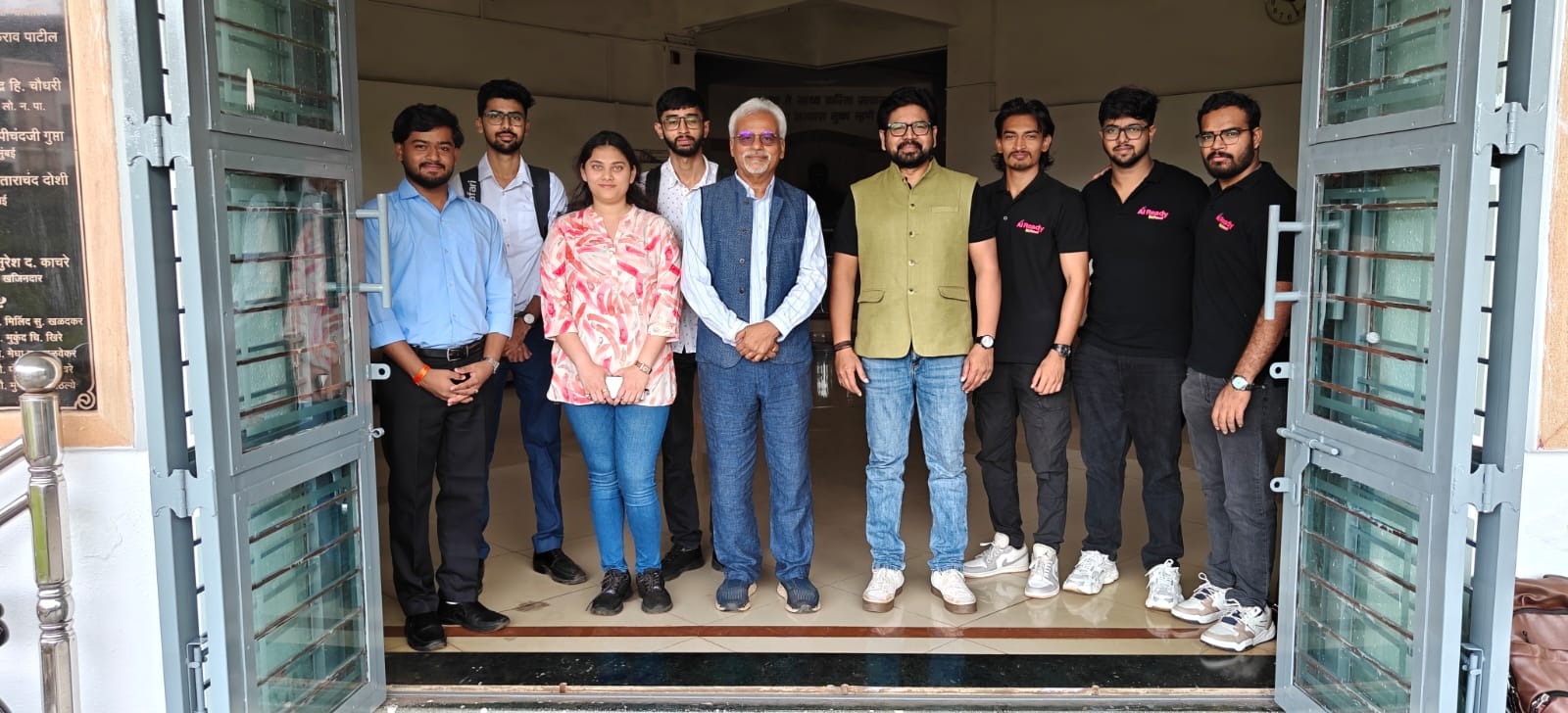
The AI Ready School team first met Dr. Jagdish Kalyandurgmath at the AI Impact Summit, where they showcased the platform's capabilities. Dr. Jagdish sits on the governing body that oversees ADV. Bapusaheb Bhonde High School and Kalpana Chawla Space Academy, both on the same campus in Lonavala — and he was keen to bring AIRS in as part of a broader set of institutional initiatives.
Dr. Jagdish and the school's teachers attended a demonstration in April. They were impressed but had real questions, so AIRS proposed a 15-day pilot to let teachers experience the platform's full functionality — both Learning with AI and Learning about AI. When the team arrived in Lonavala on 21 June, the school itself turned out to have a distinct character: an unaided, trust-run institution charging roughly ₹20,000 per student per year, with facilities — including ten fully equipped space-mission labs at the adjoining Kalpana Chawla Space Academy — well beyond what that number would suggest.
Based on past experience, the team had braced for some resistance to an AI-related initiative. They found the opposite: thanks to the governing body's foresight, all three teachers had already attended a two-day workshop on AI tools for teaching, held just fifteen days before the pilot began. That head start mattered. On arrival, the team compressed the plan from two weeks to four days — but asked for full-day access rather than the usual one-hour sessions, which the school agreed to. The pilot ran 22–25 June.
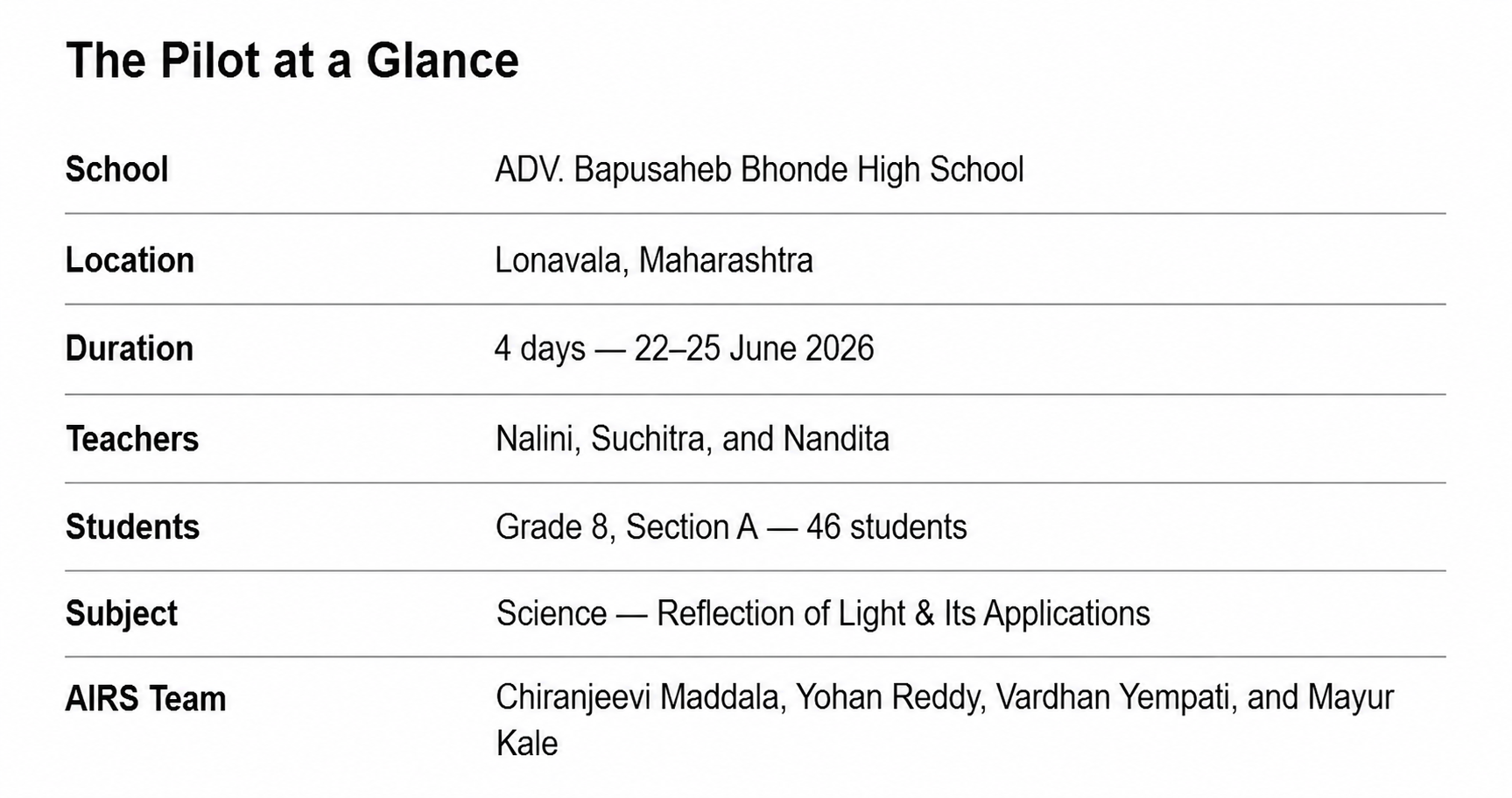
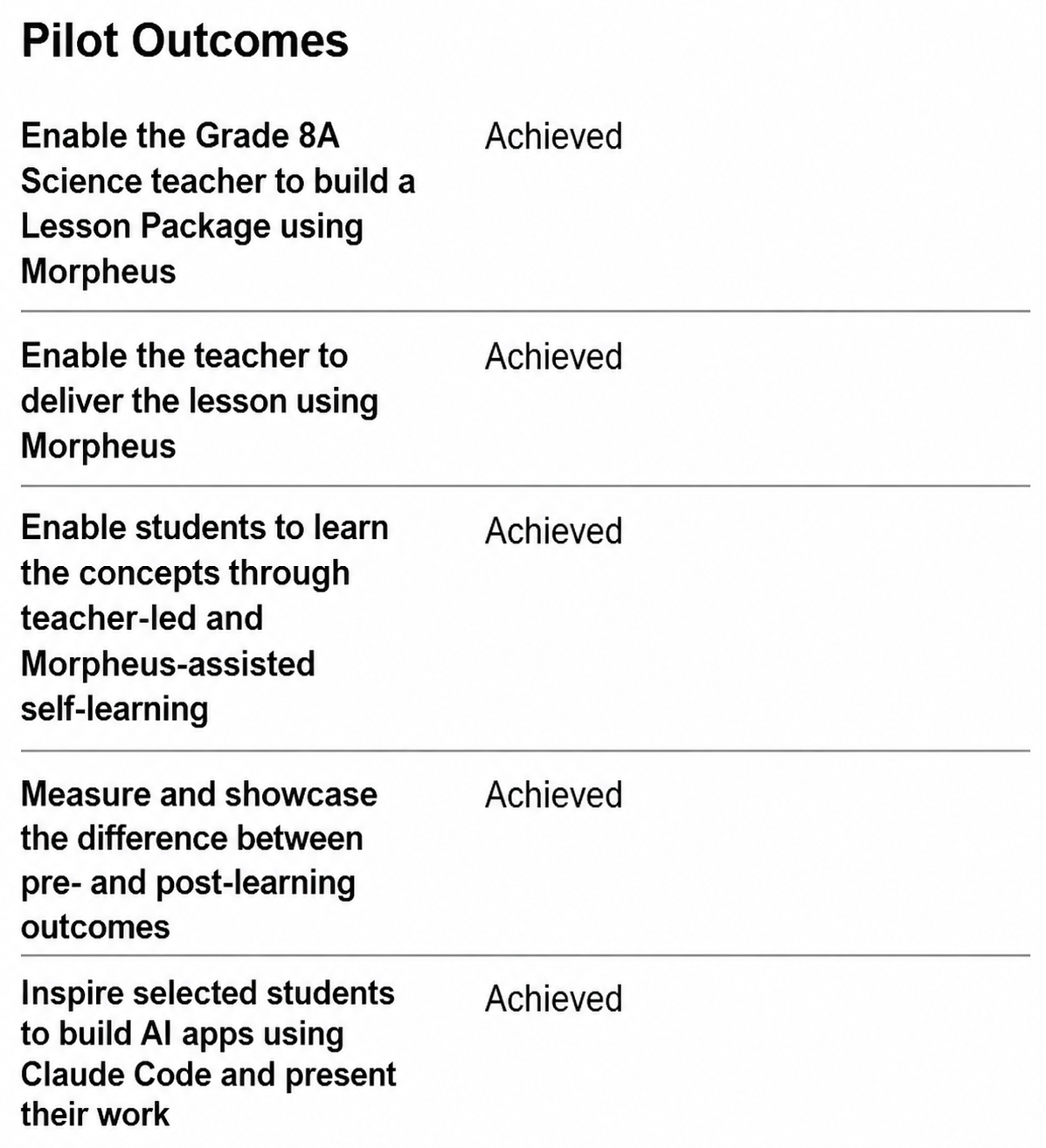
Two objectives sat behind the design. The primary one: evaluate how AIRS helps teachers streamline lesson planning, content configuration, activities, and assessment, and how it gives teachers deeper insight into student progress and struggles. The secondary one: spark genuine curiosity about AI in students, enough to make them want to keep experimenting with it. Both, as it turned out, needed their own track.
Compressing a two-week pilot into four full days meant the schedule had to be tight from the outset. This is the actual day-by-day plan the team ran, not a simplified version of it:
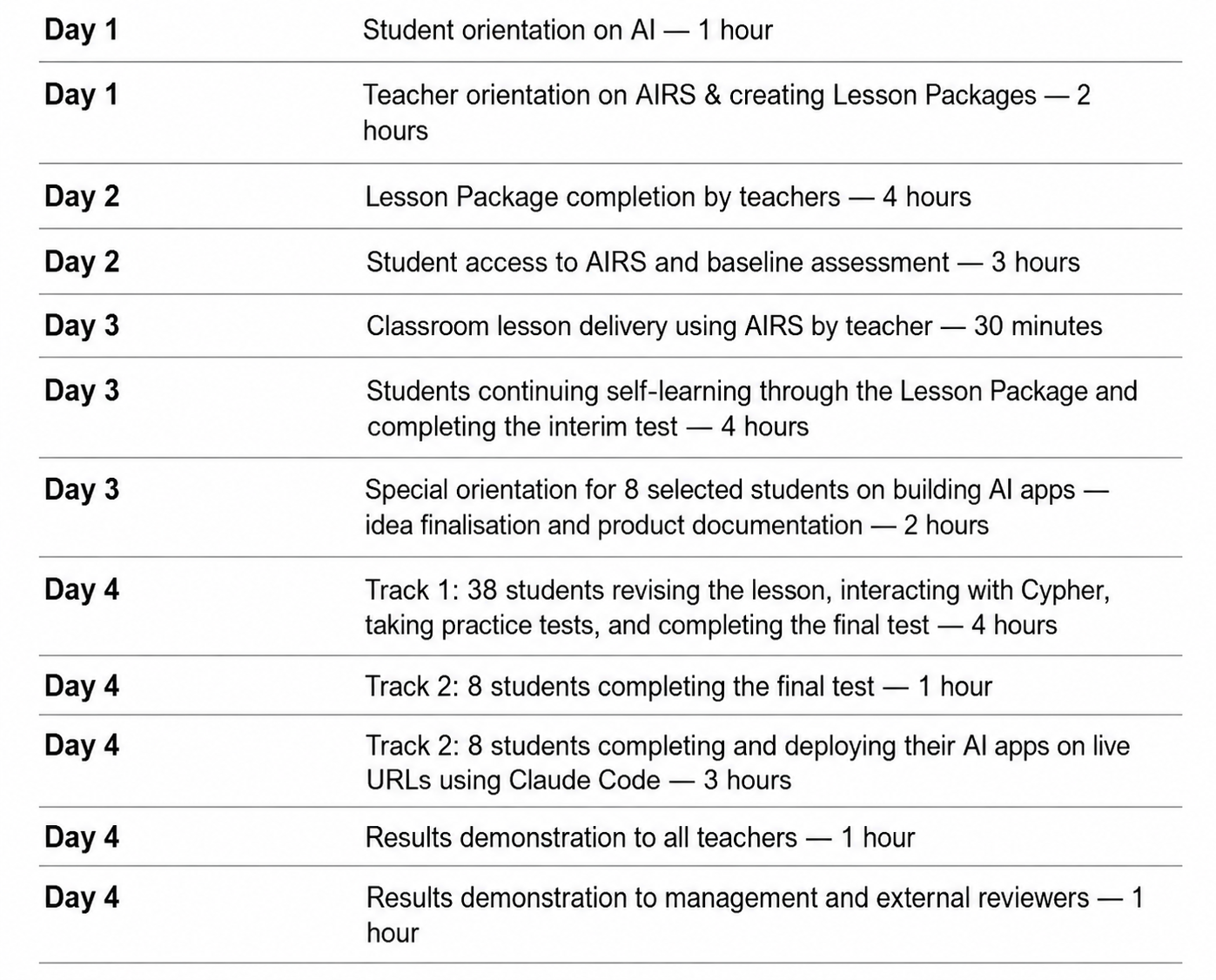
The baseline test was built in consultation with Nalini ma'am; the final test was designed independently by the AIRS team. The intent was specific: measure the shift from what students already knew coming in from a previous grade to what they understood after learning through Morpheus — not just whether scores went up.
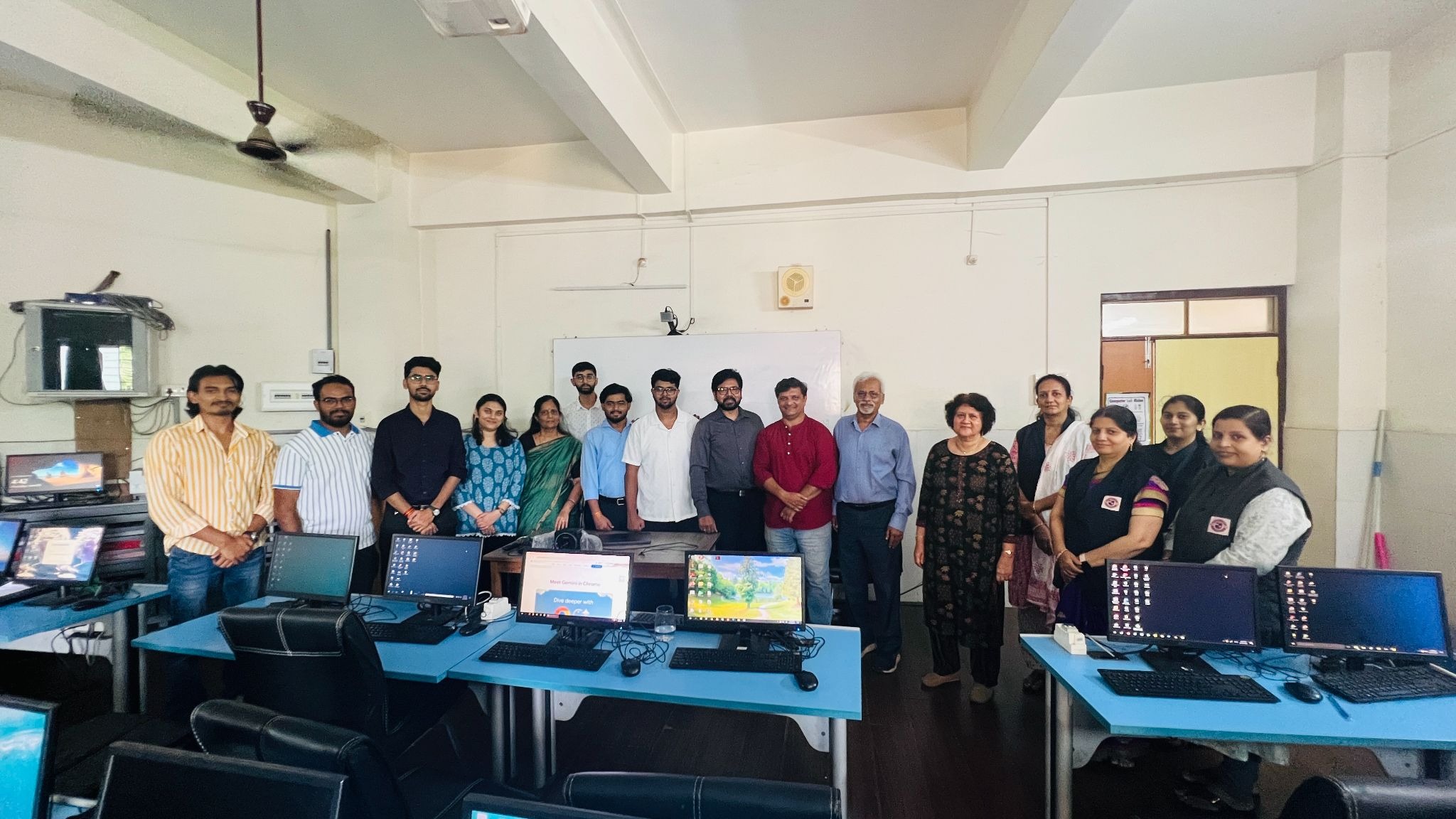
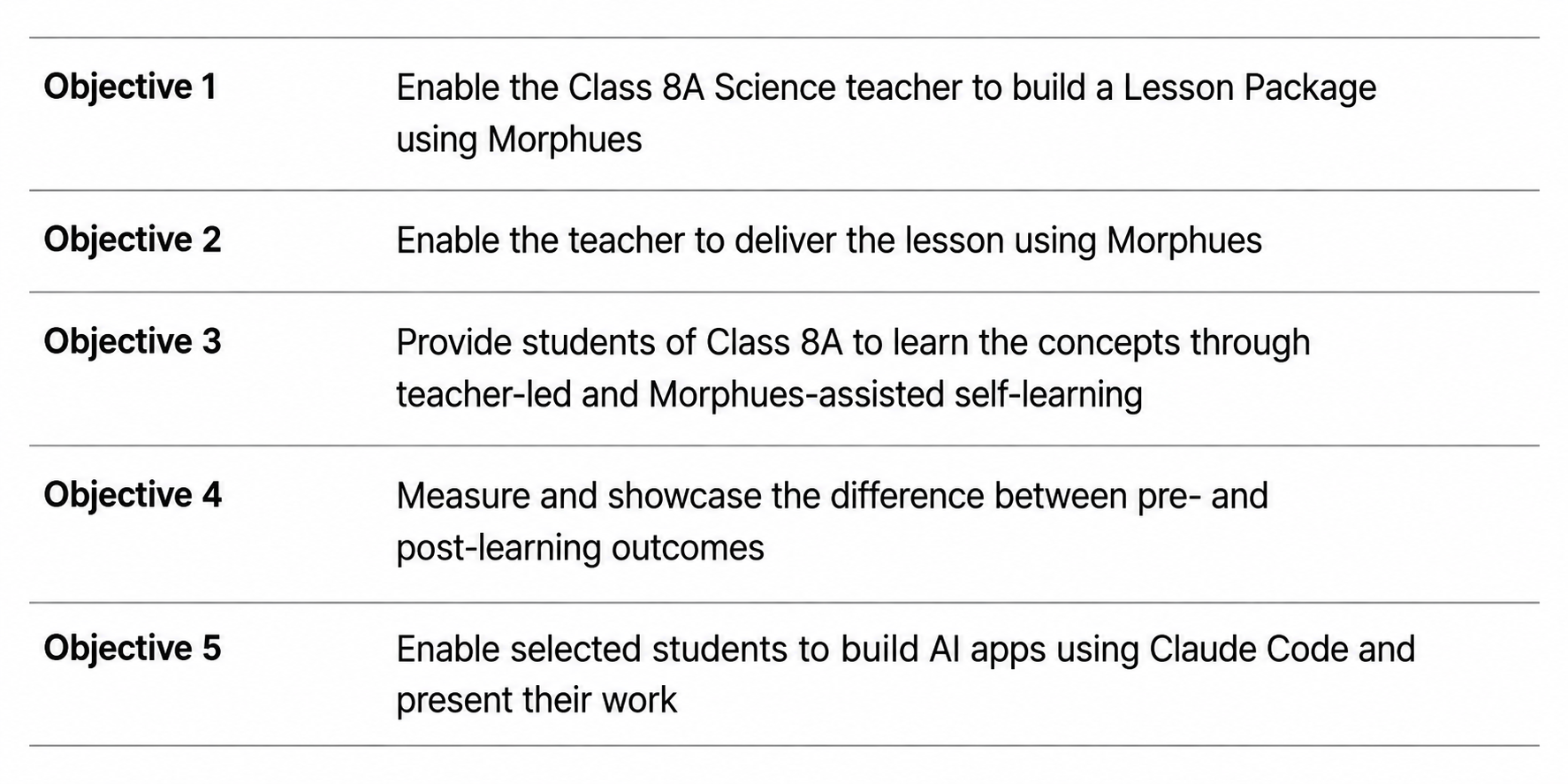
Most of the class — Track 1 — followed the standard AIRS pilot design: a baseline test, a teacher-built lesson delivered through Morpheus, self-paced learning with Cypher, and a final test on the same material. But eight students who showed particular curiosity on Day 1 were pulled into Track 2 — Innovation — where they'd spend the same four days identifying a real-world problem, writing a concept document, and building and deploying an actual working AI application using Claude Code. Nobody in Track 2 skipped Track 1's testing; they simply carried both at once.

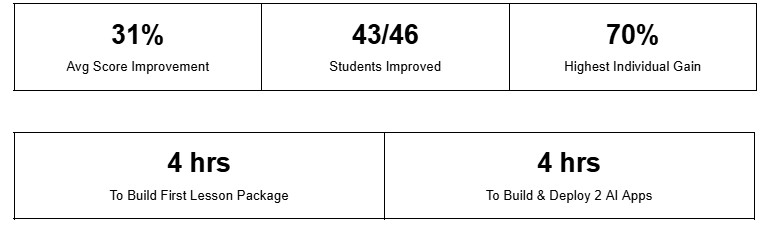
In four days and one lesson, the class average moved from 27% to 59% — a +32 point gain — with the highest individual improvement reaching +70%. Zero of the 43 students who took both tests declined. The pilot's own highlight reel rounds this to a "31% improvement," a close match using a slightly different baseline calculation; either way, this is the largest score movement of the three pilots AIRS has published to date.
The pilot's own summary table, shared with the school's management, put five numbers at the center of the result:
A 27% starting average is worth explaining rather than skating past. The topic — reflection of light — had been covered in a previous grade, and the baseline test made clear that most students hadn't retained it. That's not a criticism of the school; it's exactly the kind of gap a baseline test is supposed to surface before a lesson begins, rather than after report cards go out. Five questions accounted for most of the difficulty:
• Why should a solar eclipse not be watched with the naked eye? — 13% class accuracy
• Why is a beam of light visible when a laser passes through slightly turbid water? — 20% class accuracy
• What causes the sky to appear blue during the day? — 20% class accuracy
• Why is a laser beam not easily seen in plain water? — 24% class accuracy
• Why does the sky appear dark in space beyond Earth's atmosphere? — 31% class accuracy
Those five questions became the backbone of what the lesson needed to cover — not as an afterthought, but because the baseline data pointed directly at them before a single minute of teaching happened.
Day 1 — Orientation
The team opened by asking Grade 8A what they already knew about AI, then introduced its capabilities and limits. To find students for the Innovation track, they asked who'd want to solve a real-world problem using AI. The first to stand up was Rudrakshi Neha, who wanted to build an AI that could build more AI. Seven others followed with ideas about helping the poor, protecting nature, and supporting animals and plants — eight students in total became the Innovation track.
Meanwhile, teacher onboarding went faster than expected. Nalini, Suchitra, and Nandita already had working familiarity with ChatGPT and NotebookLM from their earlier workshop, which made it easy to explain what Morpheus does differently. All three stayed fully engaged and kept exploring the platform from home after hours that evening.
The walkthrough itself covered eighteen distinct steps — from picking a content source through to how Morpheus evaluates a finished assessment. The parts that stood out most to the teachers:
• Selecting content sources for lesson creation — LLM, PDF, or an existing presentation — and extracting lesson objectives from them
• Choosing a teaching methodology and style, then reviewing and approving the resulting lesson plan before it goes live
• Creating narrated presentations per sub-topic, adding YouTube videos with built-in comprehension checks, and integrating interactive tools like GeoGebra and Desmos
• Assigning the finished lesson to students and previewing it exactly as a student would see it
• How Cypher supports student questions with hints and guiding follow-ups rather than direct answers, while staying on-topic if a student drifts
• How Morpheus evaluates assessments and generates instant, personalised feedback and interventions
"When I was exploring NotebookLM and ChatGPT, the content was very broad and not always what I needed — I had to spend a lot of time sifting through it. But here, I can directly access the content I want. It is easy, saves time, and makes it so much simpler to teach. For teachers like us, this is truly a blessing." — Suchitra ma'am
Day 2 — Baseline Assessment & Lesson Delivery
The team finished the Lesson Packages with the teachers, set up 46 student accounts, and ran the baseline test — 25 questions, a mix of multiple-choice and short-answer, taking about 1.5 hours class-wide. The highest score was 56%, from Rudrakshi Neha; the class average was 27%, for the reasons above.
Day 3 — Live Delivery & the Innovation Kickoff
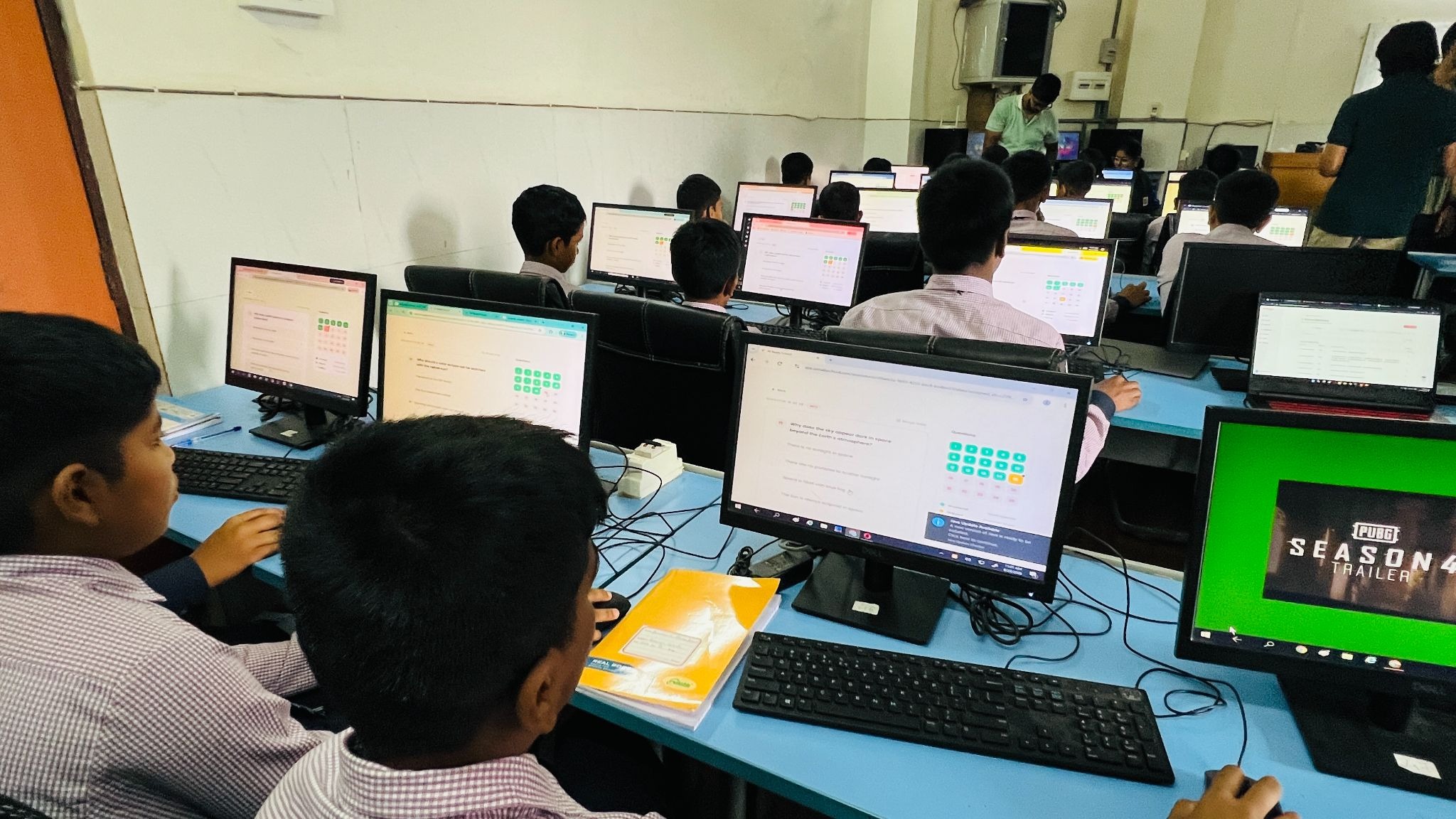
Nalini delivered the first live, in-classroom demonstration of Morpheus, guiding students through the Lesson Package she'd built while they responded to on-screen questions. One operational problem surfaced immediately: giving students simultaneous platform access while the teacher presents meant students didn't always stay in sync with the lesson. That observation produced a genuinely useful piece of product design — a three-mode delivery framework the team built on the spot:
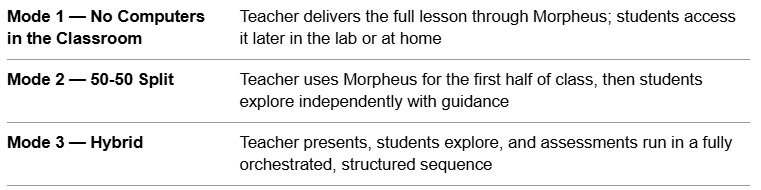
For this pilot, the team activated "Freeze" mode to stop students navigating ahead independently — and once that was in place, students were visibly engaged: exploring the lesson, taking interim tests, and starting conversations with Cypher on their own. Meanwhile, the eight Innovation-track students split into two groups and began turning their Day 1 ideas into concept documents.
Day 4 — Revision, Final Test, and Deployment
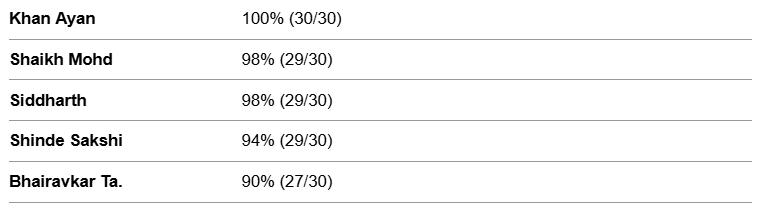
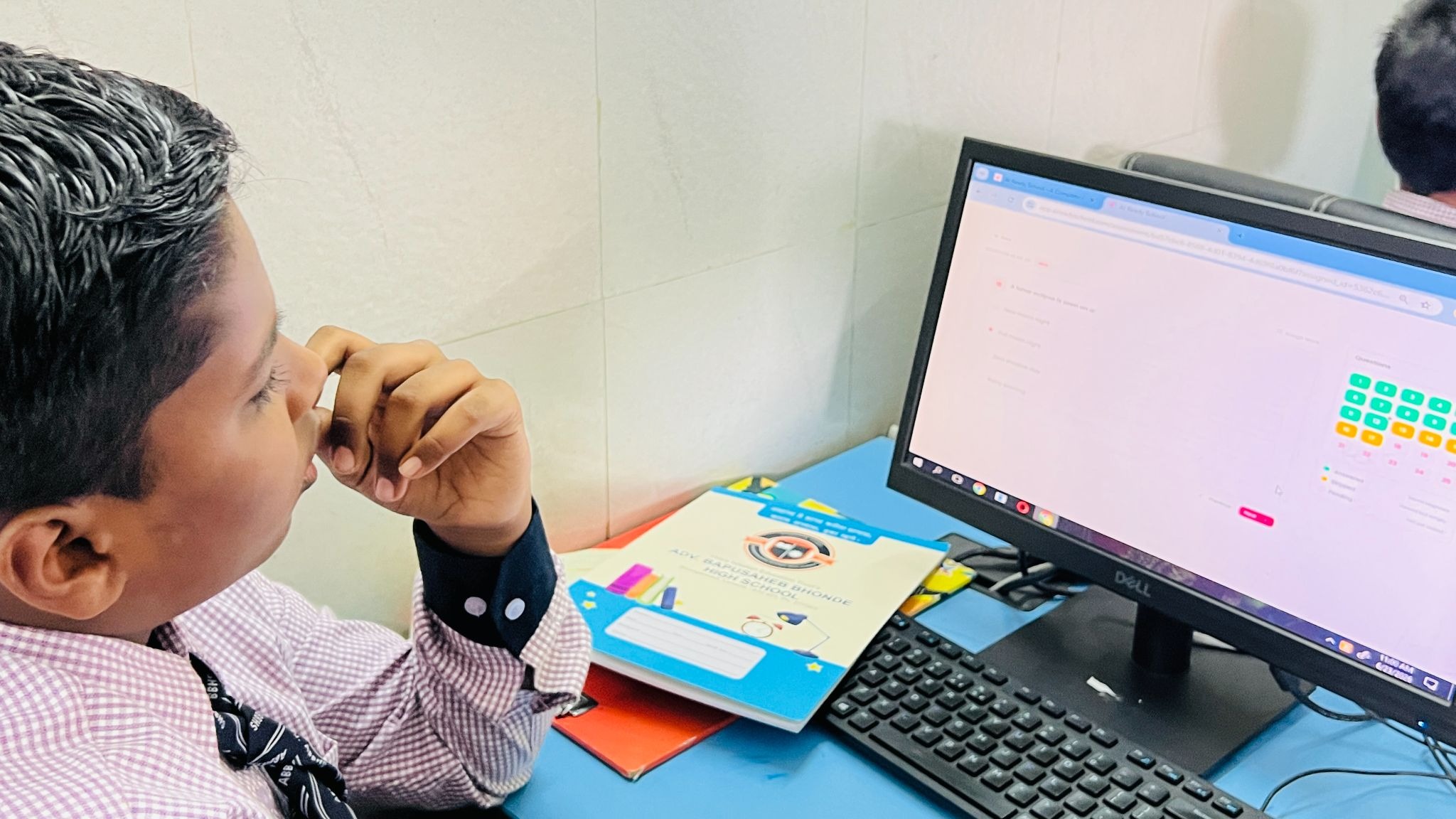
The class split across two labs: the Innovation team on the second floor, completing their final assessment within the first hour so they could get back to building; everyone else on the third floor, given roughly three hours to revise before the final test. The result: one student scored 100%, the class average rose to 59%, and the data showed a clear correlation between time spent engaging with the lesson and final performance. Rudrakshi — the Day 1 baseline leader at 56%, who'd also been leading an Innovation group — still improved to 76%, despite splitting her four days between building an app and revising for a test.
Five students led the final test outright:
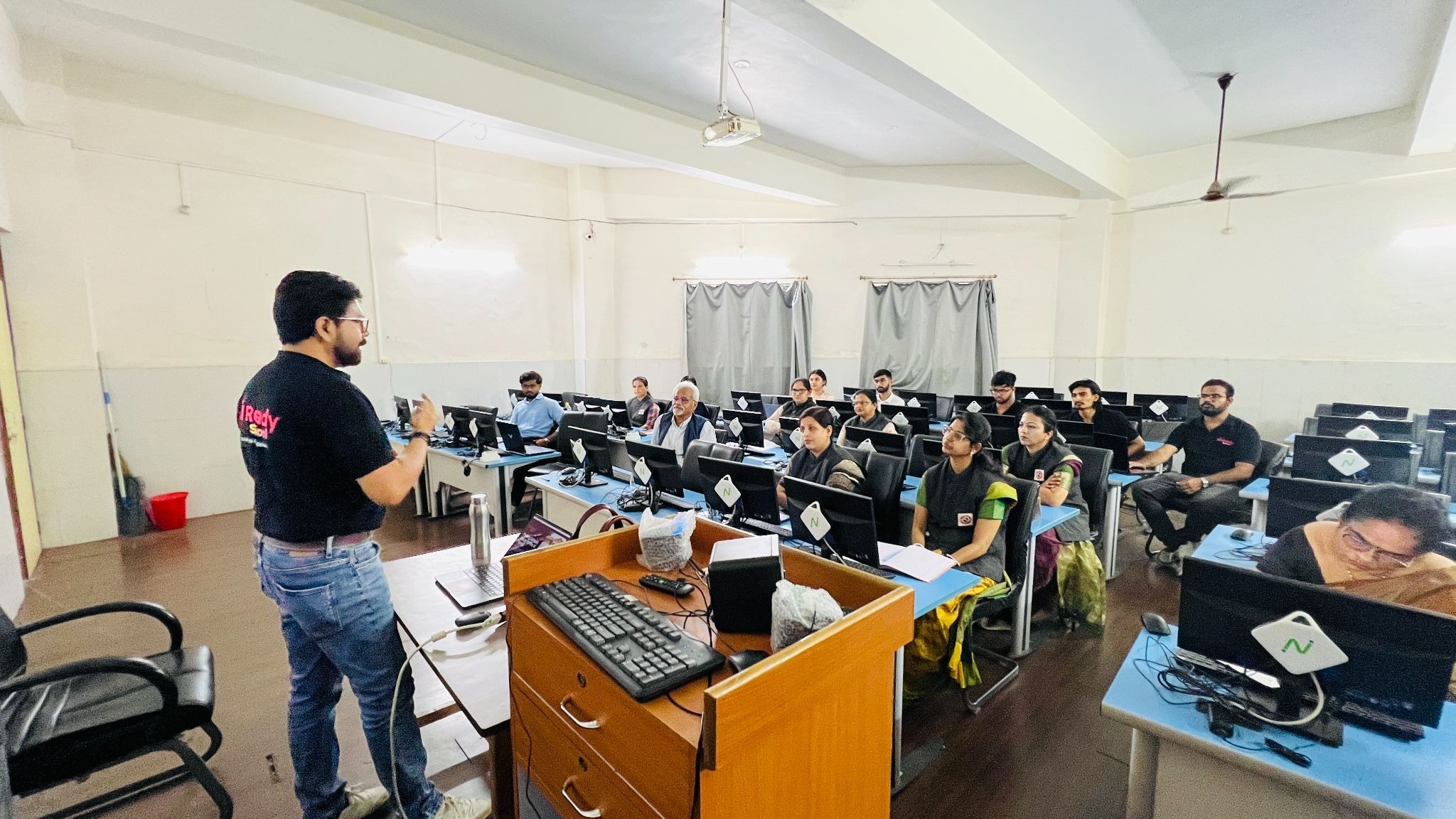
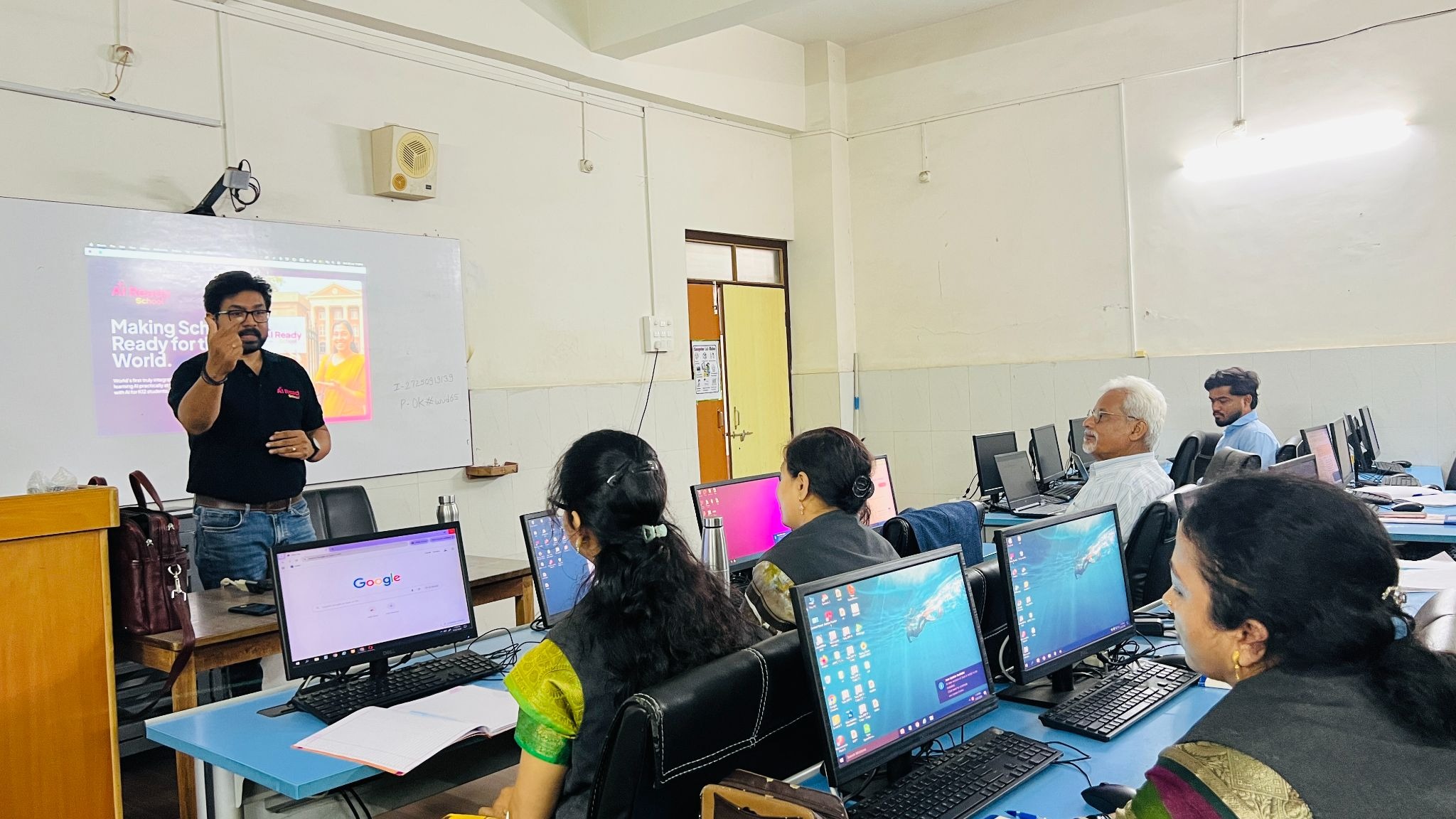
This was the part of the pilot the AIRS team was most invested in personally. Eight students, split into two groups, each took a real-world problem from idea to a deployed, working application using Claude Code — with a walkthrough of the deployment process so their apps could go live on real URLs, not just run locally on a laptop.
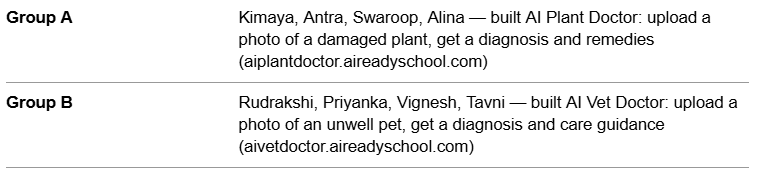
Both groups presented their finished apps to the wider group while the rest of the class was still finishing the final test — and the presentations held up: Kimaya's in particular was, by the team's account, articulate, composed, and well-structured from start to finish. For four days of work by 13-year-olds who'd never used an AI coding tool before, that's a genuinely different kind of outcome than a test-score gain, and it's the reason this pilot is being told as two stories rather than one.
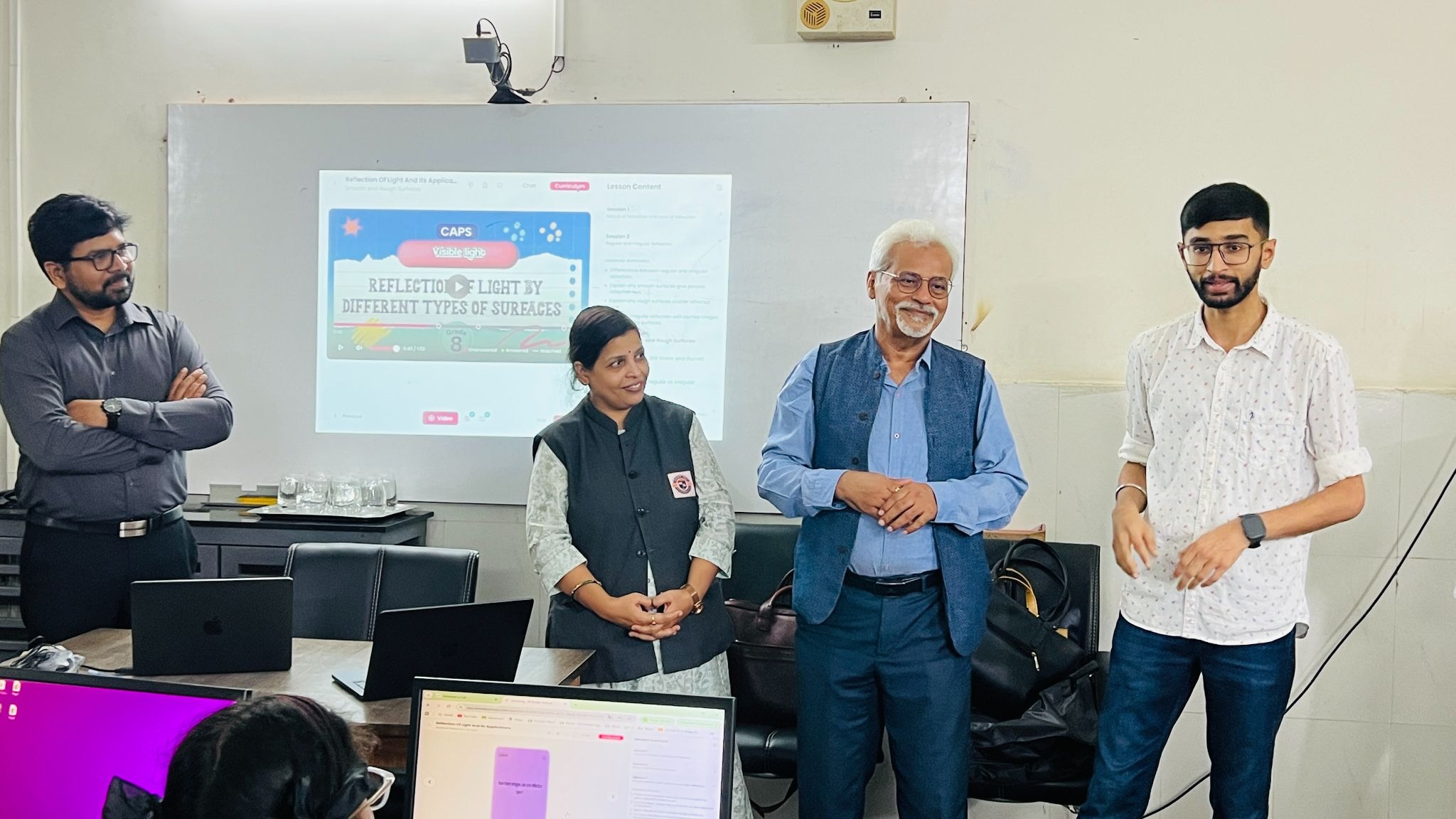
AIRS presented the pilot's results to roughly 50 teachers and the school's vice principals. Nalini, who'd delivered the live lesson, gave the most detailed reflection — and it wasn't uncritical, which is exactly why it's worth including in full rather than trimmed to the compliments.
• Cypher held context well: when a student asked it whether it believed in ghosts, it redirected them back to the topic — "that kind of contextual discipline is something I found very valuable"
• The question bank's variety and quality stood out as useful even for IIT/JEE preparation, with fast, prompt analysis
• Instant, specific feedback meant students didn't need to look elsewhere when they got something wrong
• Manual grading and analysis at this depth would have taken her an entire day; the platform did it immediately and named exactly which student needed to improve where
• Cypher answered student questions with guiding questions rather than direct answers — "genuinely thought-provoking for the students"
Her two more cautious notes matter just as much: she found students occasionally got distracted by the sheer number of features and drifted from the core concept, needing her to redirect them back — leading her to conclude the platform "may work best as a revision or recall tool, used after the teacher has already taught the lesson in class using the textbook," rather than as a first-touch replacement for direct instruction. She also felt it would be especially powerful for Classes 11 and 12 in the science stream, where visualization matters most.
Suchitra and Nandita's reflections centered on the same theme from a different angle: strong syllabus alignment, a workflow that has "everything a teacher needs" built in, and real time saved on testing and correction — historically one of the most time-consuming parts of the job. Their most practical piece of feedback: AIRS needs a mobile-compatible version, since not every student has reliable access to a tablet or laptop outside the pilot's computer lab.
"After teaching the same subjects for 20 to 30 years, it is truly refreshing to engage with and use AI-powered applications like this... With nearly 100 students in a class, it is simply not possible to individually assess every student's work and provide timely feedback. This platform changes that entirely." — Dr. Kavita Kalyandurgmath, External Reviewer
Tabassum, also reviewing externally, focused on a different value entirely — the platform's ability to surface each student's interests and strengths well enough to help guide them toward the right career path, not just the right test score. Students themselves echoed both threads: one described the instant feedback as showing "exactly where I needed to improve," and said the ability "to learn at my own pace while still following along with the teacher in class" made revision feel personalised rather than generic. An Innovation-track student called the experience of building a real app "exciting and empowering... it gave me the confidence to create something on my own. This programme has made learning more engaging, practical, and fun."
Every teacher who attended the results demonstration — roughly 50 in total, plus the vice principals — asked the same follow-up question: when would AIRS be available across the rest of the school, not just Grade 8A.
This is the third pilot AIRS has published in this series, and the three together tell a more useful story than any one of them alone. At The Indian Public School, Dehradun, a tightly scoped three-day pilot on a single Biology lesson produced a +21 point gain and a 4.8/5 student rating. At New Digamber Public School, Indore, an equally tight three-day pilot produced a more modest +7 point gain, a wider spread of individual outcomes, and a teacher who was honestly still forming her judgment on the tracking tools. Here at ADV. Bapusaheb Bhonde High School, a longer four-day window with full-day access produced the largest gain of the three — +32 points — alongside a second, entirely separate track that neither of the other two pilots attempted.
The pattern worth naming: pilot length and access seem to matter as much as the platform itself. NDPS's teacher had one lesson cycle to build trust in a new intervention-review workflow and, reasonably, hadn't fully done so by day three. Bhonde's teachers had a compressed-but-full-day format, prior AI-workshop exposure, and — per Nalini's own account — kept exploring the platform from home in the evenings. That's a different starting position, and the results reflect it. It's also exactly why AIRS is now running a longer, month-long follow-up pilot at NDPS: to see whether more time closes that gap.
None of that changes what actually happened in this classroom. The number that matters more than +32 points is that both halves of the objective were met without trading one off against the other. A class that started the week forgetting a previous grade's material ended it with a class average of 59% and zero declines among the 43 who completed both tests; at the same time, eight of their classmates spent the same four days shipping working software, deployed on real URLs, that a stranger could use today.
The teacher feedback is what makes this more than a highlight reel. Nalini's caution about feature-overload and her conclusion that the platform works best layered on top of direct instruction, not in place of it, is exactly the kind of operational detail that makes the rest of the results more credible, not less. So is Suchitra and Nandita's flag about mobile access — a real deployment constraint for schools without a dedicated lab. A pilot report that only had good news wouldn't tell a school much; this one gives the next school a clearer picture of where AIRS fits into a classroom and where it still needs work.
And the Innovation track answers a question the score gain alone can't: not just whether AIRS can raise a test average, but whether it can hand a 13-year-old enough of a foundation — in AI literacy, in problem framing, in seeing a project through to something deployed and usable — to build something real in the same week they're being tested on reflection of light. Two working apps, built and shipped by students who'd never touched an AI coding tool before Monday, is the harder number to explain away.
We're grateful to the management, teachers, students, and staff of ADV. Bapusaheb Bhonde High School for their enthusiasm and support throughout, and to Dr. Jagdish Kalyandurgmath, the JK Holistic team, and external reviewers Dr. Kavita Kalyandurgmath, Farid Shaikh, and Tabassum for the guidance and scrutiny that made this pilot a genuine test rather than a showcase.
Want Both Tracks at Your School?
TIPS and NDPS ran our standard free 3-day pilot. ADV. Bapusaheb Bhonde High School asked for more, so we extended it to four days and added a second track — a small group of students building and deploying a real AI app alongside the standard class pilot. If your school wants to try both at once, we can do the same for you.
What's included in your free pilot:
• A baseline test, an AI-built lesson delivered through Morpheus and Cypher, and a final test — the standard 3-day design, or 4 days with an Innovation track added
• A full class assessment report: student-by-student growth, surfaced misconceptions, and a Cypher-based class learning profile
• Direct teacher and student feedback surveys, published honestly — so your staff decides if it's working, not a vendor deck
• No cost, no obligation to continue — plus 2 free months of platform access if you choose to move forward
Book your free pilot at aireadyschool.com/pilot, or write to us directly at aireadyschool.com/contact — most schools go from first conversation to pilot week in under two weeks.
Human First. AI Next.™