
Chiranjeevi Maddala
June 4, 2026
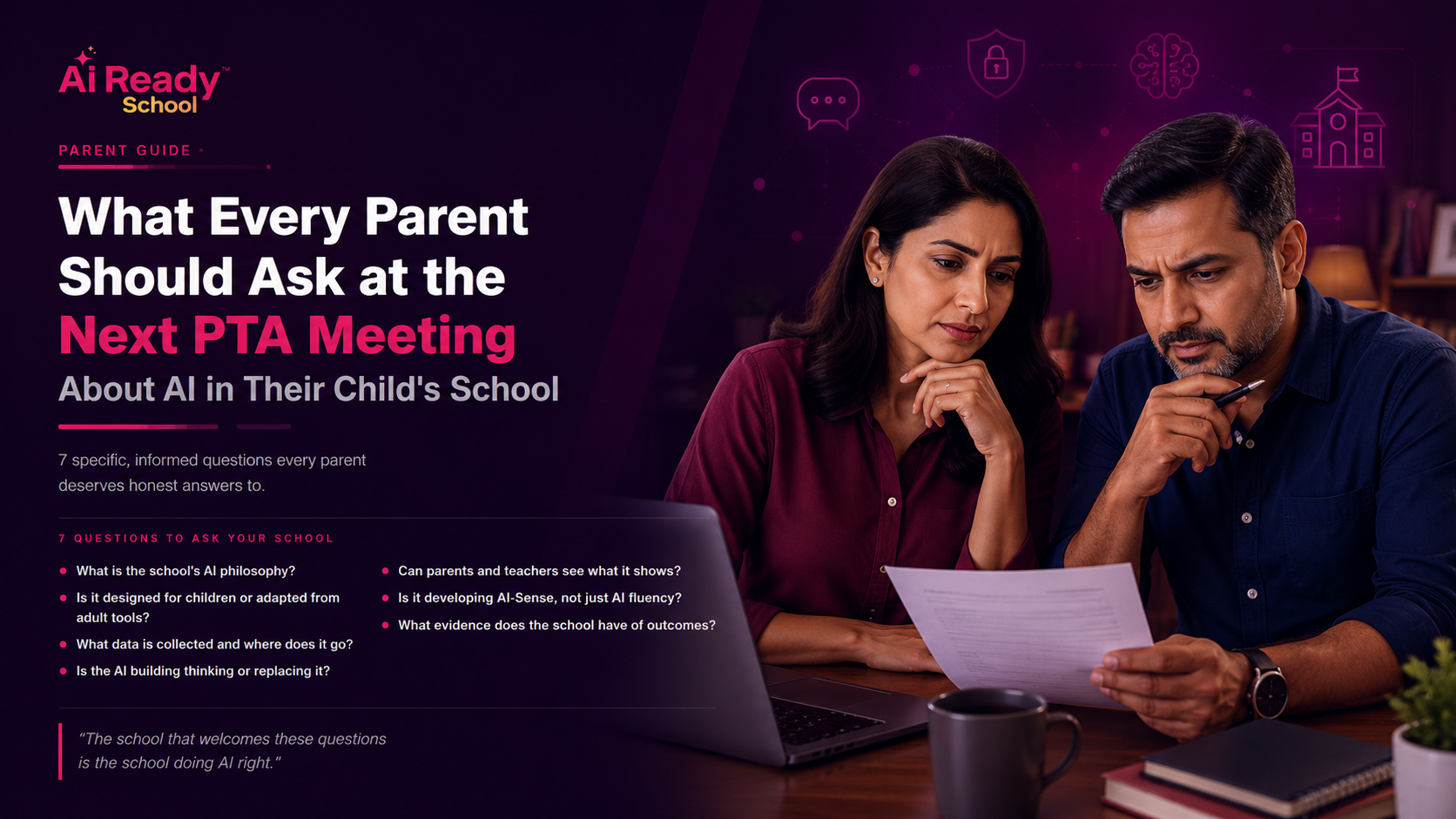
This blog is designed to be shared. If you are a school leader reading it, send it to your parent community. If you are a parent reading it, bring it to your next PTA meeting. The questions in it are not adversarial. They are the questions that every school using AI should be able to answer — and the schools that can answer them are the schools doing it right.
Something significant is happening in your child's school and it is happening faster than most parents have been able to keep up with. Artificial intelligence is being adopted across Indian schools at a pace driven partly by genuine educational conviction, partly by competitive pressure, and partly by a government mandate that makes AI curriculum compulsory from Class 3 starting 2026-27. The result is that the majority of Indian school children are now using AI tools of some kind during their school day — and the majority of their parents have not been given a clear, specific account of what those tools are, what they do, how the data is managed, and whether the educational philosophy behind the adoption is sound.
This is not a conspiracy. It is a gap. Schools are moving quickly because the mandate and the competitive environment require them to. Parent communication has not kept pace because it is genuinely difficult to explain AI in education to a parent community with diverse levels of technology familiarity, diverse concerns, and diverse expectations — especially when the school itself is still figuring out what its AI implementation will look like.
This blog closes that gap. It gives you the specific, informed questions that a parent who genuinely wants to understand their child's AI education should be asking — at PTA meetings, in conversations with the principal, in written queries to the school. These are not gotcha questions designed to embarrass the school. They are the questions that any responsible school should be prepared to answer and that, in fact, distinguish schools that have thought carefully about AI adoption from those that have simply purchased a subscription and called it an AI school.
The school that welcomes these questions is the school doing it right. The school that cannot answer them has work to do.
The most valuable thing a parent can do for their child's AI education is not to trust the school's enthusiasm. It is to ask the school to be specific.
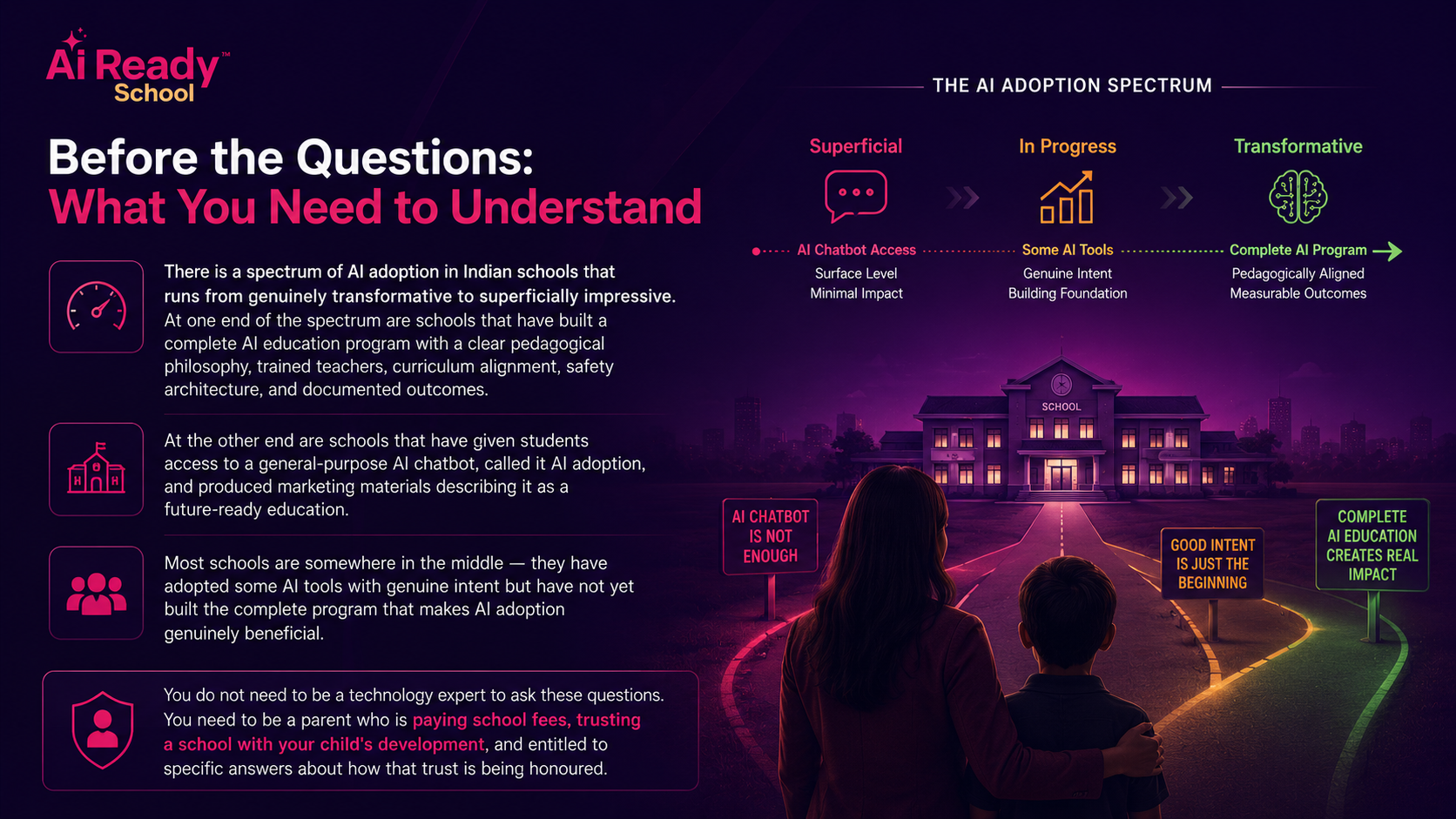
There is a spectrum of AI adoption in Indian schools that runs from genuinely transformative to superficially impressive. At one end of the spectrum are schools that have built a complete AI education program with a clear pedagogical philosophy, trained teachers, curriculum alignment, safety architecture, and documented outcomes. At the other end are schools that have given students access to a general-purpose AI chatbot, called it AI adoption, and produced marketing materials describing it as a future-ready education.
Most schools are somewhere in the middle — they have adopted some AI tools with genuine intent but have not yet built the complete program that makes AI adoption genuinely beneficial. The questions below help you understand where your child's school sits on this spectrum and what specifically you should be asking them to build or improve.
You do not need to be a technology expert to ask these questions. You need to be a parent who is paying school fees, trusting a school with your child's development, and entitled to specific answers about how that trust is being honoured.
Question 1: What is the school's philosophy about AI and learning — and where is it written down?
This is the most important question and the one that most parents do not think to ask. Every school that is using AI with children should have a written, public statement of its philosophy about the relationship between AI and education. Not a press release. A genuine philosophical position that answers: what do we believe AI should do for students and what do we believe it must never do? How do we ensure that AI develops student thinking rather than replacing it? How do we protect the teacher-student relationship that is the foundation of education?
The school with a genuine philosophy will direct you to a specific document and be able to explain it in plain language. The school without one will give you a generic answer about innovation and future readiness that sounds impressive and says nothing.
Why does this matter? Because the philosophical position determines every product and implementation decision that follows. A school with a Human First, AI Next philosophy — where AI is explicitly positioned as the instrument and the teacher as the educator — makes different decisions about which tools to use, how to deploy them, and what outcomes to measure than a school that views AI primarily as a content generation and productivity tool. The philosophy is the quality indicator. Ask for it.
Question 2: Is the AI your child uses specifically designed for children, or is it a general-purpose adult AI tool being used in a school context?
This question reveals more about an AI implementation than almost any other. There is a fundamental difference between AI tools that were designed from the ground up for K-12 students — with age-appropriate content controls built into the generation architecture, with curriculum alignment, with safety guardrails that cannot be bypassed through clever prompting — and general-purpose AI tools like ChatGPT that were designed for adult professional use and are being used in schools without the structural protections that children require.
The AI tool designed for children filters inappropriate content before it is generated, not after. It operates within curriculum boundaries that prevent it from producing content that has no educational relevance. It maintains interaction boundaries that are appropriate for the age group using it regardless of how the student phrases their requests. And it gives teachers visibility into what students are doing — not as surveillance but as professional oversight.
The general-purpose adult AI tool does none of these things reliably. Its content policies were calibrated for adult users. Its data handling practices assume adult legal capacity to consent. Its interaction boundaries can be circumvented by a curious 12-year-old with five minutes of effort.
Ask your school specifically: was the AI your child uses designed for K-12 use, or is it a general-purpose platform? If it is general-purpose, what specific modifications have been made to make it appropriate for children? If the answer is "we have given them instructions on responsible use," that is not a structural answer. It is a policy answer. Policy without structure is a promise, not a protection.
Question 3: What data does the AI collect about your child, where does it go, and who can access it?
This question matters because of what is at stake. The data that AI learning tools generate about children is not like any other school data. It is not examination scores or attendance records. It is a continuous, detailed record of how your child thinks — the questions they ask, the concepts they struggle with, the patterns in their engagement and curiosity, the specific gaps in their understanding, the emotional texture of their learning experience. This data is extraordinarily intimate and, in the wrong hands or under the wrong governance framework, it is extraordinarily vulnerable.
India's Digital Personal Data Protection Act 2023 creates specific obligations for schools that process this data. Your school is legally required to collect only the data necessary for the educational purpose, use it only for that purpose, protect it against unauthorised access, not transfer it to third parties without appropriate safeguards, and delete it when it is no longer needed.
Ask your school specifically: what data does the AI platform collect about your child? Where is it stored — on school-owned servers, on the AI vendor's servers, or on third-party cloud infrastructure? Who at the AI company can access it? Is the school's AI data processing covered by a specific contractual agreement that specifies how the vendor can and cannot use the data? And what happens to the data when your child leaves the school?
The school that uses Matrix on-premises infrastructure can answer all of these questions simply: the data stays on school-owned servers and never leaves the campus. The school that uses cloud-based AI tools should be able to produce the specific contractual documentation that governs the vendor's data handling. If the answer is "it is covered by the vendor's standard terms of service," ask to see those terms and have your school's legal advisor review them. Standard terms of service are written to protect the vendor, not your child.
Question 4: How does the AI ensure that your child is thinking, not just getting answers?
This is the pedagogical question that gets to the heart of whether AI is making your child's education better or substituting for it. The research published in March 2026 — across three independent studies — found that students who use AI tools regularly for academic work without structured pedagogical guidance show measurable decline in independent reasoning capability over time. The AI that gives students answers efficiently is the AI that is efficiently reducing their capacity to think.
Ask your school specifically: is the AI your child uses designed to give answers or to ask better questions? What happens when your child asks the AI to write their essay or solve their problem for them? Does the AI comply, or does it redirect toward guided inquiry? What specific design decisions has the AI platform made to develop student thinking rather than replace it?
Cypher was built around the explicit principle that an AI learning companion should never give a student the answer to a question the student is capable of working toward themselves. It asks students better questions. It guides them toward understanding rather than delivering understanding to them. It maintains the cognitive demand that produces genuine learning rather than the engagement optimisation that produces impressive-looking output. Ask whether the AI your child uses was designed with this principle or against it.
Question 5: Can you see what the AI is showing your child, and does the teacher see it too?
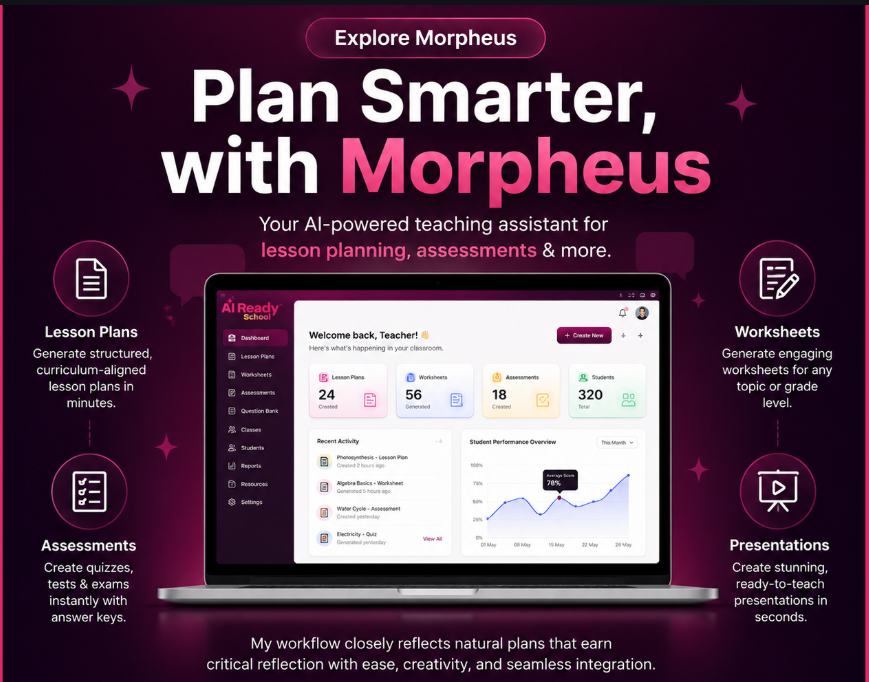
Visibility is not surveillance. It is the governance structure that allows parents and teachers to be genuine partners in a child's education rather than observers of a process they cannot see. A school that gives children access to AI tools that neither parents nor teachers can see is not a school that has deployed AI thoughtfully. It is a school that has deployed AI in the dark.
Ask your school specifically: is there a parent-facing view of your child's AI interactions and learning progress? Can you see the specific concepts your child is working on, where their gaps are, what their engagement patterns look like? Can the teacher see this in real time through a monitoring dashboard? And is the data specific enough to be actionable — not "your child had 47 AI interactions this week" but "your child is showing a specific gap in algebraic reasoning at the application level that the teacher has been notified about"?
The Morpheus monitoring dashboard gives teachers real-time, concept-level visibility into every student's learning journey. The parent reporting capability translates this data into a format that parents can understand and act on. This is what visibility in AI education looks like. Ask whether your child's school provides it.
Question 6: What is the school doing to develop your child's ability to think critically about AI — not just use it?
This question is about AI-Sense — the capability that distinguishes a student who is genuinely equipped for an AI-shaped world from one who is merely comfortable with AI tools. AI-Sense includes the ability to evaluate AI output critically, understand where AI systems fail and why, recognise the biases that AI systems encode, design effective human-AI collaborations, and reason about the ethical dimensions of AI decisions.
A student who graduates from school having used AI tools extensively but without having developed AI-Sense is a student who is dependent on those tools without understanding their limitations. In a professional context, this is the difference between someone who can produce AI-assisted work efficiently and someone who can recognise when that work is wrong, incomplete, or ethically compromised.
Ask your school specifically: does your child's AI program develop AI-Sense, or does it develop AI fluency? Is there a structured curriculum that teaches students about how AI works, where it fails, and how to evaluate its outputs critically? Are students given the opportunity to research AI systems, build AI applications, and think about AI ethics — or are they simply given AI tools to use for their existing schoolwork?
Question 7: What evidence does the school have that AI adoption is producing better outcomes for students?
This is the accountability question. Not what the school intends AI to produce. Not what the vendor claims AI produces. What your school has specifically documented as the outcome of its specific implementation with its specific student population.
Ask your school specifically: what baseline measurements did the school take before AI adoption? What do the current measurements show? What specific improvements in learning outcomes — not platform engagement statistics, but actual learning outcomes — can the school attribute to its AI implementation? And what has not improved as expected, and what is the school doing about it?
The school that can answer this question with specific data is the school that has implemented AI as a serious educational initiative. The school that answers with general claims about innovation and future-readiness has not yet built the measurement framework that makes AI adoption accountable.
Bring this blog to your next PTA meeting. Not as a challenge to the school but as a contribution to the parent community's understanding of what good AI adoption looks like. Propose that the parent body formally request answers to these seven questions in writing from the school's leadership, with a timeline for response.
Most school leaders will welcome this request. A principal who has thought carefully about AI adoption will be grateful for the opportunity to share the specific, honest answers that distinguish their school from the ones that have adopted AI superficially. A principal who has not thought carefully about AI adoption will be prompted to do so by the specificity of the questions — which is ultimately better for your child than a parent community that accepts reassurance in place of evidence.
The conversation these questions create is the most important conversation a school community can have about AI right now. It is the conversation that separates AI adoption done right from AI adoption done for appearances. And it is the conversation that your child — sitting in a classroom right now, using AI tools that were chosen by adults who may or may not have thought carefully about their implications — deserves to have happen on their behalf.
The parent who asks specific questions gives their child a school that has to provide specific answers. That is the most powerful educational advocacy a parent can exercise.
AI Ready School provides parent-facing resources that give families the visibility, the understanding, and the specific evidence they deserve about their child's AI education. Cypher generates the learner profile data that answers Question 5 specifically. Morpheus provides the monitoring dashboard and parent reporting that makes learning visible. Zion provides the safe, governed AI tool environment that answers Question 2 specifically. And our Human First, AI Next philosophy, published on our website, answers Question 1.
To share this blog with your school's parent community, or to discuss how AI Ready School can help your school answer these seven questions with confidence, reach out at hey@aireadyschool.com or call +91 9100013885.
Share This With Your Parent Community
Human First. AI Next.™