A Deep Dive into Adaptive Learning, Curriculum Intelligence, and the Future of Education
The age of uniform education is drawing to a close. For centuries, classrooms have operated on a fundamental assumption: that students of roughly the same age, exposed to the same curriculum, taught by the same teacher, will learn at comparable rates and in comparable ways. This assumption is not merely outdated — it is increasingly recognized as one of the most significant barriers to educational equity and excellence.
This article presents a comprehensive exploration of how AIReadySchool (AIRS) is addressing this challenge through a technology-forward approach to personalized learning. By combining curriculum intelligence, knowledge graphs, and adaptive tools such as Cypher and Morpheus, the AIRS platform creates a dynamic, responsive educational environment that meets each student where they are — and guides them toward where they need to be.
💡 "The measure of intelligence is the ability to change." The same principle applies to the systems we build to cultivate intelligence. Education must become as adaptive as the learners it serves.
This article examines the theoretical foundations, technical architecture, and practical implications of knowledge-state modeling — the core mechanism that enables AIRS to move from static, one-size-fits-all instruction toward genuinely responsive, data-informed learning experiences.
Traditional education models are built around structural constraints that, while historically practical, have proven deeply limiting in the context of modern learning science.
In a conventional classroom, the teacher advances through the curriculum on a fixed schedule. A student who masters a concept in two days and a student who needs two weeks receive roughly the same instruction time and the same assessment at the same moment. The faster learner grows bored and disengaged; the slower learner falls behind and loses confidence.
This pacing problem is not a reflection of teacher competence or student capability — it is a structural flaw in the system. Teachers cannot reasonably customize every lesson for thirty students simultaneously, and standardized assessments by definition measure the average, not the individual.
Conventional assessments — tests, quizzes, end-of-unit exams — are designed to evaluate what a student has learned at a fixed point in time. They produce a score, which is recorded, and the class moves on. The diagnostic potential of that assessment is largely wasted.
What if a wrong answer on a fraction problem could reveal not just that the student got it wrong, but which specific prerequisite concept they are missing? What if a pattern of errors across multiple students could automatically surface a curriculum gap? Traditional systems have neither the granularity nor the infrastructure to ask, let alone answer, these questions at scale.
Uniform education disproportionately disadvantages students whose learning styles, pacing needs, or background knowledge differ from the assumed norm. Students from under-resourced schools arrive with knowledge gaps that the standard curriculum does not account for. Students with learning differences require instructional adaptations that most classrooms cannot systematically provide.
Personalized education is, at its core, an equity imperative. When learning experiences adapt to the individual, every student — regardless of background, ability, or pace — has a genuine path to mastery.
Effective personalization requires more than knowing how a student is performing. It requires a deep, structured understanding of what they are learning and how the concepts in the curriculum relate to one another.
Curriculum intelligence refers to the systematic, machine-readable representation of educational knowledge — including not just the content itself, but the relationships between concepts, the prerequisites for each skill, the learning outcomes associated with each topic, and the ways in which mastery of one idea unlocks the ability to engage with another.
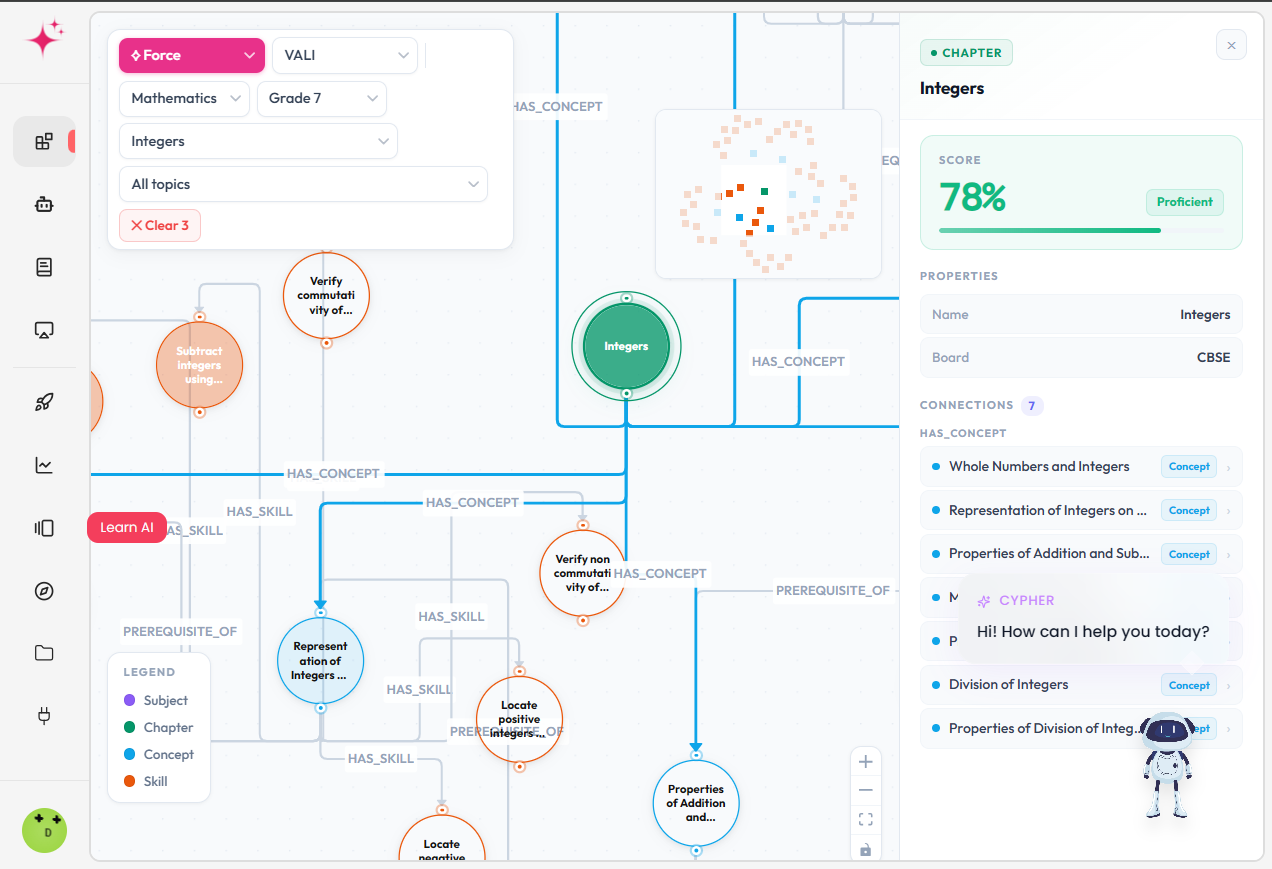
At AIRS, curriculum intelligence is operationalized through the construction of Knowledge Graphs: richly interconnected maps of the curriculum that capture how topics and skills relate across chapters, subjects, and grade levels.
A knowledge graph in the educational context is a directed graph in which nodes represent concepts, skills, or learning outcomes, and edges represent the relationships between them. These relationships may be hierarchical (a concept is a sub-type of another), sequential (one concept must be mastered before another can be introduced), or associative (two concepts frequently appear together and reinforce each other).
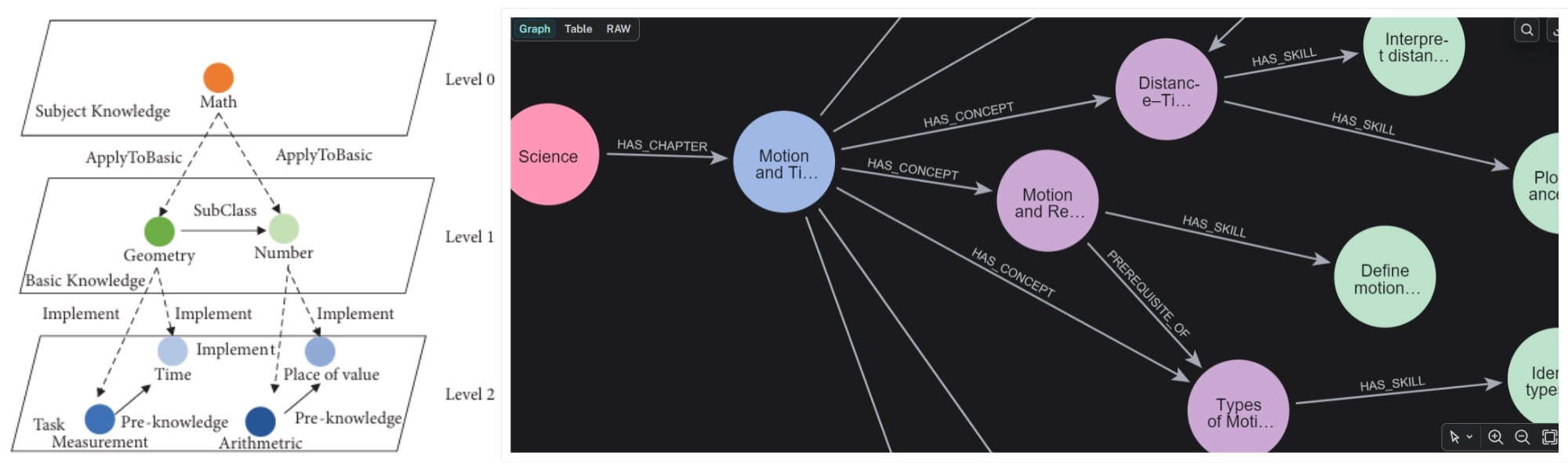
Multi dimensional knowledge graph representing curricula in a hierarchical format:Subject → Chapter → Knowledge Concept (Topics) → Skills (Assessment objectives to examine the concepts)
For example, consider a middle-school science curriculum covering Motion and Time. A knowledge graph for this domain might include nodes for Distance, Speed, Velocity, Acceleration, and Time — with edges indicating that understanding Speed requires prior mastery of Distance and Time, while Velocity builds on Speed by introducing direction. Acceleration, in turn, requires Velocity as a prerequisite.
💡 Knowledge graphs transform curriculum from a linear sequence of lessons into a multidimensional map of understanding — one that reflects the true complexity and interconnectedness of human knowledge.
The knowledge graph is not merely an academic construct — it is the operational foundation for a range of practical capabilities within the AIRS platform:
Curriculum intelligence tells the system what there is to know. Knowledge-state modeling tells the system what each individual student currently knows. Together, these two capabilities form the analytical core of the AIRS personalization engine.
A student's knowledge state is a dynamic, multi-dimensional representation of their current understanding across the skills and concepts in the curriculum. It is not a single score, nor a simple pass/fail indicator. It is a continuously updated probabilistic model of each learner's mastery across every node in the knowledge graph.
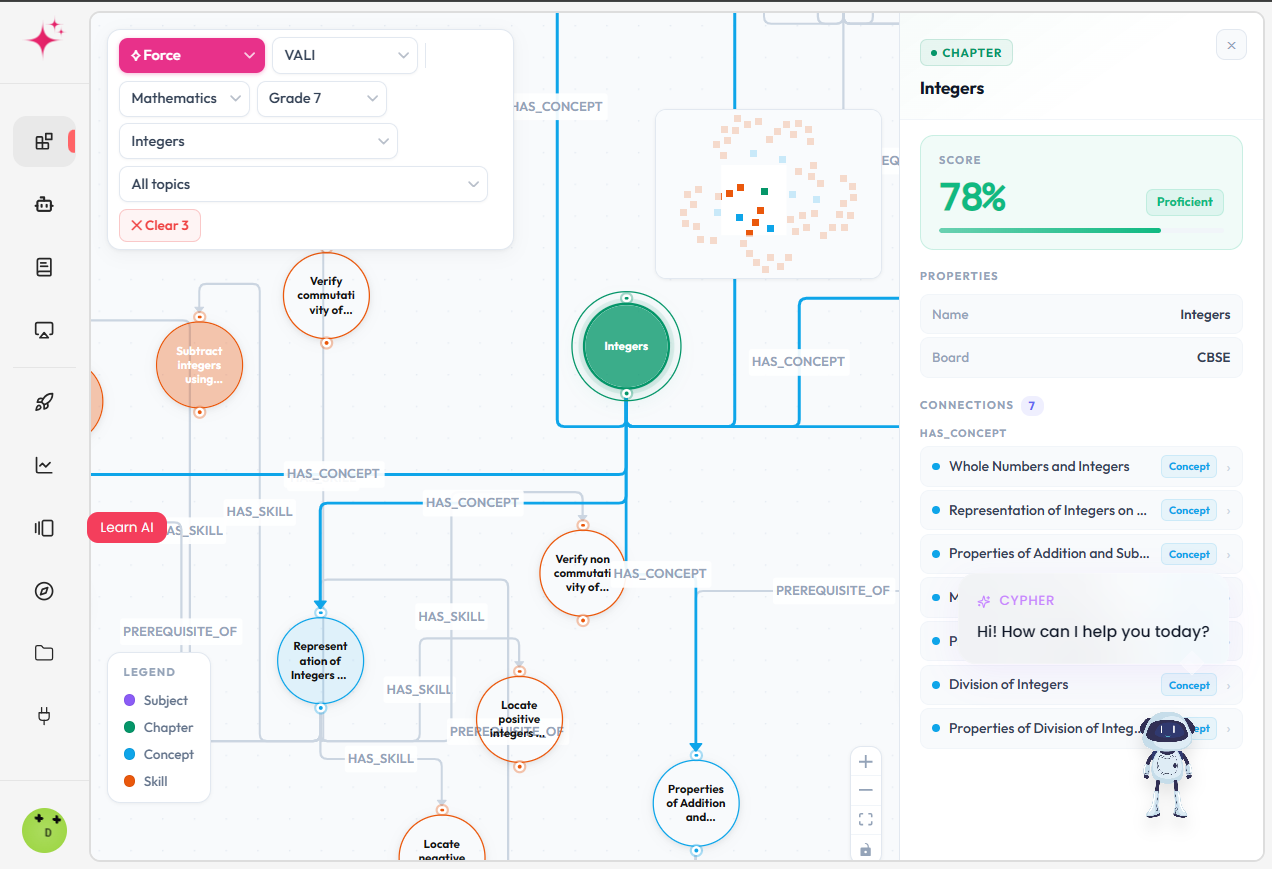
Imagine a heat map layered over the curriculum's knowledge graph. Some nodes glow brightly, indicating strong mastery; others are dim, indicating emerging understanding; still others remain dark, indicating concepts not yet encountered or not yet retained. This is the knowledge state — a living portrait of what a student knows.
Every interaction a student has with the AIRS platform contributes a signal to their knowledge state model. These interactions include:
Each of these signals is processed through the AIRS platform's modeling algorithms, which update the student's estimated probability of mastery for each relevant node in the knowledge graph.
Let:
Then:
$$% Knowledge-State Estimate for Assessment Objective i% Definitions:% K_i^{(t)} : Knowledge-state estimate of AO i after t observations% r_i^{(t)} : Binary response signal for AO i at time t (r ∈ {0,1})% n_i^{(t)} : Total number of observations for AO i up to time t\begin{equation}K_i^{(t)} = \frac{\sum_{j=1}^{t} r_i^{(j)}}{n_i^{(t)}}\end{equation}$$
Or incrementally:
$$\begin{equation}K_i^{(t)} = \frac{K_i^{(t-1)} \cdot n_i^{(t-1)} + r_i^{(t)}}{n_i^{(t)}}\end{equation}$$
Where:
new_avg_AOresponsetotal_tests_AOModern knowledge-state modeling systems often leverage Bayesian inference to update beliefs about student knowledge in response to observed evidence. The system maintains a prior belief about a student's mastery of a concept, observes new evidence (a correct or incorrect response), and updates its belief accordingly.
This approach handles uncertainty gracefully, is sensitive to question difficulty, and degrades over time in response to inactivity — knowledge not recently practiced may decay, prompting the system to recommend review.
💡 Knowledge-state modeling transforms assessment from a rearview mirror into a navigational instrument. Instead of telling students where they have been, it tells the platform where they need to go.
Over time, the accumulation of knowledge-state signals creates a dynamic learning profile: a rich, continuously updated representation of each learner's strengths, areas for improvement, preferred engagement patterns, and trajectory of progress.
This profile is not a static report card. It is a living model that evolves with every interaction, enabling the platform to make increasingly precise and personalized recommendations. The longer a student engages with AIRS, the more accurately the system understands their learning needs.
The combination of curriculum intelligence and knowledge-state modeling enables a range of personalized learning capabilities operationalized through AIRS's adaptive tools, particularly Morpheus.
In a traditional classroom, all students follow the same path through the curriculum. In an AIRS-enabled environment, each student's path is dynamically adjusted based on their current knowledge state.
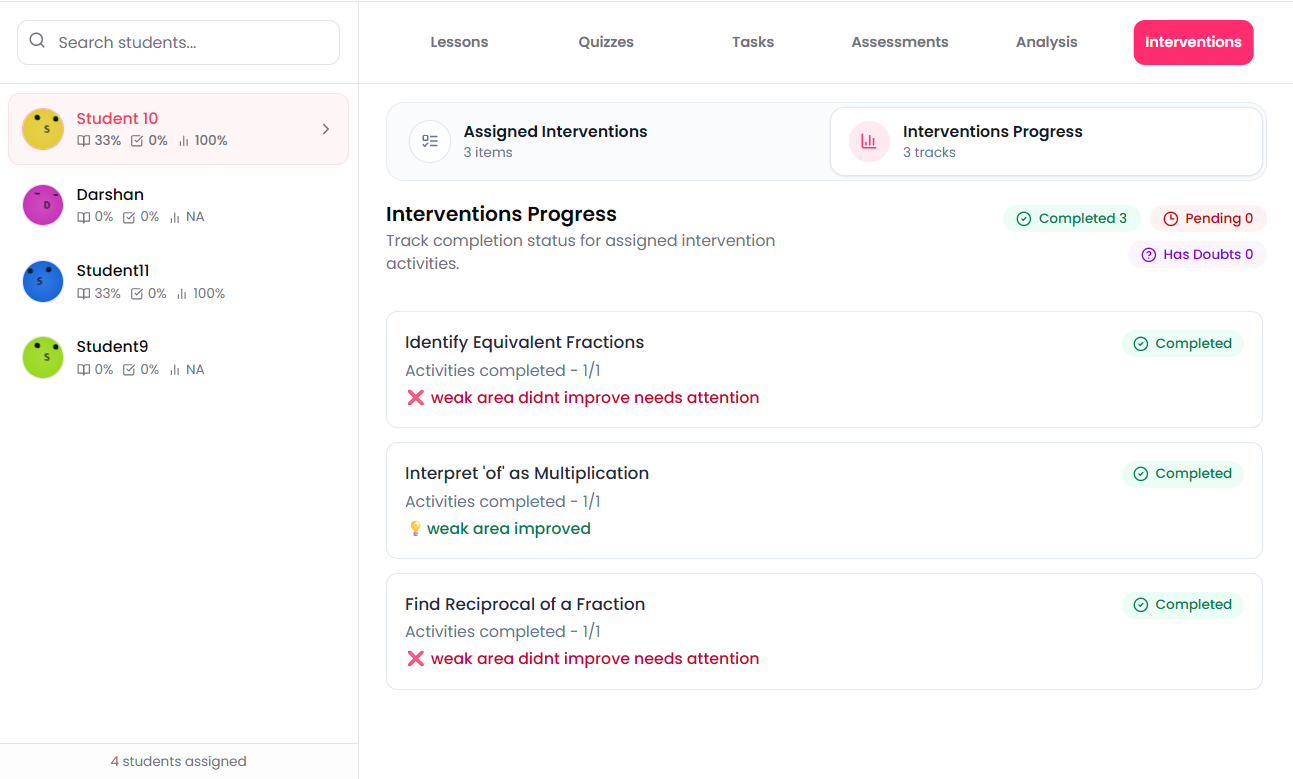
A student who has demonstrated strong mastery of foundational concepts may be advanced to more complex material ahead of the standard pace. A student struggling with a key prerequisite will be guided back to consolidate that understanding before progressing. Students who have mastered the target concepts may be offered enrichment material that extends their learning in creative or cross-disciplinary directions.
This adaptive routing reflects a fundamental reconception of what a learning path is: not a fixed highway that all students travel together, but a network of interconnected routes that each student navigates according to their own needs and capabilities.
AIRS approaches assessment as a continuous, embedded process woven into the fabric of learning rather than imposed upon it from outside. Dynamic assessments serve multiple simultaneous functions: they provide the student with feedback, they provide the teacher with diagnostic information about class-wide patterns, and they provide the system with the signals it needs to update knowledge-state models.
The questions in a dynamic assessment are not randomly selected — they are chosen based on their diagnostic value for the specific student at that specific moment. This transforms assessment from a high-stakes, anxiety-inducing event into an ongoing, low-stakes conversation between the student and the system.
When a student asks for help, the AIRS platform does not retrieve a generic explanation of the concept in question. It generates assistance calibrated to the student's specific knowledge state.
If a student is struggling with velocity because they have not yet fully grasped speed, the system will recognize this gap and address the underlying prerequisite before explaining the target concept. If a student has strong mathematical foundations but is encountering a physics concept for the first time, the explanation can leverage their mathematical knowledge as a scaffold.
By automating the data collection and analysis that would otherwise require significant teacher time, AIRS frees educators to focus on what is most distinctly human: building relationships with students, facilitating rich discussions, providing mentorship and encouragement, and designing creative learning experiences that no algorithm can replicate.
The insights generated — class-wide knowledge state summaries, individual student progress reports, curriculum gap analyses — give teachers a level of visibility into student understanding that was previously unattainable.
The rapid advancement of large language models and multimodal AI systems is creating new possibilities for educational personalization that were unimaginable even five years ago. AIRS is positioned at the intersection of these technological advances and the deep educational science of curriculum intelligence and knowledge-state modeling — creating a foundation for educational experiences that are not just adaptive but genuinely responsive.
One of the most significant challenges in personalized education is scale. A knowledge-state modeling system can maintain dynamic learning profiles for tens of thousands of students simultaneously, without fatigue, without bias, and without forgetting.
This scalability is what makes technology-enabled personalization a genuine solution to the equity challenge in education. For the first time in history, it is technically feasible to provide every student — regardless of where they live or what resources they have access to — with an educational experience genuinely tailored to their individual needs.
Several important challenges remain: privacy and data governance frameworks, teacher training programs, and assessment validity research to ensure signals are reliable and free from bias. These are solvable challenges — and the urgency of the educational equity crisis demands that they be solved.
💡 In this vision, learning systems do more than deliver content — they actively support each learner's journey toward mastery, one insight at a time.
The journey from uniform instruction to genuinely personalized learning is one of the most consequential transformations in the history of education. Knowledge-state modeling, as implemented in the AIRS platform, represents a significant step forward: by building structured representations of curriculum knowledge and continuously estimating each student's understanding within that structure, AIRS creates the analytical foundation for adaptive learning paths, dynamic assessments, and context-aware assistance.
The work is ongoing. The technology will continue to evolve. But the direction is clear, and the potential is profound. Education that meets every student where they are — and guides every student toward where they can be — is no longer a distant aspiration. It is an engineering challenge. And at AIReadySchool, it is the challenge we have chosen to meet.
AIReadySchool (AIRS) • Towards Personalized Education via Knowledge-State Modeling • 2026
Human First. AI Next.™
